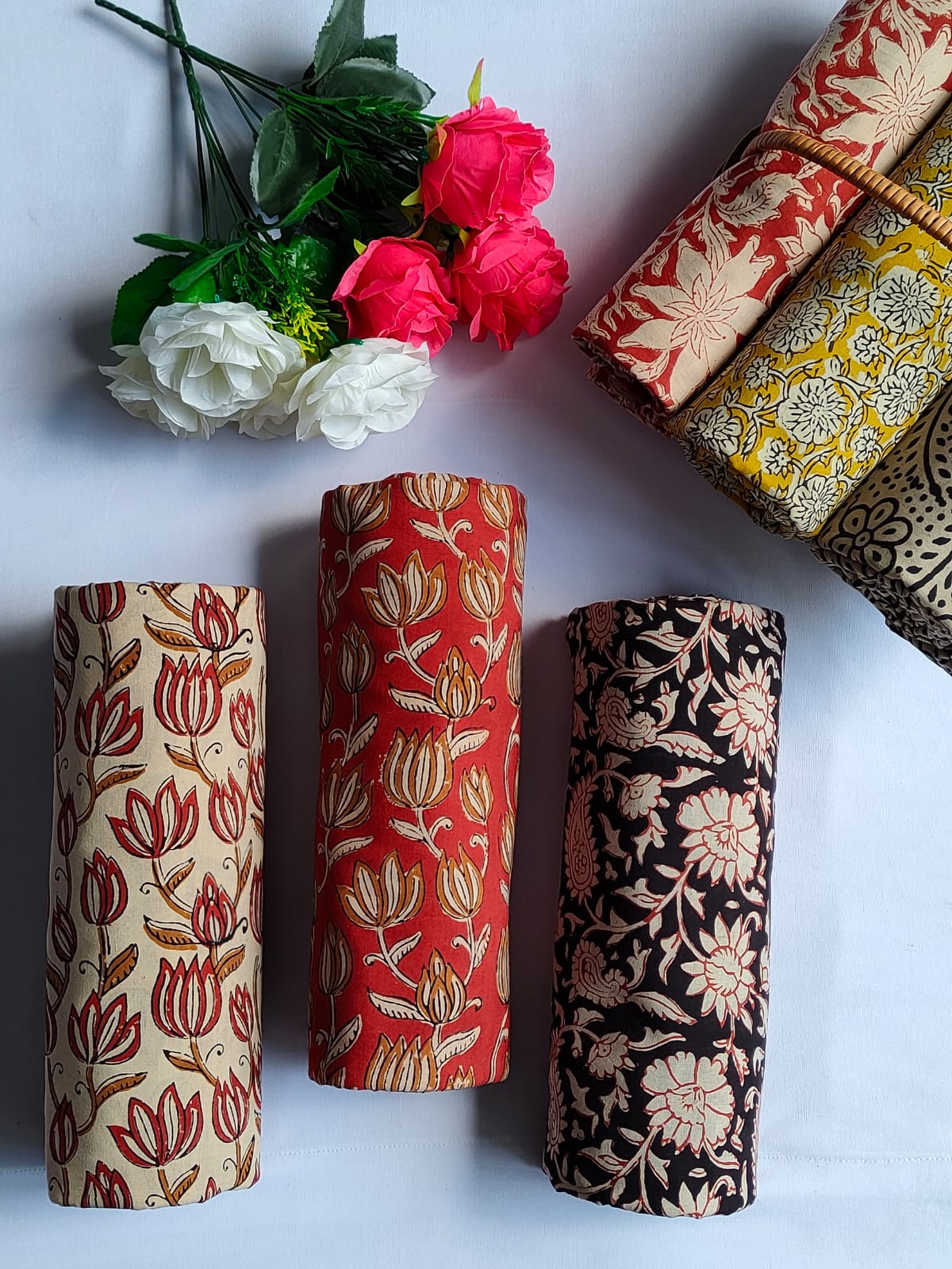


Indian block print fabric is more than a textile with beautiful patterns. It represents centuries of artistic knowledge, regional identity, skilled craftsmanship, and changing fashion. From delicate floral motifs printed near Jaipur to the intricate geometric patterns of Ajrakh and the earthy designs associated with Bagru, India's block-printing traditions have developed distinctive styles that continue to influence modern clothing and home décor.
What makes this craft remarkable is the process behind the finished fabric. Each design begins with a carved block, carefully prepared colours, and a fabric surface that must be ready to receive the print. The artisan repeats the printing process across the cloth, sometimes using several blocks to build different colours and layers of detail.
Over generations, artisans have adapted these techniques to changing materials, customer preferences, and markets. Traditional prints once used for everyday clothing, community garments, and household textiles now appear in contemporary dresses, shirts, scarves, cushion covers, bags, and designer collections.
For fabric lovers, designers, and sewing enthusiasts, understanding the history of Indian block printing makes these textiles even more interesting. It also helps explain why regional designs differ, how printing techniques developed, and what to look for when choosing printed cotton fabric today.
In this guide, we explore the origins of Indian block print fabric, the communities behind the craft, important regional traditions, the printing process, its evolution into modern fashion, and practical ways to choose and care for these textiles.
1. What Is Indian Block Print Fabric?
Indian block print fabric is textile material decorated by transferring a design onto cloth using a carved block. Wooden blocks are traditionally used, although other materials have also been employed in different printing traditions.
The artisan applies printing colour or paste to the block and presses it against the prepared fabric. Repeating the impression creates a pattern. For multicoloured designs, several blocks may be needed, with each block responsible for a particular part of the motif or a different colour.
The process requires more than pressing a block onto cloth. The artisan must control the placement, pressure, colour application, and spacing of the impressions. These details determine how the pattern appears across the finished material.
Common designs include:
-
Floral motifs featuring roses, lotuses, marigolds, and other flowers
-
Leaves, vines, creepers, and botanical patterns
-
Geometric arrangements and symmetrical repeats
-
Traditional paisley-inspired motifs
-
Small repeating motifs known as buti
-
Larger decorative motifs often called buta
-
Borders and repeating patterns designed for specific textile products
Cotton is one of the most familiar materials used for Indian block printing. It can be made into many kinds of garments and household products, although the suitability of a particular fabric depends on its weave, weight, finish, and fibre composition.
For an introduction to the craft, read our guide to the art of handblock printing and its traditional techniques.
2. The Ancient Roots of Indian Textile Printing
India has a long history of textile production, dyeing, and decorative fabric-making. Archaeological findings and historical research provide evidence of sophisticated textile practices in the Indian subcontinent, although the precise history of individual printing techniques is not always easy to establish.
Some references to Indian printed textiles connect the craft to the Indus Valley Civilisation. However, evidence of ancient textile decoration should not automatically be interpreted as proof that every modern block-printing technique existed in exactly the same form thousands of years ago.
What can be said with confidence is that Indian textile traditions developed through extensive knowledge of fibres, dyes, resist methods, patterns, and fabric preparation.
Over time, communities involved in textile production developed specialised skills. Some concentrated on preparing cloth, others on dyeing, printing, or carving the blocks used to transfer designs.
Textiles also travelled between regions and trading centres. As fabrics moved, patterns, techniques, materials, and design preferences influenced one another. Indian printed textiles became part of wider networks of trade and cultural exchange, helping different regional traditions develop and gain recognition.
The history of Indian block print fabric is therefore not a single story with one starting point. It is a collection of regional histories shaped by artisans, customers, local resources, trade, and changing social needs.
For a broader overview of the craft's development, explore what handblock printing is, including its history and process.
3. How Royal Patronage Helped Shape Indian Block Printing
Royal courts and wealthy patrons influenced many Indian textile traditions. Fine fabrics, decorative garments, furnishings, and elaborate patterns were valued in different historical settings, creating opportunities for specialised artisans.
In Rajasthan, royal patronage helped support textile crafts, including regional forms of block printing. Skilled printers developed intricate designs and colour combinations that suited the tastes of their customers.
Floral motifs, detailed borders, symmetrical patterns, and carefully arranged repeats became important elements of many traditional textiles. Different centres developed their own preferences, so fabrics from one region could look noticeably different from those produced elsewhere.
However, block printing was not only a craft for royal households. Printed textiles also served everyday needs. People used printed cloth for clothing, wraps, household bedding, and other practical items.
This broad range of uses helped the craft remain relevant beyond particular periods or styles of royal fashion.
As demand changed, artisans adapted their work. Traditional motifs could be repeated in new colour combinations, and familiar printing methods could be used to create different products.
The continued popularity of Indian block print fabric reflects this balance between preserving established techniques and responding to changing needs.
4. The Artisan Communities Behind the Craft
The history of Indian block printing cannot be separated from the people who developed and maintained it.
In several printing centres, artisan communities built specialised knowledge around fabric preparation, block carving, colour preparation, printing, washing, and finishing.
The Chippa or Chhipa community is closely associated with traditional printing in parts of Rajasthan. Other artisans, including specialist block carvers and dyers, have contributed to the process.
A printed textile may involve several people, each responsible for a different stage of production.
The block carver
The carver translates a design into a physical block. This requires attention to the shape of the motif, the depth of the carving, and the spaces that will receive colour.
Detailed designs can require several blocks. The outline, background, and additional decorative elements may each have separate blocks.
The printer
The printer applies colour to the block and transfers the design onto fabric. Repeated impressions require steady pressure and careful positioning.
When a pattern uses multiple blocks, each stage must align with the previous impressions. This is particularly important for multicoloured floral patterns and designs with fine outlines.
The dyer and fabric preparer
Depending on the printing method, the fabric may need washing, bleaching, treatment, dyeing, or other preparation before printing begins.
These steps influence how the material accepts colour and how the final pattern develops.
The finishing artisan
After printing, fabric may need drying, washing, steaming, dye fixation, or ironing, depending on the process and materials used.
These stages are important because a printed design must not only look good immediately after printing. It also needs to perform appropriately for its intended use.
To understand how these different stages work together, read how handblock printing works, including its techniques and traditions.
5. The History of Bagru Block Printing
Bagru, a town near Jaipur in Rajasthan, is one of India's well-known traditional block-printing centres.
The craft is closely associated with the Chippa community. Local conditions, including access to water and suitable spaces for washing and drying cloth, contributed to the development of printing practices in the area.
Traditional Bagru textiles are often recognised by their earthy colours, floral motifs, repeating geometric designs, and nature-inspired patterns.
Common visual elements include small flowers, leaves, vines, and larger decorative motifs arranged in repeating layouts.
Traditional colours and materials
Traditional Bagru printing has made use of natural dye materials and carefully prepared printing colours. Black, red, brown, indigo, and other earthy shades are familiar in many traditional designs.
However, modern production methods vary. Not every fabric sold as Bagru print uses natural dyes, and buyers should check the product description if the dye source matters to them.
The role of Dabu printing
Bagru is also associated with Dabu, a resist-printing technique in which a resist material protects selected areas of fabric from dye.
The result can create contrasting patterns against a coloured background. Depending on the design and process, the finished fabric may feature irregular-looking resist details, geometric motifs, or floral patterns.
Bagru and Dabu are related, but they do not mean exactly the same thing. Bagru identifies a regional printing tradition, while Dabu describes a particular resist technique.
Bagru in modern fashion
Today, Bagru-inspired designs appear on kurtas, dresses, shirts, scarves, cushion covers, bags, and other textile products.
Their earthy colour palettes can work well for everyday clothing, while bold motifs can make a strong statement in home décor.
If you want to explore this regional style, browse Bagru print cotton fabrics at Jaipur Bazar.
6. The History of Sanganeri Block Printing
Sanganer, near Jaipur, is another important centre of Indian hand block printing. Its printing tradition is particularly associated with fine patterns, delicate floral motifs, and carefully balanced designs.
Historical accounts describe the growth of Sanganeri printing through artisan migration, local craft communities, and support from patrons and customers.
The tradition is often recognised for floral patterns printed on white or light-coloured backgrounds. Flowers, leaves, vines, and small repeating motifs are common features.
Fine floral designs
Sanganeri designs frequently use small, detailed motifs. These may be arranged as individual repeats or connected through vines and larger decorative layouts.
The overall appearance can feel delicate and balanced, making the style suitable for many kinds of clothing and home textiles.
A tradition with a wide range of uses
Sanganeri printing is used for fabrics and finished products such as dresses, dress materials, scarves, bed sheets, curtains, and other furnishings.
The craft has also received formal recognition. Sanganeri Hand Block Printing was registered under India's Geographical Indication system in 2009, recognising its connection to a particular regional tradition.
Why Sanganeri prints remain popular
Fine floral patterns can be adapted to traditional garments and contemporary clothing. The same visual style can also work for accessories and home décor.
If you are choosing a Sanganeri-inspired cotton fabric, consider the size of the motifs, the background colour, and the weight of the base material.
You can learn more through this guide to beautiful handblock designs, patterns, and inspiration.
7. Ajrakh: The History of Geometric Block Printing
Ajrakh is a traditional textile-printing craft associated with Sindh and western India, particularly Kutch in Gujarat. The craft is known for complex geometric layouts, repeated borders, and layered colour combinations.
Traditional Ajrakh printing can involve multiple stages of printing, dyeing, and resist application. These processes help create detailed designs with contrasting sections and carefully arranged motifs.
Why Ajrakh looks different
Many Ajrakh textiles feature symmetrical arrangements, grids, stars, flowers, and other geometric elements.
Indigo, red, black, and white are familiar colours in traditional Ajrakh palettes, although designs and colour combinations vary.
The visual effect comes from the relationship between the central pattern, smaller details, and decorative borders. Rather than relying only on large floral motifs, many Ajrakh designs create interest through repetition and geometry.
Ajrakh's changing role
Ajrakh has historically been associated with clothing used by particular communities, including pastoral communities in Kutch. Today, the craft also appears in contemporary shirts, dresses, scarves, accessories, and home décor.
Modern adaptations allow designers to use traditional geometric patterns in new ways. However, an Ajrakh-inspired print is not necessarily made using the traditional Ajrakh process.
If you are interested in the difference between traditional craft production and contemporary printed designs, check the product's stated printing method and place of origin.
8. Bagh Printing and the Textile Traditions of Madhya Pradesh
Bagh printing is associated with Bagh in Madhya Pradesh. It is recognised for its distinctive use of contrasting colours and carefully arranged floral and geometric motifs.
Many familiar Bagh designs feature red and black elements against lighter backgrounds, although the exact appearance varies.
As with other regional crafts, the final design reflects decisions about pattern placement, colour application, fabric preparation, and the number of printing stages involved.
Bagh textiles have been used for clothing and other textile products. Their patterns can work well for garments that benefit from a distinctive repeating design, as well as for decorative fabric applications.
The history of Bagh printing also illustrates how textile techniques develop within particular communities and places. The craft has been maintained through artisan knowledge while continuing to reach customers interested in traditional Indian textiles.
9. Other Important Indian Block-Printing Traditions
Indian block printing is not limited to Rajasthan, Gujarat, and Madhya Pradesh. Several other regions have developed printing traditions with their own materials, motifs, and techniques.
Farrukhabad prints
Farrukhabad in Uttar Pradesh is associated with traditional textile printing. Designs may include floral, decorative, and repeating motifs applied to materials such as cotton and silk.
The region's printing tradition forms part of the wider history of Indian textile craftsmanship.
Banaras printing
Varanasi has a long history of textile production and printing. The city's wider textile culture includes different techniques and materials, reflecting its role as an important centre for Indian textiles.
Akola Dabu printing
Akola in Rajasthan is associated with Dabu printing, a resist technique that uses a resist paste to protect selected areas during dyeing.
The resulting designs can feature striking contrasts and distinctive patterns. The process demonstrates how the broader practice of block printing includes different methods for controlling where colour appears on fabric.
Other regional centres
Printing and dyeing traditions are also associated with locations in Gujarat, Uttar Pradesh, Madhya Pradesh, and other parts of India.
Each region contributes to the larger story of Indian printed textiles. Some traditions are closely connected with particular communities, while others reflect the movement of artisans, designs, and methods between different centres.
10. How Traditional Indian Block Printing Works
Although the details vary by region and technique, traditional block printing generally involves several stages.
Step 1: Preparing the fabric
The fabric may be washed, scoured, bleached, or otherwise treated to prepare its surface.
The exact preparation depends on the textile, printing method, and colours being used.
Step 2: Designing and carving the blocks
A design is transferred to a suitable block material and carved into the required pattern.
Fine designs require careful carving so that the intended lines and shapes can be reproduced.
For multicoloured patterns, the artisan may prepare separate blocks for different elements.
Step 3: Preparing colours and printing materials
Printing colours or pastes are prepared according to the intended process. Traditional methods have used natural dyes and other materials, while contemporary production may use synthetic dyes and modern printing formulations.
It is important not to assume that every traditional-looking fabric uses natural colours.
Step 4: Printing the pattern
The artisan applies colour to the block and presses it onto the fabric.
The process is repeated across the material. If the pattern contains several colours, additional blocks are applied in sequence.
Accurate placement matters because the design must remain visually balanced across the fabric.
Step 5: Drying and further treatment
Depending on the printing process, the cloth may be dried between stages or undergo additional dyeing and resist treatments.
Some traditional methods involve several rounds of printing, washing, and drying.
Step 6: Finishing the fabric
The printed textile may be washed, steamed, treated to fix the colour, dried, and ironed.
The purpose of these stages is to prepare the fabric for its intended use and improve the performance of the finished print.
For a closer look at the process and its history, read the complete guide to handblock printing.
11. Natural Dyes, Synthetic Dyes, and Changing Production Methods
Natural dyes have played an important role in several Indian textile traditions. Depending on the region and process, artisans have used plant-derived colourants, mineral materials, and other substances to produce different shades.
Indigo, madder-based reds, and other traditional colour sources are associated with particular printing and dyeing practices.
However, natural dyes are not the only materials used in Indian block printing today. Synthetic dyes and modern printing materials are also used, depending on the producer, design, production requirements, and price point.
This shift has influenced the way printed textiles are produced and sold.
Modern materials may allow manufacturers to achieve particular colours, meet larger orders, or simplify parts of the production process. Traditional natural-dye methods, on the other hand, require their own expertise and careful handling.
Neither the colour of a fabric nor its traditional-looking design is enough to establish which dyes were used.
If natural dyes are important to your purchase, look for clear product information rather than relying on appearance alone.
12. The Impact of Trade and Global Fashion
Indian printed textiles have participated in international trade for centuries. Their colours, motifs, and construction attracted customers in different markets, helping printed fabrics become part of a wider exchange of textile knowledge and design.
As trade networks changed, artisans and producers responded to new preferences. Designs were adapted, production methods evolved, and particular printing centres developed reputations for their characteristic styles.
Today, Indian block-print-inspired textiles appear in international fashion, independent clothing labels, accessories, and interior design.
Designers may combine traditional Indian motifs with contemporary silhouettes, minimal colour palettes, or modern product categories.
For example, a traditional floral print may be used for an oversized shirt, while a geometric pattern may be incorporated into a contemporary dress or a set of cushion covers.
The continuing appeal of Indian block printing comes partly from this flexibility. The craft has a strong historical identity, yet its designs can be adapted for many different uses.
13. How Indian Block Prints Became Part of Modern Fashion
Modern fashion has created new opportunities for traditional textile designs.
Block-printed cotton is used in casual dresses, kurtas, tunics, shirts, skirts, co-ordinated sets, scarves, and accessories. Designers also use printed fabrics for limited collections and products that emphasise a connection to traditional craft.
Everyday clothing
Small floral repeats and restrained colour combinations can work well for everyday kurtas, shirts, and dresses.
The fabric's weight and construction should match the garment design. A soft, lightweight cotton may suit a relaxed silhouette, while a firmer material may work better for structured pieces.
Contemporary silhouettes
Traditional prints are not limited to traditional garment styles. They can be used in oversized shirts, modern dresses, loose trousers, jackets, and other contemporary silhouettes.
Pattern placement becomes important when working with larger designs or garments that include several panels.
Independent clothing brands
For small fashion businesses, distinctive prints can help establish a collection's identity. Before placing a larger order, buyers should consider the fabric specifications, repeat size, colour consistency, and availability of future stock.
For more ideas about how these fabrics fit into modern design, read why designers choose block-printed cotton.
14. The Use of Block-Printed Fabric in Home Décor
Indian block printing has long been used for household textiles, and its role in home décor continues today.
Printed cotton can be used for cushion covers, curtains, table linen, bedding, decorative panels, and fabric accessories. The suitability of a particular material depends on its construction and the way the finished product will be used.
Cushion covers
A repeating floral or geometric design can create a coordinated appearance across several cushions. Larger motifs can work well on individual covers, while small repeats may create a more uniform effect.
Curtains
When choosing printed fabric for curtains, consider the material's weight, opacity, drape, and care requirements. The design should also work at the scale of the finished window covering.
Table linen
Printed cotton can be used for table runners, placemats, and tablecloths. Practical factors such as washing requirements and colourfastness matter for products that are used frequently.
Quilts and decorative projects
Different printed fabrics can be combined in patchwork and other craft projects. Coordinating background colours or choosing a consistent motif scale can help the finished item look balanced.
For additional inspiration, explore 10 creative ways to use block-printed cotton in your projects.
15. How to Choose Quality Indian Block Print Fabric Today
Understanding the history of block printing is useful, but selecting the right fabric also requires attention to practical details.
Check the fibre composition
Confirm whether the fabric is 100% cotton, a cotton blend, or another material. Do not assume that every traditional Indian print is made from cotton.
Examine the fabric construction
Consider the weight, weave, drape, and surface finish. The material should suit the garment or product you intend to make.
Review the print
Look at the clarity of the motifs, the arrangement of the pattern, and the overall colour balance.
Small differences may occur in hand-printed textiles, but variations alone do not prove that a fabric is handmade.
Ask about the printing method
A traditional-looking design may be created using hand block printing, screen printing, or another production method. If the method matters to you, check the product description or ask the seller.
Consider colourfastness and care
Colour performance depends on the dyes, printing materials, fabric, and finishing process. Follow the stated care instructions and ask about testing if the fabric will be used for a product that requires frequent washing.
Plan the amount of fabric you need
Before purchasing, check the fabric width and available length. Allow extra material if the design has a border, a large repeat, or motifs that need to match across seams.
For a more detailed checklist, read how to choose high-quality handblock fabric in 2026 and how to spot authentic quality in hand block-printed cotton.
16. Choosing the Right Block Print Design for Sewing
The best print for a sewing project depends on the shape of the finished item, the fabric's properties, and the visual effect you want.
Small motifs can be useful for shirts and children's garments. Larger florals may work well for dresses and skirts. Geometric patterns can create a distinctive appearance on kurtas, accessories, and decorative panels.
Think about the finished design before cutting the fabric.
If you are making a garment with several panels, check whether the motifs run in a particular direction. If the fabric includes a decorative border, decide where the border should appear. You may need extra fabric if you want the pattern to match across seams.
The fabric should also suit the sewing method. Some cotton fabrics are easy to handle for beginners, while others may need more careful pressing, cutting, or finishing.
For more practical guidance, explore how to choose the perfect handblock design for your project and the best handblock fabric types for sewing and crafts.
17. Hand Block Printing vs Screen Printing: Understanding the Difference
The history of Indian printed textiles includes a range of techniques. Hand block printing is one of them, but screen printing is also widely used in contemporary fabric production.
Hand block printing transfers a design using a carved block pressed against the fabric. Screen printing uses a prepared screen to apply colour through selected areas of a design.
Both methods can produce attractive patterns. The final quality depends on factors such as the base fabric, printing materials, production controls, and finishing.
Hand block printing may be preferred when a buyer specifically wants a handmade printing process or a design associated with a traditional craft. Screen printing can be suitable for designs and production requirements that benefit from prepared screens and repeatable colour application.
Neither method should be judged solely by price or appearance.
If you are comparing the two, read hand block vs screen-printed cotton fabric. You can also refer to the screen-printed cotton fabric buyer's guide and learn about the best uses for screen-printed cotton fabric in 2026.
18. How to Care for Indian Block-Printed Cotton
The right care method depends on the fabric, dyes, printing materials, and finish. Always follow the care instructions provided with the product.
A few general practices can help you care for printed cotton:
-
Wash according to the product's recommended temperature and method.
-
Use a suitable detergent and avoid harsh cleaning products unless the care instructions permit them.
-
Separate colours when necessary, particularly if the fabric is new and its colourfastness is unknown.
-
Avoid unnecessary high heat during washing, drying, and ironing.
-
Test the ironing temperature on a small area if you are uncertain.
-
Store fabric and garments clean and completely dry.
Do not assume that all hand block-printed cotton uses natural dyes or requires exactly the same washing method. Care should reflect the actual product.
For further advice, read how to care for hand block-printed cotton fabric.
19. The Future of Indian Block Print Fabric
Indian block printing continues to develop as artisans, designers, manufacturers, and buyers respond to changing markets.
Traditional craft knowledge remains important, particularly the skills required for block carving, colour preparation, printing, and finishing. At the same time, contemporary products bring traditional motifs into new garment styles, accessories, and home décor collections.
Several factors are likely to remain important for the future of the craft.
Preserving artisan knowledge
The skills involved in block printing require practice and experience. Supporting craft communities and documenting regional techniques can help preserve the knowledge associated with traditional textile production.
Accurate product information
Buyers increasingly need to understand what they are purchasing. Clear details about fabric composition, printing methods, dyes, care, and production origin help customers make informed decisions.
New uses for traditional patterns
Designers can adapt familiar motifs for contemporary products without losing sight of their historical context. This creates opportunities for traditional prints to remain relevant in changing markets.
Responsible buying decisions
Customers can make more informed choices by checking product claims, selecting fabrics suited to their intended use, and understanding the differences between traditional handmade processes and modern printing methods.
The future of Indian block print fabric will depend not only on its visual appeal but also on the people, skills, and production practices behind it.
Frequently Asked Questions
1. How old is Indian block printing?
Indian textile printing has a long history, with archaeological and historical evidence pointing to ancient textile-decoration practices. However, the precise age of specific block-printing techniques is difficult to establish, and different regional traditions developed over time.
2. Where did Indian block printing originate?
There is no single confirmed starting point for every Indian block-printing tradition. India has several historic printing centres, and the craft developed through regional communities, textile production, trade, and the exchange of techniques.
3. Which Indian state is famous for block printing?
Rajasthan is especially well known for block-printing traditions such as Bagru and Sanganer. Gujarat is associated with Ajrakh printing, while Bagh printing is associated with Madhya Pradesh. Other states also have important textile-printing traditions.
4. What is the difference between Bagru and Sanganeri prints?
Bagru is often associated with earthy colour palettes and floral or geometric motifs. Sanganeri printing is widely recognised for fine floral patterns and delicate repeats, often on lighter backgrounds. These are common design characteristics, not absolute rules for every fabric.
5. What is Ajrakh printing?
Ajrakh is a traditional textile-printing craft associated with Sindh and western India, including Kutch in Gujarat. It is known for geometric patterns, symmetrical layouts, and layered printing and dyeing processes.
6. Are all Indian block prints made with natural dyes?
No. Traditional printing methods have used natural dyes and other materials, but modern production also uses synthetic dyes and contemporary printing formulations. Check product information if the dye source is important to you.
7. Is hand block printing different from screen printing?
Yes. Hand block printing uses carved blocks to transfer designs onto fabric, while screen printing applies colour through a prepared screen. Both methods can produce attractive printed textiles, but they use different processes.
8. Can I use Indian block-printed cotton for clothing?
Yes, provided the fabric's construction suits the garment. Block-printed cotton can be used for shirts, kurtas, dresses, skirts, and other clothing. Check the weight, drape, opacity, and care instructions before purchasing.
9. Can block-printed cotton be used for home décor?
Yes. Depending on its construction and durability, it can be used for cushion covers, table linen, curtains, decorative panels, bags, and other fabric products.
10. How can I identify genuine hand block-printed fabric?
Check the seller's information about the printing method and examine the design and printing details. Small variations can occur in handmade textiles, but they are not definitive proof of authenticity. Reliable product information is more useful than appearance alone.
Conclusion
The rich history of Indian block print fabric reflects the knowledge, creativity, and skill of generations of textile artisans. From the floral designs associated with Sanganer to the earthy patterns of Bagru, the geometric layouts of Ajrakh, and the distinctive textiles of Bagh, each tradition contributes to India's wider textile heritage.
The craft has evolved alongside trade, changing fashion, new materials, and contemporary production methods. Yet the fundamental appeal of printed textiles remains: patterns can bring character to clothing, accessories, and home décor while connecting modern products with a long history of design.
For today's fabric buyers, understanding this history is a useful starting point. The next step is to consider the material itself, including its fibre composition, printing method, weight, colour performance, and care requirements.
Whether you are sewing a kurta, making a dress, creating accessories, or planning a home project, Indian block print fabric offers many possibilities.
Explore Jaipur Bazar's hand block print cotton fabric collection to discover printed cotton designs for your next project.