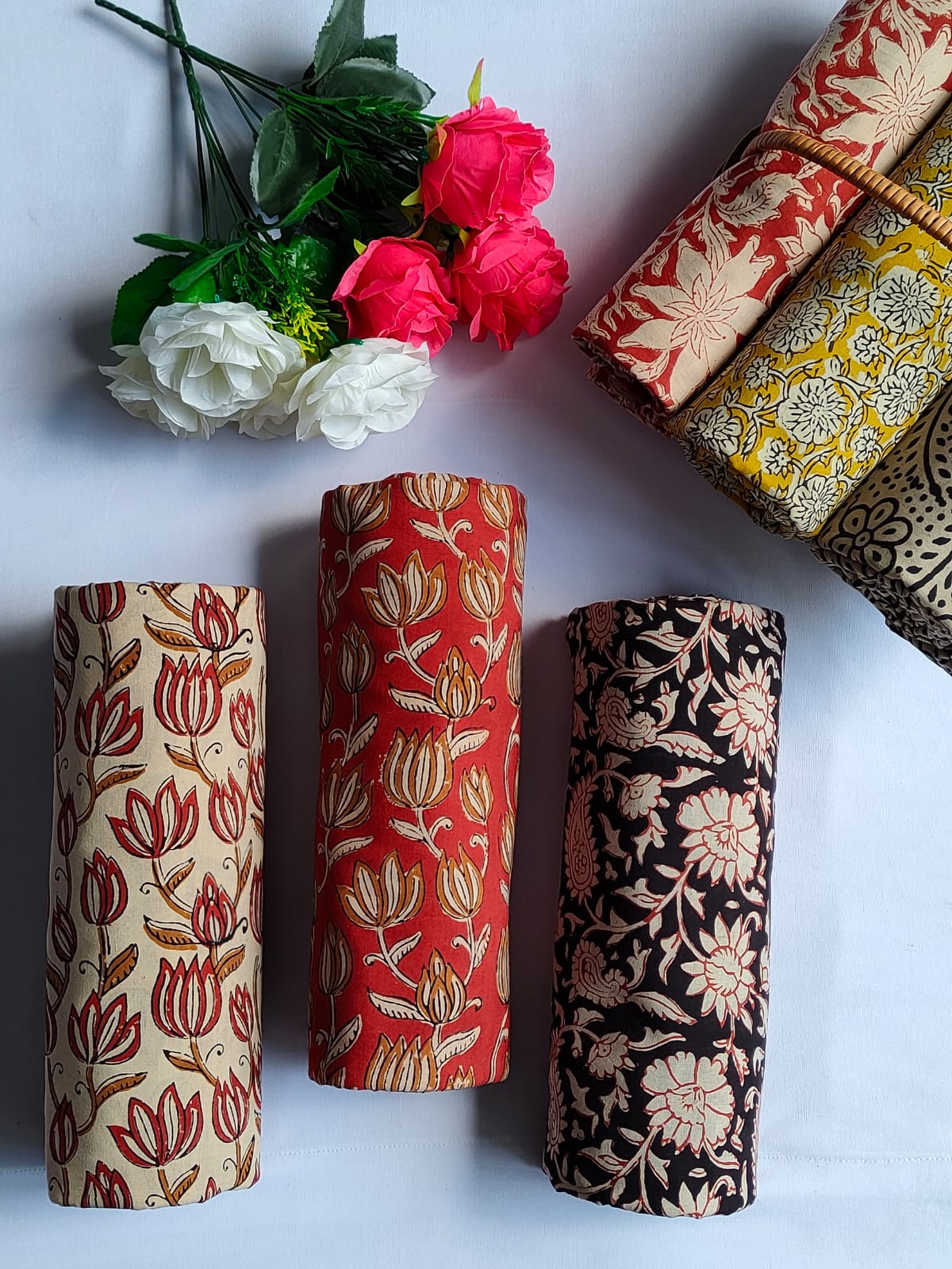


Hand block printed cotton has a distinctive appeal. Its patterns can feature delicate flowers, geometric shapes, decorative borders and traditional Indian motifs, all created through a printing process that relies on carved blocks and skilled hands. But when you shop for printed cotton fabric, how can you tell whether the fabric is genuinely hand block printed, whether its quality is good, and whether its description accurately represents the craft behind it?
These questions matter because hand block printed cotton is available in many styles, qualities and price ranges. Some fabrics are produced using traditional wooden blocks, while others reproduce similar designs through screen printing or digital printing. Both can look attractive, but the manufacturing methods are different.
A beautiful design alone does not prove authenticity. You also need to consider the printing process, cotton quality, pattern details, colour performance, finishing and, when relevant, the fabric's regional origin.
India's textile traditions provide an excellent starting point. Rajasthan's Bagru and Sanganeri printing traditions and Gujarat's Ajrakh textiles demonstrate how different communities have developed distinctive approaches to printing and dyeing fabric.
In this guide, we will explain how to assess hand block printed cotton, which quality checks are useful when shopping online, what to know about traditional Indian prints, and how to choose fabric for clothing, accessories and home décor.
What Is Authentic Hand Block Printed Cotton?
Authentic hand block printed cotton is cotton fabric on which a design has been applied using carved blocks pressed onto the cloth by hand. The printer repeats individual impressions to build the complete pattern.
A multicolour design may require several blocks. One can create the outline, another can fill the motif, and additional blocks can add other colours or details. The printer must position these impressions carefully so that the different parts of the pattern come together.
The process involves more than applying colour. Fabric preparation, the printing medium, block design and finishing all influence the finished textile.
Traditional hand block printing is practised in several Indian textile centres, including Bagru and Sanganer in Rajasthan. Ajrakh, associated with Kutch in Gujarat and a wider regional history, is another important tradition that uses blocks as part of a more extensive resist-printing and dyeing process. <Cite refs={["turn397667search1","turn397667search0","turn397667search10"]} />
It is important to distinguish between three things:
-
Printing method: Whether the design was applied using hand-carved blocks, screens, digital printing or another process.
-
Fabric quality: The cotton composition, construction, print application, finishing and suitability for use.
-
Regional authenticity: Whether a product genuinely comes from the region or craft tradition named in its description.
A fabric can be well made without being hand block printed. Similarly, a hand block printed fabric can vary in quality. The best buying decision considers all three factors rather than relying on appearance alone.
1. Check Whether the Design Was Actually Hand Block Printed
The first step is to confirm the printing method. This is especially important when buying fabric online, where a screen printed design can resemble a traditional hand block print.
Look for a clear product description
A reliable product description should identify the printing method accurately. Look for terms such as hand block printed cotton, screen printed cotton or digital print.
If the description uses broad phrases such as “traditional Indian print,” “Jaipuri design” or “ethnic cotton,” do not assume that the fabric was printed by hand.
Ask the supplier directly if the method matters to your purchase.
Understand how the design is produced
In hand block printing, the pattern is built through repeated impressions from carved wooden blocks. Multicolour designs may require separate blocks for different parts of the pattern.
In screen printing, colour passes through selected areas of a prepared screen. Digital printing transfers a design using digital printing equipment.
All three methods can produce detailed designs. A traditional-looking floral motif is therefore not enough to establish which process was used.
Do not rely on a single visual test
Some buyers look for small misalignments, uneven colour or variations between motifs as evidence of hand printing. These details can occur in hand block printing, but they are not definitive proof.
A skilled printer can produce consistent work, and screen printing can also show irregularities. Likewise, the appearance of the reverse side depends on the fabric, printing medium and process.
The most reliable approach is to combine visual inspection with accurate product information and supplier confirmation.
2. Examine the Print Quality Closely
Once you have checked the stated printing method, examine the design itself. Authenticity and quality are related but separate questions. A fabric may be hand printed and still have defects that make it unsuitable for your project.
Check the clarity of the motifs
Look at the printed pattern closely. Flowers, leaves, lines and geometric shapes should be recognisable and consistent with the intended design.
A hand block print does not need to look mechanically perfect. However, excessive smudging, missing sections or unclear motifs may indicate a printing problem.
Inspect colour alignment
Multicolour block printing often involves applying several impressions in sequence. The colours should work together to create the intended motif.
Small variations in registration may occur during manual printing. Whether these are acceptable depends on the design and the product's expected quality.
If an outline is significantly displaced from its colour fill, or if a defect disrupts a prominent motif, consider whether the fabric will still suit your project.
Look for unwanted marks
Check for stains, accidental smears, large unprinted patches or printing paste in areas where it does not belong.
Some patterns intentionally use irregular shapes or resist effects. Compare the marks with the overall design before treating them as defects.
Consider the pattern repeat
A repeating design should generally follow its intended layout. Check whether the motifs, borders and spacing work consistently across the fabric.
If you are purchasing fabric for a dress, shirt or cushion cover, consider how the pattern will look when cut and sewn. A print that appears attractive on a full length of fabric may need careful positioning around seams.
3. Assess the Cotton Fabric, Not Just the Print
One of the most common buying mistakes is focusing entirely on the design while ignoring the fabric underneath it.
Hand block printing can be carried out on different cotton constructions. The weight, weave, yarn quality and finishing influence how the fabric feels and performs.
Confirm the fibre composition
If you want pure cotton, check whether the product is explicitly described as 100% cotton. A fabric's appearance or feel alone cannot reliably confirm its composition.
For a business purchase, ask the supplier for the relevant product specifications.
Check the fabric weight
Choose the fabric according to your intended use.
-
Lightweight cotton: May suit relaxed summer tops, dresses and scarves.
-
Medium-weight cotton: Can work for kurtas, shirts, tunics and everyday clothing.
-
Firmer cotton: May be more appropriate for structured bags, pouches and some home décor projects.
These are general guidelines, not fixed rules. The actual suitability depends on the fabric's construction and the design of the finished product.
Consider the weave and surface
Look at how evenly the yarns are arranged and whether the fabric has obvious weaving defects. A close, even construction may suit some projects, while a lighter or more open structure may be desirable for others.
Do not assume that a thicker fabric is always better quality. A lightweight cotton can be appropriate for its intended use, while a heavy fabric may be unsuitable for a garment that needs a soft drape.
Evaluate the hand feel
If you can handle a sample, check whether the cloth feels suitable for the finished item.
A fabric intended for a flowing dress should behave differently from one intended for a firm tote bag. Also notice whether the print or finish makes the surface unexpectedly stiff.
For online orders, requesting a sample is often worthwhile, particularly when buying a larger quantity.
Explore Jaipur Bazar's All Cotton Fabrics collection to compare cotton options for different sewing and creative projects.
4. Understand Colour, Dye and Colourfastness
Colour is a major part of the appeal of hand block printed cotton, but colour appearance does not tell you everything about the materials used or how the fabric will perform.
Do not assume every hand block print uses natural dyes
Traditional Indian printing techniques have used natural dyes and other traditional materials. Contemporary workshops may also use synthetic dyes, pigments or a combination of materials.
The Government of India's Bagru craft documentation describes traditional materials and processes while noting that some workshops have adopted screen printing and chemical dyes to meet larger production requirements. <Cite refs={["turn397667search1"]} />
If natural dyes are important to you, ask the supplier to confirm the dye type. Do not infer that a fabric is naturally dyed simply because it has earthy colours or a muted appearance.
Ask about colourfastness
Colourfastness refers to how well colour resists fading, rubbing or transfer during use and care. Performance depends on the dye or printing medium, fabric preparation, fixation and finishing.
Ask whether the fabric has been tested for washing and rubbing performance, especially if you are buying it for garments or products that will be washed frequently.
Understand first-wash colour release
Some fabrics may release excess colour during an initial wash. The amount and whether it is acceptable depend on the materials and finishing.
Do not assume that heavy colour bleeding is proof of natural dyes or authentic hand printing. It may indicate that the colour has not been adequately fixed or that the fabric needs specific care.
Follow the supplier's instructions and test a sample before washing or processing a larger quantity.
Check colour consistency
Look at the overall colour distribution. Some variations may be part of the intended design or the manual process, but large unexpected patches or inconsistent coverage can affect the finished product.
For business orders, inspect a sample from the actual batch whenever possible.
5. Look at the Reverse Side, but Do Not Treat It as Proof
The reverse side can provide useful information about a printed fabric, but it should not be used as a standalone authenticity test.
Depending on the printing technique, the printing medium and the fabric construction, some colour may be visible on the reverse. The amount of colour transfer can vary considerably.
A hand block printed textile does not necessarily show the same amount of colour on the back as another hand printed fabric. Some screen printed fabrics may also show colour through the cloth.
When inspecting the reverse side, look for:
-
Unwanted stains or smears.
-
Areas where the fabric has been damaged.
-
Signs of an uneven finish that might affect the intended use.
-
Any differences between the front and back that the supplier should explain.
The reverse side can help you understand the fabric, but it cannot establish the printing method or regional origin by itself.
6. Learn the Difference Between Bagru, Sanganeri and Ajrakh Prints
Understanding regional traditions helps you assess whether a product description matches the style and craft being claimed.
Bagru printing from Rajasthan
Bagru, near Jaipur, is known for its hand block printing tradition, closely associated with the Chippa printing community.
Bagru textiles often feature floral motifs, repeating patterns and earthy colour combinations. The tradition also includes Dabu, a resist-printing technique in which selected areas are protected from dye to create a pattern.
Traditional Bagru production can involve several stages of fabric preparation, printing, dyeing and washing. The precise process varies with the design and materials used.
A screen printed cotton fabric may reproduce Bagru-inspired motifs, but that does not mean it was made through traditional Bagru hand block printing.
If you want to explore designs influenced by this style, visit Jaipur Bazar's Bagru Print Cotton Fabrics collection. Check the individual product descriptions to understand the actual printing method.
Sanganeri printing from Rajasthan
Sanganer, near Jaipur, is known for fine hand block printed textiles, especially delicate floral motifs, small butis, larger botanical designs and flowing vines.
The Government of India's craft documentation describes the use of wooden blocks and a production process that includes fabric preparation, printing, drying, steaming, washing and finishing. It also identifies Sanganer with fine floral patterns on light fabrics. <Cite refs={["turn397667search0","turn397667search8"]} />
Sanganeri-style designs are often used for dresses, kurtas, scarves and home textiles. However, a similar floral pattern may be produced by screen printing or digital printing.
If you are looking specifically for Sanganeri hand block printing, verify the method and origin rather than relying only on the design.
Explore Jaipur Bazar's Hand Block Print Cotton Fabrics collection to browse designs associated with Indian hand-printing traditions.
Ajrakh printing from Gujarat
Ajrakh is a distinctive resist-printing and dyeing tradition associated with Kutch in Gujarat and a wider regional history extending into Sindh.
Its patterns often feature geometric arrangements, repeating motifs and decorative borders. Indigo, red, black and white appear in many traditional designs, though colour choices can vary.
Traditional Ajrakh production involves multiple stages of preparation, resist printing, dyeing and washing. Carved wooden blocks are used to build the pattern, and the order of the stages contributes to the finished result. <Cite refs={["turn397667search10"]} />
A geometric screen printed fabric inspired by Ajrakh can be attractive and useful for contemporary clothing or home décor. But the visual resemblance alone does not establish that it was made using traditional Ajrakh techniques.
Why regional origin matters
Regional craft names communicate more than a pattern style. They can refer to particular histories, communities and methods.
If you are paying for a textile because it is represented as a genuine regional craft, ask the supplier to substantiate the origin claim. If you mainly want the look of a particular motif, a clearly described inspired design may meet your needs.
Both choices can be valid. The important thing is to understand what you are buying.
7. Check the Finishing and Overall Condition
After printing, cotton fabric may undergo washing, drying, steaming or other finishing steps, depending on the printing materials and technique.
Finishing affects how the fabric feels, how it behaves during sewing and how it responds to care.
Look for an appropriate surface feel
The fabric should feel suitable for its intended use. An unexpected stiff or sticky surface may be worth investigating, although some finishes are deliberately used to change the fabric's feel or structure.
Inspect for physical defects
Look for holes, tears, damaged edges, obvious weaving faults or marks that could interfere with cutting and sewing.
A defect near the edge may have a different effect from one in the middle of a large pattern piece. Consider how much usable fabric remains.
Ask about shrinkage
Cotton can shrink depending on its construction, processing and care. If the fabric is intended for fitted clothing or a commercial product, ask whether shrinkage information is available.
Where appropriate, wash and dry a sample using the intended care method before cutting the full quantity.
Confirm the usable width
The stated width influences how efficiently you can cut garments and accessories. Check the usable width rather than estimating it from product photographs.
If the print includes a border or a directional motif, allow extra fabric for matching and cutting.
8. How to Check Hand Block Printed Cotton When Shopping Online
Buying fabric online gives you access to a wide range of patterns, but you cannot immediately feel the cloth or inspect every part of the print.
A systematic approach can help you make a better decision.
Step 1: Read the full product description
Look for the fibre composition, printing method, width, price unit, available quantity and care instructions.
If a product is described as Bagru, Sanganeri or Ajrakh, check whether the description explains the production method and origin.
Step 2: Examine all available photographs
Look at the overall pattern and any close-up images. Check motif clarity, colour distribution and the scale of the design.
If the photographs do not show enough detail, ask for additional images before ordering.
Step 3: Ask questions about the printing process
Useful questions include:
-
Is this fabric hand block printed, screen printed or digitally printed?
-
What is the cotton composition?
-
What is the usable width?
-
Are the colours or dyes specified?
-
What care instructions should I follow?
-
Can you provide a sample?
If regional authenticity is important, ask where the fabric was produced and what evidence supports the description.
Step 4: Request a sample
A sample allows you to assess the feel, weight, print quality and colour before committing to a larger purchase.
It is especially useful for garment manufacturers, independent fashion labels and buyers making multiple products from the same fabric.
Step 5: Check the supplier's policies
Before ordering, review shipping times, return conditions and the process for reporting damaged or incorrectly described fabric.
For a business order, confirm stock availability and ask whether future batches may differ in colour or construction.
Step 6: Test before production
If the fabric will be used for a larger project, test the sample for shrinkage, colour performance and suitability for sewing.
The sample should represent the fabric you expect to receive. If the order is important, clarify whether the supplier can maintain the same specification across the batch.
9. Common Myths About Authentic Hand Block Printed Cotton
Some common assumptions can lead buyers to choose fabric for the wrong reasons.
Myth 1: Every hand block print has visible imperfections
Not necessarily. Hand block printing can produce small variations, but a skilled printer may achieve very consistent results. The presence or absence of irregularities does not prove authenticity.
Myth 2: Natural-looking colours mean natural dyes were used
Colour alone cannot confirm the dye type. Traditional and contemporary fabrics may use different dyes and pigments. Ask the supplier if this detail matters.
Myth 3: Colour on the reverse proves the fabric is hand printed
No. The amount of colour visible on the reverse depends on the fabric, printing medium and production method. It is not a reliable standalone test.
Myth 4: A traditional motif proves regional origin
A pattern inspired by Bagru, Sanganer or Ajrakh may be produced elsewhere using modern printing methods. Check the production location and method if you need a region-specific textile.
Myth 5: Hand block printed cotton is always better quality
Hand block printing describes how a design is applied, not the overall quality of the cotton. Fabric construction, printing quality, finishing and care performance all matter.
Myth 6: Every hand block printed fabric is suitable for every project
A lightweight fabric may not be appropriate for a structured bag, while a firm cotton may not provide the drape required for a loose dress. Choose according to the finished product.
10. How to Choose Authentic Hand Block Printed Cotton for Different Projects
The right fabric depends on what you plan to make.
| Project | What to check |
|---|---|
| Kurtas and tunics | Fabric weight, drape, print scale and wash performance |
| Dresses and tops | Comfort, construction, coverage and pattern direction |
| Shirts | Fabric stability, usable width and alignment around plackets and collars |
| Tote bags | Fabric strength, lining needs and resistance to everyday wear |
| Pouches and accessories | Suitable weight, print placement and ease of sewing |
| Cushion covers | Fabric strength, colourfastness and cleaning requirements |
| Table runners | Print layout, care instructions and suitability for frequent washing |
| Boutique collections | Consistent specifications, sample approval and reliable supply information |
For garments, plan how the motif will fall across seams and panels. For bags and home décor, consider the fabric's strength and expected use.
If the project requires a particular regional craft, verify the production method separately from the fabric's suitability.
Jaipur Bazar offers several categories to explore, including Cotton Cambric Fabrics, Mulmul Cotton Fabrics, Printed Cotton Fabrics and Plain Cotton Fabrics. Review each product's specifications before selecting a fabric for your project.
11. Why Accurate Craft Descriptions Help Preserve Indian Textile Traditions
Authenticity is not only a buying concern. It also affects how people understand and value India's textile heritage.
Traditional printing knowledge involves block carving, colour preparation, fabric handling, printing and finishing. Regional practices may depend on specific techniques and the knowledge of the people who continue them.
When a product is accurately described, customers can decide whether they want a traditional hand printed textile, a contemporary screen print or a design inspired by a regional style.
This helps prevent confusion between different production methods and gives buyers a clearer understanding of what they are paying for.
You can support responsible textile sourcing by asking questions, checking descriptions and choosing suppliers who explain their products honestly. When buying a named regional craft, seek reliable information about the production location and technique.
It is also important to avoid treating every contemporary adaptation as a loss of tradition. Textile practices change, and modern printing methods can have their own uses. The key is to describe the process accurately rather than presenting one method as another.
Conclusion: Look Beyond the Pattern
Authentic hand block printed cotton is defined by its printing process, while its overall quality depends on the cotton, the print application and the finishing. A beautiful floral design or traditional colour palette may attract your attention, but those details alone cannot establish how a fabric was made.
To make a confident purchase, confirm the printing method, inspect the motifs, check the fabric composition and weight, ask about colourfastness, and review the finishing. If regional origin or natural dyes are important to you, request specific information instead of relying on appearance.
Bagru and Sanganeri printing in Rajasthan and Ajrakh in Gujarat demonstrate the depth of India's textile heritage. Their patterns and techniques offer a rich source of inspiration, but each tradition deserves to be described accurately.
Explore Jaipur Bazar's Hand Block Print Cotton Fabrics collection and Bagru Print Cotton Fabrics collection to discover designs associated with Indian textile traditions. Compare the product details carefully to find fabric that suits your project and understand the process behind the print.
Frequently Asked Questions
1. How can I tell if hand block printed cotton is authentic?
Start by checking the product description and confirming that the design was applied using carved wooden blocks by hand. Examine the print and fabric quality, and ask about the production method if necessary. No single visual clue proves authenticity.
2. Does authentic hand block printed cotton have imperfections?
Small variations in pattern placement or colour can occur during manual printing. However, imperfections are not required for authenticity, and large smudges or damaged areas may still be quality problems.
3. Can I identify hand block printing by looking at the reverse side?
Not reliably. Colour visibility on the reverse depends on the fabric and printing process. Use the reverse side as one part of your inspection, not as proof of the printing method.
4. Does authentic hand block printed cotton always use natural dyes?
No. Traditional and contemporary hand block printing may use different dyes or pigments. Ask the supplier for the dye information if natural dyes are important to your purchase.
5. What is the difference between Bagru and Sanganeri prints?
Bagru and Sanganeri are regional hand block printing traditions associated with Rajasthan. Bagru is often associated with earthy colours and resist-printing techniques, while Sanganeri printing is known for fine floral patterns. Specific designs and materials vary.
6. Is Ajrakh hand block printed?
Traditional Ajrakh is a resist-printing and dyeing tradition associated with Kutch in Gujarat and a wider regional history. Carved blocks are used as part of its multistage production process. A fabric with Ajrakh-inspired motifs may be made using a different printing method.
7. How can I check the quality of cotton fabric before buying?
Check the fibre composition, fabric weight, width, weave, print clarity and finishing. Ask about colourfastness and shrinkage, and request a sample if possible. Consider whether the fabric suits the garment or product you intend to make.
8. Is hand block printed cotton suitable for everyday clothing?
Yes, if the cotton construction, print and finishing are appropriate for the garment. Check the fabric's drape, comfort, care requirements and expected wash performance before purchasing.
9. Can screen printed fabric look like hand block printed cotton?
Yes. Screen printing can reproduce traditional-looking floral, geometric and repeating designs. The appearance alone may not reveal the printing method, so check the product description or ask the supplier.
10. Where can I buy hand block printed cotton online?
You can browse Jaipur Bazar's Hand Block Print Cotton Fabrics collection and Bagru Print Cotton Fabrics collection. Review the product description for fabric composition, printing method, available quantity and care instructions before ordering.