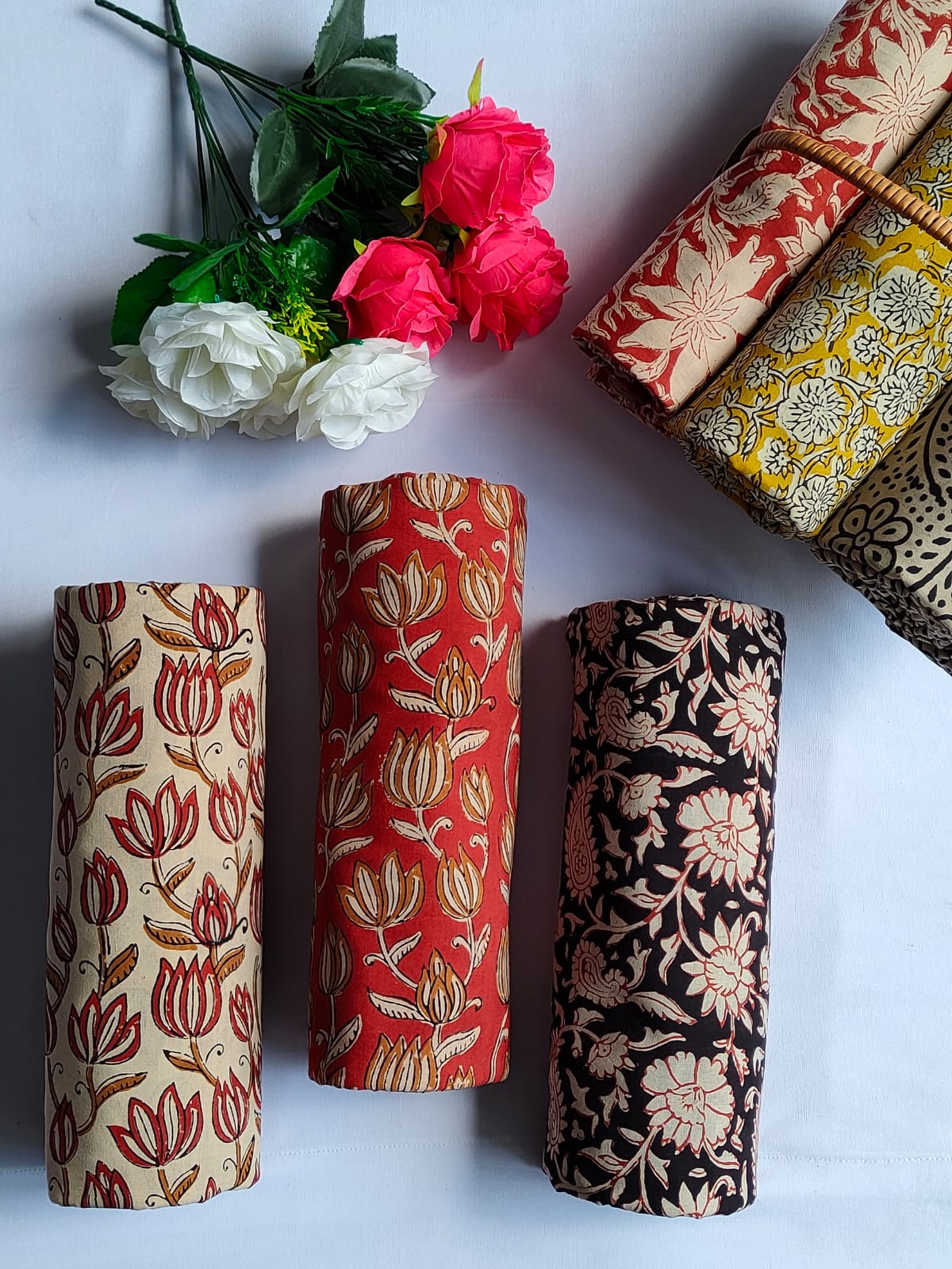


Cotton fabric is available in countless colours, patterns and finishes, but the way a design is printed can make a significant difference to its appearance, production process and price. Two popular methods are hand block printing and screen printing. Both can create beautiful floral motifs, geometric patterns, traditional Indian designs and contemporary prints, yet they achieve these results in very different ways.
Hand block printing has a long history in India's textile industry. From the delicate floral patterns of Sanganer in Rajasthan to the earthy designs of Bagru and the geometric arrangements of Ajrakh in Gujarat, the craft reflects generations of printing knowledge and regional artistic traditions. Screen printing, meanwhile, offers a practical way to reproduce designs across fabric lengths with consistent placement and a wide range of colours.
If you are buying cotton fabric for clothing, sewing, home décor or a small fashion business, understanding these differences can help you make a better decision. The right choice depends on your design preference, budget, intended use, required quantity and expectations about the printing process.
In this guide, we will compare hand block and screen printed cotton fabric, explain how each method works, explore India's regional printing traditions and share practical tips for choosing the right fabric.
What Is Hand Block Printed Cotton Fabric?
Hand block printed cotton fabric is made by applying a design to cloth using carved wooden blocks. Each block carries a specific part of the pattern and is pressed onto the fabric by hand with printing colour or paste.
For a multicolour design, the printer may need several blocks. One block might create the outline, while others add the background, smaller details or additional colours. The printer must position each impression carefully so that the different parts of the design form a complete pattern.
This process requires skill, concentration and an understanding of how the fabric, printing medium and blocks work together. Even a simple repeating motif can involve many individual impressions across a length of cotton.
Hand block printing is practised in several parts of India, with regional styles developing their own motifs, colour palettes and techniques. Rajasthan is particularly well known for traditions such as Bagru and Sanganeri printing, while Kutch Ajrakh is an important textile tradition associated with Gujarat.
The finished fabric may show small variations in colour placement or pattern alignment. These variations can occur during manual printing, although the presence of irregularities alone does not prove that a fabric is hand printed.
It is also important to understand that hand block printing does not automatically mean natural dyes have been used. Traditional and contemporary workshops may use different dyes, pigments and finishing processes. Buyers should check the product details if a particular dye type matters to them.
What Is Screen Printed Cotton Fabric?
Screen printed cotton fabric is produced by transferring a design through a prepared screen onto the fabric. The screen has selected open areas that allow printing ink or colour paste to pass through while the remaining areas block it.
A design with several colours may require separate screens or printing stages for each colour. The screens are aligned with the fabric so that the different parts of the pattern come together in the intended arrangement.
Screen printing can be carried out manually or with automated equipment. The production setup depends on the manufacturer, the design and the quantity being produced.
This method is widely used for floral prints, geometric designs, abstract patterns, stripes and contemporary graphics. It can also reproduce motifs inspired by traditional Indian textiles, including designs that resemble the visual language of Bagru, Sanganer or Ajrakh.
However, a screen printed design inspired by a traditional craft is not the same as a textile made using that craft's original printing method.
For example, a screen printed cotton fabric featuring delicate Sanganeri-style florals does not become hand block printed simply because the motifs look similar. The distinction is in how the design is applied, not just how the finished fabric looks.
Screen printing can be a practical option for buyers who need repeated patterns, consistent design placement or fabric for larger production runs. The final quality still depends on the cotton base, printing medium, fixation process and finishing.
Hand Block vs Screen Printed Cotton Fabric: Key Differences
Although both methods can produce attractive printed cotton, their production processes and characteristics differ.
| Feature | Hand block printing | Screen printing |
|---|---|---|
| Printing method | Carved wooden blocks are pressed onto fabric by hand | Ink or colour paste passes through selected areas of a screen |
| Main skill involved | Block carving, colour application and manual pattern alignment | Screen preparation, colour separation, registration and process control |
| Pattern consistency | Small variations may occur between impressions | Consistent repeats are possible with suitable equipment and process control |
| Design production | Depends on the blocks and the printer's technique | Can accommodate many design styles and repeated production |
| Colour application | Colours are applied through successive block impressions | Colours are applied through one or more screen-printing stages |
| Typical production scale | Often labour-intensive and suited to craft-led production | Can be adapted to manual or automated production |
| Regional craft connection | May form part of a recognised regional printing tradition | Can reproduce regional-inspired motifs without using the traditional craft method |
| Price considerations | Labour, block preparation, complexity and finishing influence cost | Screens, setup, production quantity, ink and finishing influence cost |
| Best buying approach | Check the craft process, fabric quality and product origin | Check fabric construction, print clarity, colour performance and finishing |
Neither method is automatically better in every situation. A well-made screen print may be suitable for a project that needs consistent repeats, while a carefully produced hand block print may appeal to someone who values the craft process and its visual character.
The important thing is to choose according to your needs rather than assuming that one printing method always produces better cotton fabric.
1. Difference in the Printing Process
The most fundamental difference is how the design moves from a pattern onto the cloth.
How hand block printing works
The process generally begins with a design that is carved into a wooden block. The block is prepared so that its raised surface transfers the intended motif onto the fabric.
The cloth is spread across a suitable printing surface. The printer applies colour to the block and presses it against the fabric, repeating the impression across the required area.
When multiple colours are used, each colour may need a separate block or printing stage. The printer must align these impressions carefully to create the finished design.
Depending on the fabric and printing system, additional steps such as washing, dyeing, steaming, drying and finishing may follow.
Traditional resist-printing techniques add further stages. In these methods, selected areas are protected from dye so that the final pattern emerges after subsequent processing.
How screen printing works
Screen printing starts with a prepared screen that contains the design. Printing ink or colour paste is pushed through the open areas of the screen onto the cotton.
The fabric or screen is moved into position for each repeat. In multicolour designs, the screens must be aligned correctly so that the colours appear in the intended places.
Once printing is complete, the fabric undergoes the appropriate drying, curing, steaming or other fixation process required by the printing medium.
The exact process varies between manufacturers. Some use manual tables, while others use automated equipment for greater production capacity.
The main difference: hand block printing relies on repeated manual impressions from carved blocks, whereas screen printing transfers colour through a prepared mesh screen.
2. Difference in Design and Pattern Appearance
Both methods can create a wide range of designs, but the production process affects how patterns are developed and reproduced.
Hand block printed designs
Hand block printing is well suited to repeating motifs, floral arrangements, decorative borders and patterns built from individual block impressions.
Because the printer places each impression by hand, small variations can occur in spacing, alignment or colour application. These variations may contribute to the character of the finished fabric, depending on the design and the printer's technique.
The craft also has a close relationship with regional design traditions. A pattern may reflect motifs, colours and arrangements associated with a particular textile-printing community.
Screen printed designs
Screen printing can reproduce precise, repeating motifs and complex arrangements. It is suitable for designs that need consistent placement across a fabric length.
It can also accommodate contemporary graphics, abstract artwork and colour combinations that are not tied to traditional regional styles.
A screen printed fabric may look very similar to a hand block printed design. Photographs alone are not always enough to identify the process reliably.
If the method matters to your purchase, check the product description or ask the supplier how the fabric was printed.
3. India's Regional Hand Block Printing Traditions
To understand the cultural significance of hand block printing, it helps to look beyond the finished pattern. India's regional textile traditions reflect the knowledge of printers, dyers, block carvers and communities that have developed distinctive approaches to fabric decoration.
Three important examples are Bagru, Sanganer and Ajrakh.
Bagru printing in Rajasthan
Bagru, near Jaipur, is known for its hand block printing tradition, closely associated with the Chippa printing community.
Bagru textiles are often recognised for earthy colour combinations, floral motifs and repeating patterns. Depending on the design, the palette may include indigo, red, black, brown and other shades.
One technique associated with Bagru is Dabu, a form of resist printing. A resist material is applied to selected areas of the fabric to prevent dye from colouring those sections in the usual way. The cloth is then dyed and processed to reveal the intended pattern.
Traditional Bagru printing can involve several stages of preparation, printing, dyeing and washing. The process depends on the particular design and materials used.
Bagru is a regional printing tradition, while Dabu describes a resist-printing technique. The terms are related, but they do not mean exactly the same thing.
Screen printed fabrics can imitate the appearance of Bagru motifs or earthy colour palettes. However, a similar-looking design is not evidence that the fabric was produced using Bagru hand block printing.
Explore Jaipur Bazar's Bagru Print Cotton Fabrics if you are looking for cotton designs influenced by this textile style.
Sanganeri printing in Rajasthan
Sanganer, near Jaipur, is known for its fine hand block printed textiles, particularly delicate floral patterns and botanical motifs.
Designs may include small butis, larger floral forms, vines and decorative arrangements on light backgrounds. Sanganeri printing has been used for dress materials and other textiles, including home furnishings.
The traditional process involves printing with carved wooden blocks and carefully handling the fabric through the required preparation and finishing stages. The craft depends on both the precision of the blocks and the skill of the printer.
Sanganeri designs are a useful example of how a regional printing tradition develops its own visual identity. Fine floral motifs can be reproduced using screen printing too, but the appearance alone does not establish that the fabric was printed in Sanganer or made by hand.
If you prefer the detailed floral style associated with Rajasthan, browse Jaipur Bazar's Hand Block Print Cotton Fabrics.
Ajrakh printing in Gujarat
Ajrakh is a distinctive resist-printing tradition associated with Kutch in Gujarat and with a wider textile history extending into Sindh.
Ajrakh fabrics are known for carefully arranged geometric patterns, repeated motifs and decorative borders. Indigo, red, black and white are prominent in many traditional designs, although the exact palette depends on the textile.
Traditional Ajrakh production can involve multiple stages of fabric preparation, resist printing, dyeing and washing. Carved wooden blocks are used to create the intricate patterns, and the sequence of printing and dyeing is central to the final result.
These processes require detailed planning because the different parts of the pattern must align across the fabric.
Contemporary screen printing can reproduce geometric arrangements inspired by Ajrakh. That can be useful for designers seeking a particular visual style, but screen printing is not the same as traditional Ajrakh production.
Buyers who specifically want authentic Ajrakh should ask about the production method and origin rather than relying only on the motif or colour palette.
Why these traditions matter today
Regional printing traditions continue to influence contemporary fashion, accessories and home textiles. Their designs offer inspiration for new products while preserving visual connections to India's textile heritage.
Their future also depends on whether the people who maintain these skills can continue their work and whether buyers understand the value of the craft.
Choosing accurately described hand block printed textiles can support demand for artisan production. Screen printed fabrics inspired by regional motifs can also serve contemporary design needs, provided they are described honestly.
The goal is not to treat one method as a replacement for the other. It is to recognise their differences and give customers enough information to make an informed choice.
4. Which Printing Method Offers Better Colour and Detail?
Colour and detail depend on several factors, including the design, printing medium, fabric preparation, application technique and finishing.
Colour in hand block printing
In hand block printing, each impression contributes to the final pattern. Depending on the process, a fabric may feature subtle variations in colour placement or intensity.
Some traditional techniques use natural dyes, while other hand printed textiles use synthetic dyes or pigments. It is therefore important not to assume that every hand block printed fabric is naturally dyed.
The final appearance depends on the materials and the skill used throughout production.
Colour in screen printing
Screen printing can produce clear, consistent colour areas when the screens, inks and printing process are properly controlled.
It can be useful for designs that require precise colour placement or repeated motifs. However, the quality of the result still depends on the ink or paste, the base fabric and the fixation process.
A poorly executed screen print may have uneven coverage, smudges or weak colour performance. The method itself does not guarantee a high-quality result.
How to evaluate colour quality
When buying either type of fabric, look for:
-
Clear, well-defined motifs.
-
Even colour application appropriate to the design.
-
No unexpected smudging or missing printed areas.
-
Suitable colourfastness for the intended use.
-
Finishing that does not make the fabric uncomfortably stiff or unsuitable for the project.
If you are ordering fabric for commercial production, request a sample and test it under realistic care conditions before committing to a large quantity.
5. Which Is More Durable: Hand Block or Screen Printed Cotton?
There is no universal answer. Durability depends on the cotton fabric, yarn quality, construction, printing medium, fixation, finishing and how the fabric is used and cared for.
A well-made hand block printed cotton fabric can be suitable for clothing and home textiles. A well-made screen printed cotton fabric can also perform well when the print has been correctly applied and fixed.
Likewise, either type can disappoint if the base fabric is unsuitable or the printing and finishing are poorly executed.
Before purchasing, consider the following:
For garments: Check the fabric's drape, comfort, expected shrinkage and ability to withstand regular washing.
For bags and accessories: Consider the strength of the base fabric, the amount of friction the product will experience and whether a lining or reinforcement is required.
For home décor: Check the intended care method and whether the fabric is suitable for frequent use.
For products that need regular washing: Ask about colourfastness and test a sample using the recommended washing instructions.
Do not rely on the front appearance or reverse side alone to determine durability or authenticity. A close inspection can offer useful clues, but a fabric specification and suitable testing provide better evidence of performance.
6. Difference in Price and Production Cost
Hand block and screen printed fabrics have different cost structures.
What influences hand block printing costs?
Hand block printing involves preparing and maintaining the blocks, applying individual impressions and managing the additional stages required by the design.
The cost can depend on:
-
The complexity of the pattern.
-
The number of colours and blocks required.
-
The time needed for printing and finishing.
-
The type of cotton used.
-
The dyes, pigments and other materials.
-
The skill and labour involved.
-
The order quantity and supplier's production arrangements.
A complex multicolour design may require more work than a simpler repeating pattern.
What influences screen printing costs?
Screen printing may require design preparation and screen setup before production begins. Each colour can involve additional preparation, and the cost per metre depends on the production method and quantity.
Factors include:
-
The number of colours.
-
Screen preparation and setup costs.
-
Printing equipment and labour.
-
Fabric quality and width.
-
Ink or printing paste.
-
Fixation and finishing.
-
Order quantity and wastage.
Larger runs may distribute setup costs across more metres, but this does not mean every screen printed fabric will be cheaper than every hand block printed fabric.
How should buyers compare prices?
Compare fabrics with similar specifications rather than looking only at the price per metre.
Check the cotton composition, width, weight, print quality, finishing and usable quantity. For a business, calculate how much usable fabric is required for each finished product.
If you value artisan production, also consider whether the supplier can explain the printing process and the work involved.
7. Which Fabric Is Better for Clothing, Sewing and Home Décor?
The right printing method depends on the finished product and the look you want to achieve.
| Intended use | Hand block printed cotton | Screen printed cotton |
|---|---|---|
| Everyday dresses and kurtas | Suitable when the cotton weight and print work for the garment | Suitable for a wide range of repeating patterns |
| Boutique collections | Useful for craft-led designs and small-batch concepts | Useful for coordinated designs and repeat production |
| Shirts and tunics | Works well with suitable fabric construction and motif scale | Offers options for consistent pattern placement |
| Tote bags and pouches | Can add a distinctive craft-led appearance | Useful for repeatable graphics and coordinated designs |
| Cushion covers | Suitable for decorative designs when the base fabric is appropriate | Offers many pattern and colour options |
| Table linen | Suitable when care requirements and colour performance are appropriate | Can work well when the print is suited to regular use |
| Design-led collections | Offers a direct connection to hand printing when the process is genuine | Offers flexibility for contemporary and repeated designs |
For either method, the base cotton matters just as much as the print. Lightweight cotton may suit relaxed garments, while firmer constructions may be more appropriate for accessories or furnishings.
Jaipur Bazar offers several cotton fabric categories that can help you compare options for your project:
Check individual product descriptions for the actual composition, printing method, width and care instructions before placing an order.
8. How to Identify Hand Block Printed and Screen Printed Cotton When Buying Online
The difference can be difficult to identify from a product photograph, particularly when screen printing reproduces a traditional-looking design.
Use these checks before purchasing.
Read the product description carefully
Look for a clear statement of the printing method. Terms such as “hand block printed,” “screen printed” and “traditional-inspired print” describe different things.
If the description uses broad phrases such as “Jaipuri print” or “ethnic print,” ask the supplier what method was used.
Examine close-up photographs
Look closely at the motif edges, colour application and pattern alignment. Small variations can occur in hand printing, but they are not conclusive proof of the method. Screen printing can also show defects or variations when production control is poor.
Ask about the production location
If you are buying a fabric specifically for its regional identity, ask where it was produced and whether the supplier can substantiate that claim.
A design inspired by Bagru or Ajrakh does not necessarily originate in those regions.
Request a sample
A physical sample lets you assess the fabric's hand feel, weight, print clarity and suitability for sewing.
For business orders, it also gives you an opportunity to test shrinkage and colour performance before committing to the full quantity.
Check the supplier's specifications
Confirm the composition, usable width, available quantity, finishing and care requirements. For larger orders, ask whether repeat batches are expected to match the approved sample.
A reliable supplier should be able to explain what is known about the fabric and be clear when a detail cannot be verified.
9. How Are India's Printing Traditions Being Preserved?
The preservation of hand block printing depends on more than maintaining traditional motifs. It also involves sustaining the skills and livelihoods connected to the craft.
Block carvers, printers, dyers and other textile workers contribute different parts of the production process. Their knowledge includes how to prepare blocks, align patterns, apply colours, manage resist techniques and finish the fabric.
Regional traditions continue to adapt to modern markets. Artisans and manufacturers may introduce new colour combinations, motifs and product applications while retaining particular elements of their established craft.
However, traditional production can require considerable time and labour. Competition from faster manufacturing methods can make it difficult for craft-based businesses to remain viable.
Buyers can help preserve these traditions by making informed choices:
-
Purchase from suppliers who accurately describe their printing methods.
-
Seek out artisan-made textiles when hand production is important to the project.
-
Ask about regional origin rather than relying on visual resemblance.
-
Avoid assuming that every traditional-looking design uses natural dyes.
-
Share accurate information about the textiles used in products and collections.
Screen printing also has a legitimate place in the textile market. It can make a wide range of patterns available for contemporary clothing, accessories and interiors. The important point is to distinguish modern production from traditional craft rather than treating them as interchangeable.
For Jaipur Bazar, India's regional textile heritage provides a rich source of design inspiration. A clear distinction between printed cotton and hand block printed cotton helps customers understand their choices and appreciate the different methods behind the fabric.
10. Which Should You Choose: Hand Block or Screen Printed Cotton?
Choose hand block printed cotton if you specifically want fabric made through a manual block-printing process, value the skills involved in that craft or are developing a collection around artisan-made textiles.
Choose screen printed cotton if the design, fabric construction and available production options meet your requirements, particularly when consistent repeats or contemporary patterns are important.
Before deciding, ask yourself:
-
Do I need a verified hand block printing process, or do I mainly want a particular visual style?
-
What fabric weight and construction suit my project?
-
How important are colourfastness, wash performance and repeat consistency?
-
What quantity do I need?
-
Can the supplier provide accurate product details and a sample?
These questions help you choose based on practical requirements rather than assumptions about which printing method is always superior.
Conclusion
Hand block printing and screen printing are two distinct ways of decorating cotton fabric. Hand block printing uses carved wooden blocks applied by hand and connects many textiles to India's regional craft traditions. Screen printing transfers colour through a prepared screen and can produce consistent repeating designs across a range of production setups.
Bagru and Sanganeri printing in Rajasthan and Ajrakh in Gujarat demonstrate how regional textile traditions develop their own motifs, techniques and cultural significance. Their designs continue to influence modern fashion and fabric collections, but a similar-looking screen print should not be confused with a textile made using the traditional craft process.
When buying cotton fabric, consider the base material, weight, print clarity, finishing, care requirements and intended use. Ask questions about production methods and regional origin whenever those details matter.
Explore Jaipur Bazar's Printed Cotton Fabrics for a range of printed options, or browse Hand Block Print Cotton Fabrics if you are looking for designs associated with India's hand-printing traditions. Compare product specifications carefully to find the right fabric for your next sewing, clothing or home décor project.
Frequently Asked Questions
1. What is the main difference between hand block and screen printed cotton fabric?
Hand block printing uses carved wooden blocks pressed onto fabric by hand. Screen printing transfers colour through selected open areas of a prepared screen. Both methods can produce repeating designs, but their production processes are different.
2. Is hand block printed cotton better than screen printed cotton?
Neither is automatically better. Hand block printing may be the preferred choice when the craft process and artisan production matter to you. Screen printing may suit projects that need consistent repeating designs. Fabric quality depends on the cotton, printing materials, finishing and care.
3. Is screen printed cotton fabric cheaper?
It can be, depending on the design, setup costs, order quantity and finishing. Screen printing may distribute setup costs over larger production runs, while hand block printing involves manual work and block preparation. Compare actual product specifications and prices rather than assuming one method is always cheaper.
4. Does hand block printed cotton always use natural dyes?
No. Although natural dyes are associated with some traditional printing practices, contemporary hand block printed fabrics may use natural dyes, synthetic dyes or other printing materials. Check the supplier's description if dye composition is important to you.
5. How can I tell whether cotton fabric is hand block printed?
Start with the product description and ask the supplier about the printing method. Close-up photographs may offer clues, but minor irregularities or colour visibility on the reverse are not definitive proof. Requesting a sample and clear production information is a more reliable approach.
6. Are Bagru and Sanganeri prints the same?
No. Both are regional hand block printing traditions associated with Rajasthan, but they have different design characteristics and histories. Bagru is often associated with earthy palettes and resist-printing techniques, while Sanganer is widely known for fine floral motifs. Individual designs and materials can vary.
7. What is the difference between Ajrakh and screen printing?
Traditional Ajrakh is a resist-printing and dyeing tradition associated with Kutch in Gujarat and a wider regional history. It involves carved blocks and multiple stages of printing and dyeing. Screen printing uses a prepared screen to transfer colour. A screen printed geometric pattern inspired by Ajrakh is not necessarily traditional Ajrakh.
8. Which cotton fabric is suitable for dresses and kurtas?
The best option depends on the desired drape, coverage and structure. Lightweight or medium-weight cotton can suit many dresses and kurtas, but you should check the actual fabric construction, weight and finishing before purchasing.
9. Can hand block printed and screen printed cotton both be used for home décor?
Yes. Both can be suitable for cushion covers, table accessories and other decorative projects, depending on the fabric's strength, print performance and care requirements. Confirm that the base cloth is suitable for the intended use.
10. What should I check before ordering printed cotton fabric online?
Check the fibre composition, fabric width, weight, printing method, colourfastness information, care instructions, available quantity, shipping details and return conditions. Request a sample when the fabric is intended for a larger order or commercial production.