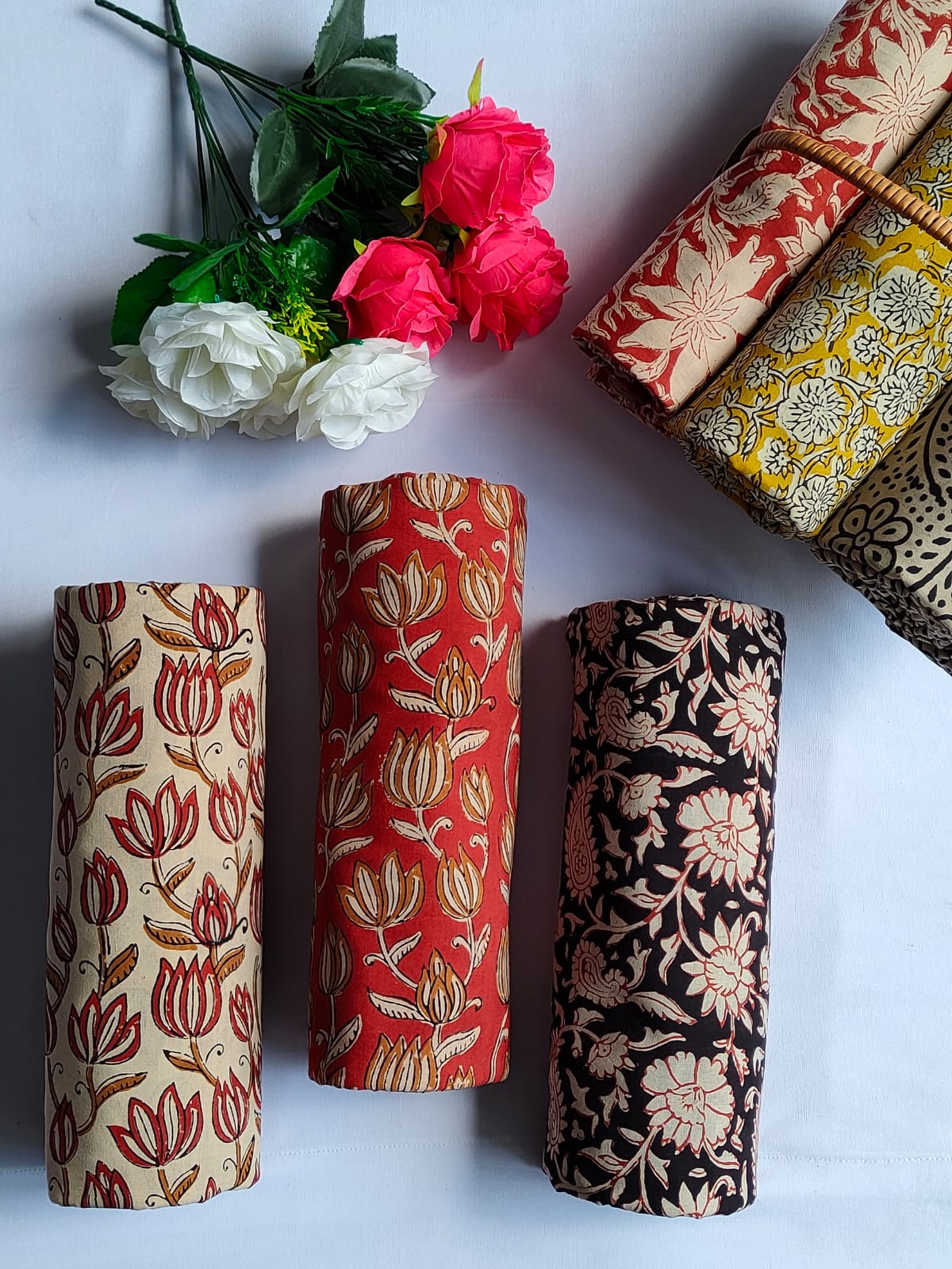


Indian handblock printing brings together colour, craftsmanship and regional identity in a way few textile traditions can match. A small floral motif from Rajasthan, an earthy resist print from Bagru or a symmetrical geometric pattern from Gujarat can transform a simple piece of cotton into something full of character.
For fabric lovers, the beauty of handblock prints lies in their variety. Some patterns are delicate and understated, while others use bold shapes, deep indigo, rich red and intricate borders. Many have roots in traditional Indian clothing, but they also work beautifully for contemporary dresses, oversized shirts, kurtas, co-ord sets, scarves, tote bags and home décor.
Behind these patterns are generations of artisans who have developed specialised ways of carving wooden blocks, preparing fabric, applying colours and repeating designs by hand. Regional traditions such as Bagru, Sanganer and Ajrakh show how geography, available materials and community knowledge have shaped India's printed textiles.
In this guide, we explore some of the most beautiful handblock designs, the traditions that inspire them and practical ways to use them in modern creative projects. We also look at how buyers, designers and textile businesses can help keep these craft traditions visible.
What Makes Handblock Designs So Special?
Handblock printing involves transferring a design onto fabric using carved blocks. Artisans apply printing colour or paste to the block and press it onto the cloth, repeating the impression to build a pattern. More complex designs may require several blocks for outlines, colours and decorative details.
The beauty of the finished fabric depends on more than the motif itself. The scale of the pattern, the contrast between colours, the spacing of the impressions and the texture of the cloth all influence the result.
Here are a few qualities that make handblock designs appealing:
-
Distinctive motifs: Flowers, leaves, vines, geometric shapes and ornamental patterns offer a wide range of styles.
-
Regional character: Different printing centres have developed recognisable design traditions.
-
Versatility: Printed cotton can be used for everyday clothing, occasion wear, accessories and home furnishings.
-
Handcrafted detail: Manual printing can produce subtle variations in placement and impression.
-
Creative flexibility: The same design inspiration can be adapted to different colour palettes, garment shapes and project sizes.
Not every fabric with a traditional-looking pattern is handblock printed. Screen printing and digital printing can reproduce similar motifs. If the printing method matters to you, check the product description rather than relying on appearance alone.
To learn more about the craft itself, read Jaipur Bazar's The Art of Handblock Printing: A Complete Guide.
Regional Traditions That Inspire Indian Handblock Designs
Some of the most recognisable Indian block print styles come from Rajasthan and Gujarat. Although they share the use of printed patterns on fabric, their visual languages and techniques can be quite different.
Bagru Prints: Earthy Colours and Nature-Inspired Patterns
Bagru, near Jaipur in Rajasthan, has a long association with traditional handblock printing, particularly the work of the Chhipa community. Its printing heritage is known for earthy colours, repeating motifs and patterns inspired by plants, flowers and the natural surroundings.
Traditional Bagru designs often feature combinations of red, black, brown and indigo. The overall appearance can feel grounded and organic, making these prints a favourite among people who prefer textiles with a rustic, handcrafted character.
Floral motifs may be arranged in small repeats or larger compositions. Some patterns are compact and evenly spaced, while others create more elaborate arrangements across the cloth.
Bagru is also associated with Dabu, a mud-resist printing technique. In this process, a resist paste protects selected areas of the fabric from dye, creating contrasting shapes once the paste is removed. Bagru and Dabu are related, but they are not interchangeable terms: Bagru describes a regional tradition, while Dabu describes a technique.
Design inspiration: Try earthy floral prints for relaxed kurtas, cotton dresses, tunics, skirts, cushion covers and tote bags.
Explore Jaipur Bazar's Bagru Print Cotton Fabrics collection for patterns inspired by this traditional design language. Check each product's description to confirm its actual origin and printing method.
Sanganeri Prints: Delicate Florals and Elegant Repeats
Sanganer, near Jaipur, is another important centre of Rajasthan's printing heritage. Sanganeri handblock printing is widely recognised for fine floral patterns, botanical details and carefully arranged motifs, often printed on light-coloured fabric.
Small flowers, buds, leaves, vines and paisley-inspired forms are common elements. The terms buti and buta are often used for smaller and larger decorative motifs, while a bel is a flowing vine or creeper and a jaal is an interconnected pattern.
These designs can look especially graceful on white, cream or other light backgrounds. Their fine details work well for clothing where the print should feel decorative without overpowering the overall silhouette.
Sanganeri printing has a recognised regional identity, and official Indian craft documentation records its history, motifs and production process.
Design inspiration: Choose delicate floral repeats for summer dresses, everyday kurtas, blouses, skirts, scarves and lightweight home textiles.
For more printed options, browse Jaipur Bazar's Printed Cotton Fabrics collection.
Ajrakh Prints: Symmetry, Indigo and Geometric Beauty
Ajrakh is a distinctive resist-printing tradition associated with Sindh and the Kutch region of Gujarat, with related traditions also found in parts of Rajasthan. It is known for carefully balanced geometric patterns, repeated motifs and strong colour contrasts.
Deep indigo, red, black and white are familiar colours in traditional Ajrakh designs. Patterns may include stars, diamonds, floral geometry and intricate borders, arranged to create a sense of symmetry and rhythm.
Traditional Ajrakh production can involve numerous stages of washing, printing, resist application and dyeing. Each stage contributes to the final pattern, and the process requires a detailed understanding of how the fabric and printing materials interact.
Today, Ajrakh-inspired designs appear in shirts, kurtas, stoles, jackets, scarves and home accessories. Contemporary adaptations may use different colours and materials, but they should not automatically be described as authentic traditional Ajrakh without evidence of their origin and process.
Design inspiration: Explore indigo geometric patterns for statement shirts, structured jackets, stoles, tote bags and cushions.
For a closer look at the process, read Jaipur Bazar's guide to How Handblock Printing Works: Techniques & Traditions.
12 Beautiful Handblock Design Ideas for Fabric Lovers
The following patterns offer inspiration for choosing printed fabric for clothing, accessories and creative projects. Some are closely associated with particular regional traditions, while others are broader design categories found across different Indian textile styles.
1. Delicate Floral Buti Prints
Small floral butis are a versatile choice for anyone who prefers a subtle pattern. A motif might consist of a tiny flower, a leaf sprig or a stylised bud, repeated across the fabric.
The effect depends on the space between motifs. Closely arranged butis create a more detailed appearance, while widely spaced motifs allow the base colour to remain prominent.
Best for: Everyday kurtas, blouses, children's clothing, summer dresses and scarves.
Styling idea: Pair a small floral print with plain trousers or a solid-coloured skirt. The print adds detail without requiring elaborate styling.
2. Traditional Bagru Floral Patterns
Bagru-inspired florals often use earthy colours and repeating botanical motifs. Flowers, leaves and small ornamental elements may be arranged in compact groups or spread across the fabric.
The appeal lies in the combination of traditional-looking motifs and grounded colour palettes. Red, black, brown and indigo can create a strong visual identity, although contemporary interpretations may use other colours.
Best for: Tunics, relaxed dresses, kurtas, skirts and cushion covers.
Styling idea: Let the print be the main feature. Choose simple accessories and complementary solid colours to keep the outfit balanced.
3. Dabu Resist Prints
Dabu patterns are created using a resist technique that protects selected areas of cloth during dyeing. This can produce contrasting shapes, textured effects and layered patterns.
Depending on the design, Dabu prints may include florals, dots, irregular outlines or repeating geometric forms. Their slightly textured appearance can make them feel different from sharply defined direct prints.
Best for: Casual shirts, everyday kurtas, relaxed dresses, stoles and soft furnishings.
Styling idea: Combine a Dabu-inspired fabric with plain cotton in a colour drawn from the print.
Discover the design possibilities in Jaipur Bazar's Dabu Cotton Fabrics collection.
4. Sanganeri Floral Jaal
A floral jaal connects flowers, leaves and vines into a continuous arrangement. Rather than placing each motif separately, the pattern spreads across the fabric in an interconnected network.
Fine jaal patterns can look delicate on light backgrounds, while larger repeats create a more noticeable decorative effect.
Best for: Long dresses, kurtas, skirts, dupattas and bedding.
Styling idea: Look at the pattern's scale before choosing fabric. Smaller jaals suit understated outfits, while larger patterns can work well for garments designed to make a statement.
5. Bel and Creeper Motifs
A bel is a flowing vine or creeper motif that can travel across a fabric, form a border or connect flowers and leaves. The design creates movement and can look especially elegant when used along the edge of a garment.
Best for: Kurtas, dress borders, scarves, dupattas, table runners and cushion covers.
Styling idea: Use a vine pattern along cuffs, hems or neckline panels. If the fabric has a directional design, plan the cutting carefully so the motif runs in the intended direction.
6. Bold Buta and Paisley-Inspired Designs
Larger decorative motifs create a stronger visual statement than small butis. They may take the form of stylised flowers, leaves, paisley-like shapes or ornamental arrangements.
Because the motifs are more prominent, their placement can affect the finished garment. A large design may look very different across a full front panel than it does on a narrow sleeve.
Best for: Statement kurtas, tunics, jackets, dresses, stoles and cushions.
Styling idea: Choose a simpler garment silhouette when working with large motifs. This allows the pattern to remain the focus.
7. Indigo Geometric Patterns
Indigo is closely associated with traditional textile styles such as Ajrakh. Its deep blue shades work well with repeated geometric shapes, small floral elements and contrasting borders.
The patterns can range from simple grids to intricate symmetrical compositions. Indigo also pairs easily with white, cream, beige and earthy shades.
Best for: Shirts, kurtas, casual jackets, dresses, bags and cushion covers.
Styling idea: Use indigo prints for a versatile wardrobe piece that can be styled with neutral trousers or plain cotton fabric.
8. Ajrakh-Inspired Geometric Jaal
Geometric jaal designs use repeated shapes to form a connected pattern. Diamonds, stars, circles and stylised floral elements may be arranged into a carefully balanced composition.
Ajrakh is particularly associated with geometric symmetry and detailed borders, although not every geometric print is an Ajrakh textile.
Best for: Shirts, jackets, kurtas, stoles, scarves and contemporary ethnic wear.
Styling idea: Look for a design with a repeat size that suits your project. A small geometric print can work for everyday clothing, while a larger repeat can create a bold statement.
9. Lotus and Botanical Prints
Flowers, leaves and flowering branches are common sources of inspiration across Indian textile design. Lotus-inspired motifs can be highly decorative or simplified into clean, repeated shapes.
Botanical patterns offer an alternative to conventional small florals while keeping the fabric connected to nature-inspired design.
Best for: Dresses, blouses, kurtas, scarves, cushion covers and table linen.
Styling idea: Choose a light ground for a softer look, or a deeper background for more contrast.
10. Star and Symmetrical Motifs
Star-shaped patterns and other symmetrical forms create a sense of order. They are particularly suitable for designs that rely on repetition and carefully aligned shapes.
In Ajrakh-inspired textiles, geometric motifs may be combined with smaller decorative details and borders to form a complex overall pattern.
Best for: Shirts, jackets, stoles, tote bags and decorative cushions.
Styling idea: Pair a high-contrast geometric fabric with a plain garment or accessory so the repeated shapes remain easy to appreciate.
11. Nature-Inspired Bird and Leaf Prints
Birds, leaves, buds and flowering branches appear in many Indian decorative traditions. These motifs may be realistic, stylised or simplified into repeating patterns.
They offer an interesting option for people who enjoy botanical prints but want something less conventional than an all-over floral design.
Best for: Shirts, relaxed dresses, children's clothing, bags and home décor.
Styling idea: Look for enough space between motifs so each shape remains visible. A simple silhouette can balance a detailed print.
12. Border and Two-Colour Designs
Some of the most practical handblock patterns use a decorative border or a limited colour palette. Borders can run along the edge of the cloth, while two-colour prints rely on contrast between the motif and background.
These designs can be easier to coordinate with plain fabrics and are useful for projects that need clear pattern placement.
Best for: Kurtas, skirts, dresses, scarves, table runners, tote bags and cushion covers.
Styling idea: Plan where the border will sit before cutting the fabric. For sleeves or matching garment panels, allow enough material to align the design.
How to Choose the Right Handblock Pattern
A beautiful design is only one part of choosing fabric. The composition, weight, width and finish of the cloth also matter, especially when you are buying fabric for a specific project.
Think About the Finished Garment
Small floral prints can be useful for everyday clothing, while larger motifs may work better on wide panels or statement garments. Border designs need extra attention because their placement may determine how the finished garment looks.
If you are making a shirt, dress or kurta, consider the size of the pattern in relation to the garment's shape.
Check the Fabric Composition and Weave
Handblock printing describes a method of applying a design, not the fibre itself. Check whether the product is cotton or another material, and review its fabric weight and weave.
If you prefer cotton for your project, explore All Cotton Fabrics at Jaipur Bazar and compare the available options.
Choose a Colour Palette That Suits Your Project
Earthy red and brown patterns can create a traditional look. Indigo geometry offers stronger contrast, while delicate florals on light backgrounds often feel softer.
Think about the colours you already own or the room where a home décor item will be used. This makes it easier to choose a fabric that you will enjoy using.
Read the Product Description
Check the fabric width, composition, print details and care instructions. If a product is described as Bagru, Sanganeri or Ajrakh, look for reliable information about its origin and production method.
For additional guidance, read Jaipur Bazar's guide to identifying high-quality cotton fabric.
Plan for Care and Washing
Different printed fabrics can respond differently to washing, depending on the dye, printing materials, finishing and fabric construction. Follow the product's care instructions rather than assuming every traditional print needs the same treatment.
Jaipur Bazar's guide to caring for and washing woven cotton fabrics offers additional general fabric-care advice.
How Indian Handblock Printing Traditions Are Preserved Today
Traditional printing survives when the knowledge behind it continues to be practised, taught and valued. The preservation of Bagru, Sanganer, Ajrakh and other textile traditions involves artisans, craft organisations, designers, sellers and customers.
Passing Craft Skills to the Next Generation
Handblock printing requires several specialised skills. Blocks must be carved accurately, printing materials prepared properly and patterns aligned across the fabric. Resist printing adds further steps involving paste, dye and washing.
These skills develop through experience and practice. Supporting workshops and businesses that maintain traditional knowledge helps create opportunities for younger artisans to learn the craft.
Protecting Regional Identity
Bagru, Sanganer and Ajrakh have distinctive histories and design traditions. Regional recognition, craft documentation and Geographical Indication systems can help preserve that identity and distinguish recognised products from designs that simply take inspiration from them.
For customers, this means looking beyond a pattern's appearance. A product can be inspired by a traditional style without being made in the region associated with it. Clear and accurate descriptions help buyers understand the difference.
Adapting Traditional Prints for Contemporary Use
Traditional motifs remain relevant when people find new ways to use them. Designers may adapt a floral pattern for a modern shirt, use geometric prints in jackets or apply printed cotton to bags and home accessories.
These adaptations can introduce traditional design to new audiences while keeping the original craft visible. The important point is to describe the design honestly and recognise the tradition that inspired it.
Helping Buyers Discover Craft Textiles
Online fabric stores make it easier for people to discover regional printing styles without visiting the craft centres themselves. Useful product photographs, clear descriptions and accurate information about composition and printing methods help shoppers make informed decisions.
Businesses can contribute by explaining the design, avoiding unsupported claims and giving customers practical information about how the fabric can be used.
Being Thoughtful About Sustainability Claims
Some traditional printing processes use natural dyes and materials, while others use synthetic dyes or combine different methods. The environmental impact depends on the actual materials, water use, dyeing process and waste management.
A handblock-printed fabric is not automatically organic or environmentally harmless. Buyers who care about sustainability should look for specific information rather than relying on general claims.
Explore India-Inspired Block Print Fabrics at Jaipur Bazar
Indian handblock designs offer endless inspiration for fabric lovers. The earthy motifs associated with Bagru, Sanganer's delicate florals and Ajrakh's geometric patterns each bring a different character to printed textiles.
Jaipur Bazar's India-inspired fabric collections offer shoppers a way to explore printed cotton designs for clothing, sewing and creative projects. Whether you are planning a summer dress, a relaxed shirt, a kurta, a tote bag or a cushion cover, choose a design that suits your project and check the product details before ordering.
Start with the Hand Block Print Cotton Fabrics collection, explore Bagru Print Cotton Fabrics, or discover the textured look of Dabu Cotton Fabrics.
The beauty of these designs goes beyond colour and pattern. Each tradition carries a record of artistic knowledge, regional identity and the people who keep the craft alive. By choosing thoughtfully and learning about the textile traditions behind a design, fabric lovers can enjoy Indian prints while helping their stories reach new generations.
Frequently Asked Questions
What are the most beautiful handblock designs?
Popular design styles include delicate floral butis, Bagru-inspired florals, Dabu resist prints, Sanganeri floral jaals, bel vines, paisley-inspired motifs, indigo geometry, Ajrakh-inspired patterns, botanical prints and decorative borders. The best choice depends on your preferred style and intended use.
What is the difference between Bagru, Sanganer and Ajrakh prints?
Bagru is often associated with earthy colours, botanical motifs and Dabu resist printing. Sanganer is widely recognised for fine floral patterns on light backgrounds. Ajrakh is known for geometric symmetry, deep indigo and red tones, and complex resist-printing techniques. These are broad characteristics, and individual fabrics can vary.
Are all handblock prints made with natural dyes?
No. Traditional printing practices include natural dyes, but contemporary production may use synthetic dyes or a combination of materials. Check the details of the individual product if dye composition is important to you.
What fabrics work well for handblock printing?
Cotton is widely used in Indian handblock printing, although other fabrics can also be printed. The best fabric for a project depends on its composition, weave, weight, finish and intended use.
Can handblock printed cotton be used for home décor?
Yes. Depending on the fabric's weight and construction, printed cotton can be used for cushion covers, table runners, curtains and other decorative projects. Check the product details to make sure the fabric suits the intended use.
How can I tell whether a print is genuinely handblock printed?
Appearance alone is not conclusive because screen and digital printing can reproduce similar patterns. Look for clear information about the printing method, the maker or workshop and the product's origin.
Where can I buy India-inspired handblock print cotton fabric online?
You can explore Jaipur Bazar's Hand Block Print Cotton Fabrics collection. Review the available product details to find a pattern and fabric suitable for your project.
Final Thoughts
The most beautiful handblock designs are not defined by a single motif or colour palette. Their appeal comes from the variety of Indian textile traditions and the skill required to translate patterns onto cloth.
From Bagru's earthy designs and Sanganer's delicate florals to Ajrakh's intricate geometry, these traditions offer plenty of inspiration for modern clothing and creative projects. Understanding their regional roots makes choosing a fabric more meaningful, while thoughtful buying and accurate product information help keep the craft's story alive.
Whether you prefer a small floral repeat or a bold geometric pattern, Indian handblock printing offers a rich source of ideas for fabric lovers.