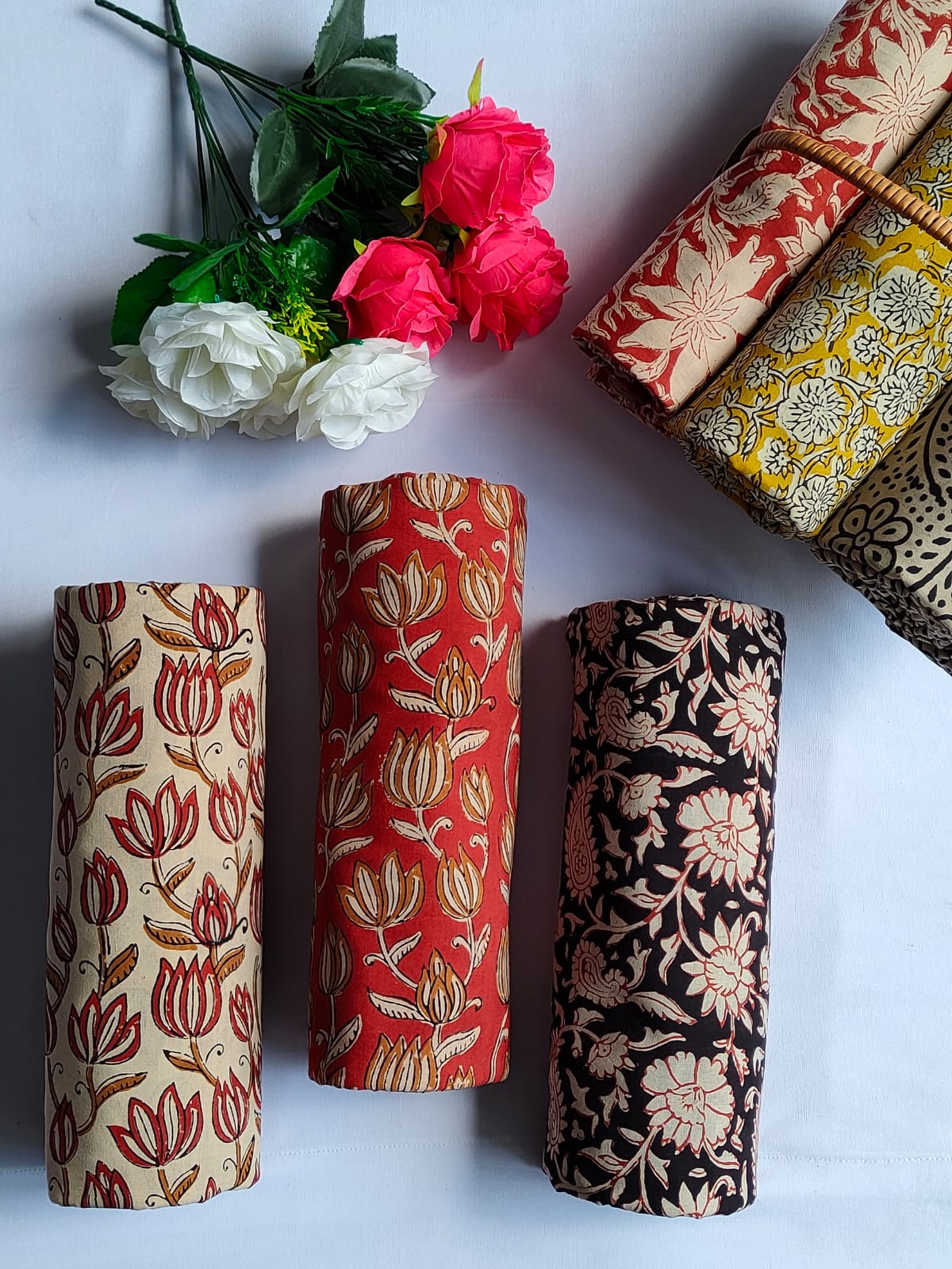


Handblock printing is one of India's most recognisable textile traditions. It transforms plain fabric into patterned cloth through the careful use of carved wooden blocks, printing colours, and skilled hand movements. Every impression is placed by an artisan, and a complex design may require several blocks, multiple colours, and a series of finishing stages.
The craft has deep roots in India's textile history, but it is not limited to the past. Today, handblock-printed fabrics appear in everyday clothing, scarves, dresses, kurtas, tote bags, cushion covers, bed linens, and contemporary fashion collections. Their appeal comes from the combination of visual beauty, practical use, and the human skill involved in making them.
Different regions have developed their own printing traditions. Rajasthan is particularly known for Bagru and Sanganeri prints, while Gujarat's Kutch region is associated with Ajrakh, a complex resist-printing tradition recognised for its geometric designs and deep indigo colours. Each craft reflects a distinct history, local design vocabulary, and body of technical knowledge.
For anyone interested in textiles, understanding handblock printing means looking beyond the finished pattern. It means learning how the blocks are carved, how the fabric is prepared, how colour is applied, and how artisans preserve their skills while adapting to changing markets.
At Jaipur Bazar, India's textile heritage inspires a selection of printed cotton fabrics for clothing, sewing, and creative projects. The Hand Block Print Cotton Fabrics collection is a useful starting point for discovering India-inspired designs and finding printed cotton for your next project.
In this guide, we explore what handblock printing is, how it developed, how the process works, what distinguishes India's regional printing traditions, and how this craft continues to find a place in modern life.
1. What Is Handblock Printing?
Handblock printing is a method of decorating fabric by pressing a carved block onto its surface to transfer a design. Traditionally, the blocks are made from wood, although the tools and materials used can vary.
The artisan applies printing colour or a resist paste to the block, positions it on the fabric, and presses it down to create an impression. Repeating this action produces a pattern across the cloth.
Simple designs may use one block and one colour. More elaborate patterns can require several blocks, with each block responsible for a particular colour, outline, or decorative detail.
For example, a floral motif might use one block to print the outline of a flower, another to fill its petals, and a third to add leaves. The printer must position each impression accurately so the separate elements form a complete design.
This is what makes handblock printing different from many other textile-printing methods. The design is built through repeated physical impressions rather than being transferred through a digital file, screen, or roller.
What makes handblock printing special?
The technique combines artistic design with practical skill. The artisan needs to understand the block, the printing material, the fabric surface, and the amount of pressure required to create a clear impression.
Small variations may occur because each impression is made by hand. However, handmade does not automatically mean irregular or imperfect. Experienced printers work carefully to achieve consistent patterns and colour application.
Handblock printing also preserves knowledge that extends beyond the printing table. Block carvers, printers, dyers, washers, and finishers may all contribute to a finished textile.
These skills are part of India's wider textile heritage, with distinct regional traditions documented by the Government of India's handicrafts resources. Read the official overview of handblock printing.
2. A Brief History of Handblock Printing in India
India has a long history of producing and trading decorated textiles. Printed cotton was valued for its patterns, colours, and versatility, and Indian textiles became important in regional and international trade.
The history of handblock printing is not a single, simple timeline. Textile traditions developed across different places and periods, influenced by local communities, trade routes, royal patronage, available materials, and changing tastes.
The Indira Gandhi National Centre for the Arts' mapping of Indian textiles identifies block-printed textiles as a longstanding part of India's textile heritage and documents regional traditions such as Bagru, Sanganer, and Ajrakh. Explore the Indian textile mapping report.
Early textile traditions and trade
Indian textile production developed through a combination of weaving, dyeing, printing, embroidery, and other decorative techniques.
Printed fabrics travelled between communities and markets, carrying designs and production knowledge with them. As textiles moved across regions, artisans adapted motifs and methods to local preferences and materials.
The history of printed cloth is therefore closely connected to trade, migration, and cultural exchange.
Royal patronage and regional craft centres
Royal courts and wealthy patrons played a role in supporting many Indian textile traditions. Demand for decorated clothing and furnishings encouraged artisans to refine designs and develop specialised production skills.
Over time, places such as Bagru and Sanganer in Rajasthan became recognised for distinctive printing styles. In Gujarat, Ajrakh developed into a highly specialised tradition combining geometric designs with resist-printing and dyeing techniques.
These regional identities emerged through the work of artisan communities rather than through a single uniform national style.
From traditional workshops to contemporary markets
Handblock printing continues today, but the markets and products have changed.
Traditional motifs are now used in contemporary clothing, home textiles, accessories, and creative projects. Some workshops continue to use established dyeing and printing methods, while others incorporate modern dyes, new colour palettes, or different production processes.
This evolution allows the craft to reach new customers. It also makes accurate product descriptions important, especially when a contemporary design is inspired by a traditional print but is not produced using the original technique.
3. How Does Handblock Printing Work?
The exact process depends on the regional tradition, fabric, colour system, and printing method. Nevertheless, several stages are common to many forms of handblock printing.
Step 1: Preparing the fabric
Before printing, the cloth needs to be suitable for the chosen colour system.
Cotton fabric may be washed or treated to remove starch, oils, or other substances that could interfere with colour application. Depending on the process, preparation may include scouring, bleaching, or other treatments.
Proper preparation helps the printing material interact with the fabric as intended. The details vary between workshops and printing traditions.
Cotton is commonly used because it is versatile and available in many weights and constructions. If you want to understand the material itself, read Jaipur Bazar's guide to how cotton fabric is produced and processed.
Step 2: Designing the pattern
The design must be planned before the blocks are carved.
Traditional motifs may include flowers, leaves, vines, birds, paisley forms, geometric shapes, borders, and repeating patterns. The designer must consider how the motif will look on its own and how it will repeat across a length of fabric.
A small flower can create a delicate all-over print. A larger motif may become the focal point of a garment or furnishing. Borders and connected patterns need additional planning so that their elements align.
The design may be based on an established regional style or adapted for a contemporary product.
Step 3: Carving the wooden blocks
The design is transferred onto a suitable piece of wood, and the block maker carves the surface to create the printing pattern.
The carved areas transfer colour to the fabric, while the recessed areas generally remain unprinted in a direct-printing process.
Fine details require careful carving. The block must also be comfortable to hold and durable enough for repeated use.
Some patterns require a set of blocks rather than a single one. Separate blocks may be needed for outlines, fills, borders, and different colours.
Block carving is a skilled craft in its own right. The quality and design of the block influence the clarity of the printed motif.
Step 4: Preparing the colours
The printing materials may include natural dyes, synthetic dyes, pigments, and printing pastes, depending on the technique.
Traditional dye systems may use ingredients such as indigo, madder, or iron-based preparations. Other workshops use modern colour systems to achieve particular shades or production requirements.
Colour preparation is important because the printing material must work with the fabric and the intended process.
One point worth remembering is that handblock printed describes how a design is applied. It does not automatically mean the fabric uses natural dyes.
Step 5: Printing the design
The artisan applies colour or printing paste to the carved block and presses it onto the fabric.
The block must be positioned carefully. The printer controls the pressure and the amount of colour so the design appears clearly without spreading beyond the intended areas.
The process repeats across the fabric, impression by impression. For a long piece of cloth, this may require hundreds or thousands of placements.
Experience helps the printer maintain a steady rhythm and recognise when the block needs more colour or a different amount of pressure.
Step 6: Adding other colours
A multicolour design may need several blocks and printing stages.
For example, an outline might be printed first, followed by separate blocks for the flower petals and leaves. Each part must align with the others.
This alignment is known as registration. It is particularly important when the design contains fine details or several colours.
Step 7: Drying, fixing, and washing
After printing, the fabric may need to dry before further treatment.
Depending on the printing method, colour may be fixed through washing, steaming, heating, or additional dyeing stages. Some traditional processes involve repeated printing and dyeing rather than a single printing stage.
The fabric is then washed and finished as required, removing excess printing material and preparing the textile for its intended use.
The exact sequence varies considerably between direct printing and resist printing.
4. Direct Printing vs. Resist Printing
Two broad approaches help explain the different appearances of Indian handblock-printed fabrics: direct printing and resist printing.
Direct printing
In direct printing, colour is applied to the fabric through the carved block. The design appears in the areas where the printing material is deposited.
This method can produce floral motifs, repeating patterns, borders, and multicolour designs.
Sanganeri printing is widely associated with fine floral motifs printed with wooden blocks.
Resist printing
In resist printing, selected parts of the fabric are protected from dye. An artisan applies a resist material to the cloth through a block, then dyes the fabric.
The protected areas resist the dye and retain a contrasting appearance. Depending on the process, several stages of resisting and dyeing can build up the final design.
Dabu printing in Rajasthan and Ajrakh in Gujarat are well-known examples of traditions that use resist techniques.
Why does the technique matter?
The process affects the appearance of the fabric.
Direct printing deposits colour onto the intended parts of the design. Resist printing creates patterns by controlling where the dye can and cannot penetrate.
Some resist-printing traditions require many stages and considerable technical knowledge. Their patterns emerge from the relationship between the blocks, the resist material, and the sequence of dyeing.
When shopping for fabric, it is useful to understand the difference between a handblock-printed textile, a resist-printed textile, and a machine-printed fabric that imitates a traditional design.
5. Bagru Printing: An Earthy Tradition from Rajasthan
Bagru, near Jaipur, is one of Rajasthan's established centres of handblock printing. The craft is closely associated with the Chhipa printing community and is known for earthy colour combinations, stylised motifs, and traditional resist-printing techniques.
The region's printing heritage developed through generations of practical knowledge about preparing cloth, carving blocks, applying colour, and washing printed textiles.
The Government of India's handicrafts documentation identifies Bagru as a regional printing tradition with its own materials, designs, and production practices. Read the official Bagru printing profile.
What makes Bagru prints distinctive?
Bagru designs are often associated with reds, blacks, indigo blues, browns, and earthy shades.
Flowers, leaves, vines, stylised geometric forms, and repeating motifs are common design elements. Some patterns use small motifs arranged closely together, while others feature larger designs and more open backgrounds.
The result can feel grounded and organic. The visual character often comes from the contrast between darker motifs and lighter areas of fabric.
Contemporary Bagru-inspired designs may use different colours and patterns, so these characteristics should be treated as common associations rather than strict rules.
Understanding Dabu printing
Dabu is a mud-resist printing technique associated with Bagru and other printing centres in Rajasthan.
The artisan applies a prepared resist paste to the fabric using a carved block. The resist protects selected areas from dyeing. After the cloth is dyed and the resist is removed, the protected areas appear as contrasting parts of the design.
The exact materials and stages can vary between workshops. Not every Bagru print is a Dabu print, because Bagru includes direct-printing techniques as well.
Bagru prints in modern life
Bagru-inspired textiles are used for kurtas, dresses, shirts, scarves, dupattas, skirts, cushion covers, bedspreads, and other products.
Their traditional motifs can be adapted to contemporary garments without losing their visual connection to Rajasthan's printing heritage.
For readers interested in these patterns, Jaipur Bazar's Bagru Print Cotton Fabrics collection offers a place to explore Bagru-inspired cotton prints.
Check individual product listings for the actual printing method, fibre composition, and current availability.
6. Sanganeri Printing: Delicate Florals from Rajasthan
Sanganer, near Jaipur, is another major centre of Rajasthan's textile-printing heritage. Sanganeri printing is known for fine floral motifs, detailed patterns, and designs often printed on white or light-coloured fabric.
The craft has developed a distinctive visual language through flowers, leaves, vines, and other nature-inspired motifs.
The Government of India's handicrafts resources describe Sanganeri printing as a tradition associated with small floral patterns, butis, butas, paisleys, and other decorative forms. Explore the official Sanganeri printing profile.
The signature look of Sanganeri prints
Sanganeri prints often feature delicate flowers and foliage arranged in repeating patterns.
A buti generally refers to a small motif, while a buta can describe a larger decorative motif. Vines and connected floral arrangements create flowing patterns across the fabric.
White and off-white backgrounds are strongly associated with the tradition, although contemporary designs may use a wider range of colours.
The fine detail makes Sanganeri prints suitable for garments and home textiles where a patterned surface is wanted without an overly bold appearance.
How Sanganeri printing works
The fabric is prepared for printing, and artisans use carved wooden blocks to apply the design.
Outlines and fills may require separate blocks. The printer must place each impression carefully so that the motifs remain consistent across the fabric.
After printing, the textile goes through the appropriate drying, colour-fixing, washing, and finishing stages.
Sanganeri Hand Block Printing is documented as a recognised geographical textile tradition under India's Geographical Indication system. This recognition helps identify a product associated with a particular place and established craft identity. It does not, by itself, verify the origin of every product that resembles a Sanganeri design.
Sanganeri prints in contemporary clothing and interiors
Sanganeri-inspired prints can be found in dresses, kurtas, shirts, scarves, dupattas, bed linens, curtains, and cushion covers.
Small repeating motifs can work well for all-over garment designs. Larger motifs may suit a statement panel, while delicate florals can add detail to accessories and home décor.
Explore Jaipur Bazar's Hand Block Print Cotton Fabrics collection for cotton prints inspired by Indian block-printing traditions.
7. Ajrakh Printing: Gujarat's Geometric Resist Tradition
Ajrakh is a distinctive printing tradition associated with Kutch in Gujarat and with the wider historical region that includes Sindh.
It is known for intricate geometric patterns, symmetrical arrangements, and colours that often include deep indigo, red, black, and pale unprinted areas.
Unlike a simple direct-print design, traditional Ajrakh can involve a complex sequence of fabric preparation, resist printing, dyeing, and washing.
The Government of India's handicrafts documentation describes Kutch Ajrakh as a multi-stage tradition using carved wooden blocks, resist materials, and dyes that include indigo and red-producing ingredients. Read the official Kutch Ajrakh profile.
What makes Ajrakh distinctive?
Ajrakh designs often use geometric symmetry, stars, flowers, dots, grids, borders, and repeating shapes.
The patterns can be dense and intricate, with each element contributing to a carefully balanced composition.
Indigo is particularly important to many Ajrakh textiles. It is often paired with red and black to create strong contrasts and detailed patterns.
How Ajrakh resist printing works
The artisan applies resist materials to selected areas of the fabric, protecting them during dyeing. Additional printing and resist stages can then be used to create further colours and details.
The sequence matters because each stage affects the next. The artisan must understand how the resist, dyes, and fabric interact to produce the intended design.
Traditional Ajrakh production can involve many stages and require considerable experience. Contemporary products may adapt the visual style or use different materials, so the actual process should be confirmed when authenticity is important.
Ajrakh in modern fashion and home décor
Ajrakh patterns are used for shirts, kurtas, scarves, stoles, dupattas, jackets, bags, cushion covers, and other products.
The geometric structure can work particularly well in simple garment shapes, where the fabric becomes the main visual feature.
For sewing, think about the scale of the motif and how it will appear across the finished item. A large pattern may require extra fabric to show the design properly, while smaller pieces may display only part of a motif.
You can browse Jaipur Bazar's Printed Cotton Fabrics collection for India-inspired printed cotton options. Check individual listings for the actual print style and production details rather than assuming every geometric print is Ajrakh.
8. Bagru, Sanganer, and Ajrakh: What Is the Difference?
These traditions demonstrate how handblock printing can produce different visual styles and finished textiles.
| Feature | Bagru | Sanganer | Ajrakh |
|---|---|---|---|
| Regional association | Bagru, Rajasthan | Sanganer, Rajasthan | Kutch, Gujarat, with historical links to Sindh |
| Common visual style | Earthy colours and stylised motifs | Fine floral patterns and delicate repeating designs | Geometric symmetry and layered patterns |
| Commonly associated colours | Red, black, indigo, brown, earthy tones | Often light backgrounds with floral colours | Indigo, red, black, pale unprinted areas |
| Associated methods | Direct printing and Dabu resist printing | Fine handblock printing and colour layering | Multi-stage resist printing and dyeing |
| Contemporary uses | Clothing, accessories, home textiles | Clothing, bedding, curtains, accessories | Clothing, scarves, stoles, accessories, home décor |
These are broad descriptions rather than strict rules. Individual workshops may use different colours, designs, and materials.
The appearance of a fabric alone cannot establish where it was made or whether it was produced using a traditional process. Clear information about the maker, origin, and printing method is more useful when verifying a regional textile.
9. The Role of Wooden Blocks in Handblock Printing
Wooden blocks are at the centre of traditional handblock printing. Their design and construction influence how clearly a motif appears and how easily the artisan can repeat it.
Selecting suitable wood
Traditional blocks are made from wood that can hold carved details and withstand repeated handling. The choice of wood depends on the production tradition and the requirements of the design.
The wood must be prepared so that the block can be carved accurately and used repeatedly.
Carving the motif
The block maker transfers the design to the wood and carves the surface to create the printing pattern.
Fine lines, small flowers, and complex geometric forms require precision. A design that uses several colours may need multiple blocks that fit together.
Maintaining the blocks
Blocks need to be cleaned and stored appropriately so that printing residue does not interfere with later impressions.
A damaged block can affect the clarity of the pattern. Depending on its condition, it may need repairs or replacement.
The block maker's work is therefore an important part of the craft. Preserving handblock printing also means maintaining the knowledge required to create and care for the tools.
10. What Materials and Dyes Are Used?
The materials used in handblock printing vary by region, technique, and workshop. The final appearance of the fabric depends on the interaction between the printing material, the fabric, and the finishing process.
Natural dyes
Traditional dye systems may use ingredients such as indigo, madder, and other plant-based or mineral-related materials.
These methods require knowledge of preparation, application, and colour development. Results can vary according to the materials and process.
However, not all handblock-printed textiles are naturally dyed. Some workshops use synthetic dyes or combine traditional printing techniques with modern colour systems.
Synthetic dyes and pigments
Modern colour systems allow artisans to produce a wide range of shades and can be used in hand printing as well as machine printing.
The use of synthetic dyes does not automatically mean that a fabric was machine printed. The printing method and the colour materials are separate aspects of production.
Resist materials and mordants
Resist materials protect selected parts of the fabric from dye. Mordants may be used in certain dyeing processes to help particular dyes bond with the textile.
Ajrakh and Dabu illustrate how these materials can be used in complex printing sequences.
If you specifically want naturally dyed fabric, ask the seller which dyes and materials were used. Do not rely only on the appearance of the colours or the word traditional.
11. How Handblock Printing Is Preserved Today
Traditional printing survives when artisans can continue practising their craft, pass on their skills, and earn a living from their work.
Preservation therefore involves more than keeping historic patterns in circulation. It also means supporting the communities, workshops, and production networks behind the textiles.
Passing skills to younger generations
Many aspects of handblock printing are learned through experience.
A skilled printer understands how much colour to apply, how to position the block, and how to respond when an impression does not come out as expected. Dyers learn how materials behave, while block makers develop specialised carving skills.
These abilities are difficult to learn from written instructions alone. Training, practice, and opportunities to work alongside experienced artisans help keep the knowledge alive.
Supporting artisan livelihoods
A printed textile may involve block carvers, printers, dyers, washers, finishers, and other workers.
Supporting the craft means recognising this wider network of skills. Reliable demand and fair commercial relationships can help workshops retain experienced workers and continue production.
Buyers can contribute by seeking transparent product descriptions, understanding the work involved, and supporting businesses that represent the origin and method of production accurately.
Protecting regional craft identities
Geographical Indication recognition can help identify products whose reputation or characteristics are connected with a particular place.
Bagru and Sanganeri printing are documented regional textile traditions, while Ajrakh has a distinct identity associated with Kutch and the wider Sindh region.
Recognition can help preserve the identity of these crafts, but it should not be treated as proof that every product resembling a regional design was made in the corresponding location.
Adapting traditional designs for contemporary products
Traditional motifs continue to inspire new garments, accessories, and home textiles.
A floral pattern can be used for a modern shirt, while a geometric print may become a cushion cover or bag. Designers may also adapt colours, motif sizes, and garment shapes.
This evolution can help traditional crafts reach new customers. The important point is to distinguish a textile made using a traditional technique from one that is merely inspired by its visual style.
Digital commerce and textile education
Online stores and educational content help customers discover regional textiles beyond the places where they are produced.
Good product photographs and clear descriptions help buyers compare fabric types, dimensions, and colours. Educational articles can explain the differences between Bagru, Sanganer, and Ajrakh, giving customers a better understanding of what they are buying.
For Jaipur Bazar, connecting information about Indian textile heritage with an India-inspired printed cotton collection gives customers a way to explore the fabrics while learning about the traditions behind them.
12. How to Choose Handblock-Printed Fabric Online
If you are buying printed fabric for sewing, clothing, or home décor, the pattern is only one part of the decision. The material must also suit the intended use.
Check the fibre composition
Read the product description to confirm whether the fabric is cotton, a cotton blend, or another material.
If you specifically want pure cotton, look for an explicit fibre-composition statement. Terms such as cotton feel or cotton-like do not necessarily mean that the fabric is 100% cotton.
Consider the fabric construction
The underlying fabric affects how a printed textile drapes, gathers, and behaves during sewing.
Lightweight cotton may suit relaxed garments, while a more closely constructed cotton may work better for projects requiring a stable surface.
You can compare mulmul cotton fabrics, cotton cambric fabrics, and plain cotton fabrics to explore different cotton options. Check individual product listings to determine whether the desired print is available.
Examine the print carefully
Look at close-up images to assess the motif size, colour combination, and pattern placement.
Photographs can help you decide whether a design suits your project, but they cannot conclusively establish whether a fabric was handprinted. If the production method matters to you, ask the seller for details.
Confirm the quantity and dimensions
Fabric may be sold by the metre, yard, cut length, or piece. Check the unit of sale and make sure enough material is available for the project.
If you need to match patterns across sleeves, collars, or multiple items, allow extra fabric for placement and cutting.
Review dye and care information
If natural dyes are important to you, confirm which dyes were used. Review the washing and ironing instructions before ordering.
Where samples are available, a small piece can help you assess the fabric's texture, colour, and construction.
For additional guidance, read Jaipur Bazar's article on how to identify high-quality cotton fabric.
13. Caring for Handblock-Printed Fabric
Care requirements vary according to the fabric construction, dye system, and finishing process.
Follow the product instructions
Check the seller's care guidance before washing. Some fabrics may require gentler handling than others.
If the care information is unclear, ask the seller for recommendations.
Test a small piece where possible
A small test can help you observe whether colour transfers or changes during washing. It cannot guarantee how the fabric will behave after repeated washes, but it can reduce the risk of damaging a larger piece.
Separate colours where appropriate
When washing is permitted, separating strongly coloured textiles from lighter materials can help reduce unwanted colour transfer.
Use a suitable detergent and avoid aggressive treatment unless the product instructions allow it.
Dry and iron carefully
Follow the recommended drying and ironing method. Excessive heat or unsuitable handling may affect some dyes, finishes, or lightweight fabric constructions.
For broader cotton-care advice, visit the best ways to care for and wash woven cotton fabrics.
14. Discover India-Inspired Block Print Fabrics at Jaipur Bazar
India's handblock-printing traditions demonstrate how regional history, artistic design, and skilled handwork come together in textiles.
Bagru is associated with earthy colours and resist-printing techniques. Sanganer is recognised for detailed floral patterns. Ajrakh showcases complex geometry and layered dyeing processes.
These traditions continue to inspire clothing, accessories, sewing projects, and home décor. Understanding their differences helps buyers appreciate the techniques behind the patterns and choose fabrics that suit their needs.
Jaipur Bazar's India-inspired printed cotton selection is a useful starting point for people looking for fabric for clothing, sewing, and creative projects.
Explore these collections:
-
Hand Block Print Cotton Fabrics: Explore printed cotton designs inspired by India's block-printing heritage.
-
Bagru Print Cotton Fabrics: Discover designs associated with Bagru's earthy visual style.
-
Dabu Cotton Fabrics: Browse cotton prints associated with Dabu resist printing.
-
Printed Cotton Fabrics: Compare printed cotton options for clothing, accessories, and creative work.
-
All Cotton Fabrics: Browse the wider selection of cotton fabric options.
Check individual product listings for current availability, fibre composition, construction, and printing details. A traditional-looking design does not automatically establish that a fabric was produced using a particular regional technique.
Frequently Asked Questions
What is handblock printing?
Handblock printing is a textile-printing technique in which artisans use carved blocks to transfer designs onto fabric. The process may involve several blocks and colours, followed by drying, dyeing, washing, and finishing as required.
How old is handblock printing in India?
India has a long history of printed textiles, with evidence of historic block-printing traditions and regional craft practices. The exact origins of the technique are complex, and it is more accurate to understand it as a tradition that developed across different places and periods rather than assign one simple starting date.
What is the difference between Bagru and Sanganeri printing?
Bagru is commonly associated with earthy colours and techniques such as Dabu resist printing. Sanganeri printing is often recognised for fine floral motifs and detailed repeating patterns, frequently on light-coloured backgrounds. Individual products can vary.
What is Ajrakh printing?
Ajrakh is a regional textile-printing tradition associated with Kutch in Gujarat and the wider Sindh region. It is known for intricate geometric patterns, indigo and red colours, and complex resist-printing and dyeing processes.
Are all handblock-printed fabrics made with natural dyes?
No. Some artisans use natural dyes, while others use synthetic dyes or modern colour systems. If natural dyes are important to you, confirm the materials used for the specific product.
Is handblock printing different from screen printing?
Yes. Handblock printing applies designs using carved blocks pressed onto the fabric by hand. Screen printing transfers colour through a screen. Both can be used to create patterned textiles, but the production processes differ.
What can be made from handblock-printed cotton?
Depending on its weight and construction, handblock-printed cotton can be used for dresses, kurtas, shirts, scarves, tote bags, pouches, cushion covers, table linens, and many other sewing and craft projects.
How can I tell if a fabric is genuinely handblock printed?
Ask about the maker, origin, and printing method. Close-up photographs can help you examine the pattern, but small irregularities alone do not prove that a fabric was printed by hand.
How are traditional printing techniques preserved today?
They are preserved through artisan training, continued workshop production, recognition of regional craft identities, transparent sourcing, and demand for traditionally produced textiles. Contemporary designers also help keep the craft relevant by adapting patterns for modern products while accurately describing the methods used.
Where can I explore India-inspired block print cotton fabrics online?
You can browse Jaipur Bazar's Hand Block Print Cotton Fabrics collection and its Printed Cotton Fabrics collection. Check the individual listings for the print style, fibre composition, and availability.
Conclusion: A Living Tradition Printed One Block at a Time
Handblock printing is a meeting point of history, design, material knowledge, and skilled handwork. The finished fabric may show a simple flower or an intricate geometric pattern, but behind it lies a process involving block carving, fabric preparation, colour application, and careful finishing.
The traditions of Bagru, Sanganer, and Ajrakh demonstrate how different communities have developed distinctive ways of working with cloth. Their motifs, colours, and techniques preserve regional identities while continuing to inspire contemporary fashion and home décor.
The craft remains alive because artisans continue to practise their skills, pass knowledge between generations, and adapt their work to changing markets. Supporting this heritage means recognising the people behind the textiles and understanding the difference between a traditionally produced print and a design that simply draws inspiration from one.
For anyone interested in exploring Indian textile patterns, handblock printing offers both creative possibilities and a connection to a wider cultural story.
Discover India-inspired designs through Jaipur Bazar's Hand Block Print Cotton Fabrics collection. Explore the available printed cotton options, review their specifications, and choose a fabric that brings your next sewing or creative project to life.
Related Blogs to Read:
| Hand Block Print Fabric for Sewing & Crafts |
| The Art of Handblock Printing: A Complete Guide |
| How Handblock Printing Works: Techniques & Traditions |
| What Is Handblock Printing? History, Process & More |