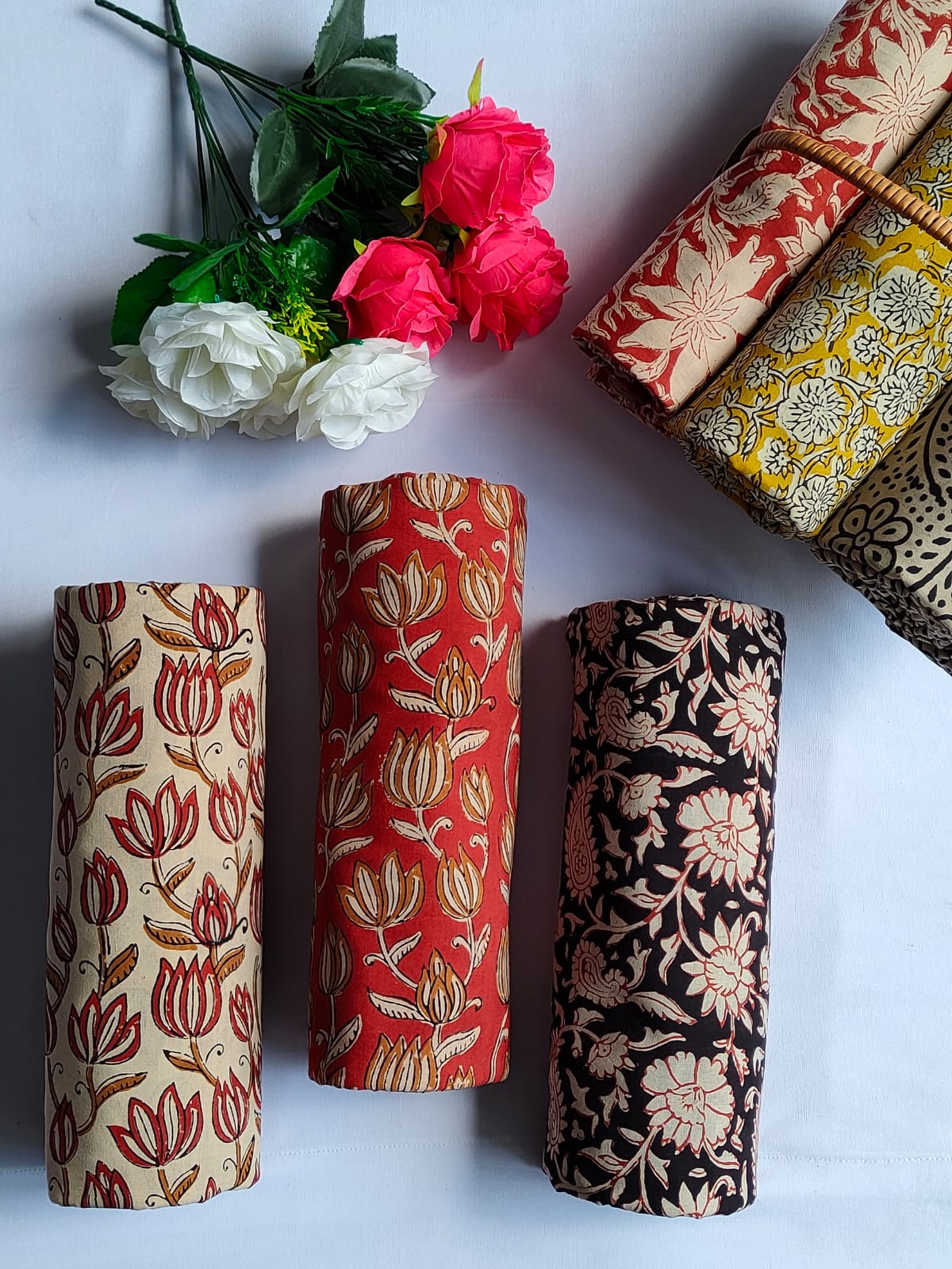


India's textile heritage is filled with colours, patterns, and techniques that have been passed down through generations. Among these traditions, handblock printing holds a special place. It brings together the skill of woodcarvers, the knowledge of dyers, the experience of printers, and the creativity of artisans who transform plain fabric into something distinctive.
From the earthy red and black prints of Bagru in Rajasthan to the delicate floral patterns of Sanganer and the intricate indigo geometry of Ajrakh in Gujarat, every regional printing tradition tells a different story. The designs reflect local landscapes, cultural influences, available materials, and the communities that have preserved these crafts over time.
Today, handblock-printed fabrics appear in contemporary clothing, scarves, dresses, cushion covers, curtains, table linens, and other everyday products. Designers and fabric enthusiasts appreciate them not only for their appearance but also for the human skill involved in making them.
At Jaipur Bazar, India's rich cotton-printing heritage provides inspiration for people exploring traditional prints for clothing, sewing, and creative projects. The brand's hand block print cotton fabric collection is a useful place to discover printed cotton fabrics inspired by India's textile traditions.
This complete guide explores how handblock printing works, what makes Bagru, Sanganeri, and Ajrakh distinctive, how the craft has evolved, and what buyers can do to support the artisans and traditions behind the fabric.
1. What Is Handblock Printing?
Handblock printing is a textile-printing technique in which artisans use carved blocks, usually made from wood, to transfer designs onto fabric. The carved surface of each block carries a particular part of the pattern. When coated with printing colour and pressed onto fabric, it leaves an impression of that design.
A simple print might use a single block and one colour. More elaborate patterns may require several blocks, with a separate block for outlines, background colours, and smaller details. The printer must align each impression carefully so that the finished design forms a continuous pattern.
Unlike machine printing, traditional handblock printing depends on the printer's hand movements, judgement, and experience. The artisan controls the pressure, placement, amount of colour, and rhythm of each impression.
Small variations can occur between impressions. These differences are often a natural result of the manual process rather than evidence of poor quality. However, careful handblock printing still requires precision, consistent colour application, and a good understanding of the fabric and printing materials.
Why is handblock printing important in Indian textile culture?
India has a long and diverse history of textile production, dyeing, weaving, embroidery, and printing. Handblock printing is one part of this wider heritage, with regional traditions that developed their own distinctive motifs and methods.
In Rajasthan, the printing centres of Bagru and Sanganer are particularly well known for their cotton textiles. Gujarat's Kutch region is associated with Ajrakh, a complex resist-printing tradition recognised for its rich indigo, red, black, and white patterns.
These crafts are more than decorative techniques. They preserve specialised knowledge about carving, colour preparation, printing, washing, and finishing. They also support interconnected groups of artisans, including block makers, printers, dyers, washers, and traders.
The Indian government's handicrafts resources document Bagru, Sanganeri, and Kutch Ajrakh as distinct textile traditions with their own histories and production methods. 【turn448863search11】【turn448863search5】【turn448863search2】
2. The Traditional Handblock Printing Process
Although the details differ from one region to another, handblock printing generally involves preparing the fabric, preparing the blocks, applying colour, and treating the cloth so that the print becomes stable.
Understanding the process helps explain why traditional printed fabric requires both time and skill.
Step 1: Preparing the fabric
Before printing begins, the fabric must be prepared to receive the colour. Cotton cloth may contain starch, natural impurities, or finishing agents that affect how printing pastes and dyes behave.
Depending on the technique, the fabric may be washed, scoured, bleached, or otherwise treated. The exact preparation varies according to the fibre, dye system, and regional method.
Good preparation helps the colour apply more evenly and allows the printer to work on a suitable surface.
Step 2: Carving the wooden blocks
The design begins with the block itself. A block maker transfers a pattern to a suitable piece of wood and carves the areas that will produce the desired impression.
The block may contain flowers, leaves, vines, geometric forms, paisleys, borders, or more elaborate motifs. Fine details require careful carving because the finished fabric reproduces the shapes created in the wood.
Complex designs often use a set of blocks rather than one. Different blocks may be needed for the outline and separate colours.
The skill of the block maker is essential. A well-carved block helps the printer achieve a clear impression and repeat the pattern across a length of fabric.
Step 3: Preparing the colours and printing materials
The colour used in handblock printing may come from natural dyes, synthetic dyes, pigments, or combinations of materials, depending on the craft tradition and the specific product.
Traditional natural-dye processes can involve ingredients such as indigo, madder, iron-based preparations, plant extracts, and mineral materials. Different ingredients and preparation methods produce different colours and effects.
It is important not to assume that every fabric described as handblock printed uses natural dyes. Many contemporary artisans use synthetic colours, and some products combine traditional printing techniques with modern materials.
Buyers who prefer natural dyes should look for clear information about the dyes used rather than relying only on words such as traditional, artisan-made, or eco-friendly.
Step 4: Printing the design by hand
The artisan applies colour or printing paste to the carved surface of the block and presses it onto the fabric.
Each impression must be placed carefully beside the previous one. The printer learns to recognise the correct pressure, angle, and amount of colour through experience.
A long piece of fabric may require hundreds or thousands of impressions, depending on the pattern, fabric length, and design density.
When the design uses several colours, the printer repeats the process with the appropriate blocks. This makes registration, or the alignment of the different parts of the pattern, especially important.
Step 5: Drying and fixing the colour
After printing, the fabric may need to dry before the next stage. Depending on the process, colour fixing may involve steaming, washing, heating, or other treatments.
Natural-dye and resist-printing techniques can involve several additional stages. Ajrakh, for example, uses repeated printing, resisting, dyeing, and washing to create its characteristic layered patterns.
The correct treatment depends on the materials used. There is no single finishing process that applies to every handblock-printed fabric.
Step 6: Washing, drying, and finishing
The printed fabric may be washed to remove excess colour or printing paste. It is then dried and finished according to the requirements of the product.
In traditional printing centres, washing and drying are important parts of the wider production process. They also illustrate why textile printing depends on more than the person who stamps the block.
The completed fabric can then be inspected, measured, cut, or prepared for sale.
For a broader understanding of cotton processing, read Jaipur Bazar's guide to how cotton fabric is produced and processed.
3. Bagru Block Printing: Rajasthan's Earthy Textile Tradition
Bagru, a town near Jaipur in Rajasthan, is one of India's best-known centres for traditional handblock printing. The craft is closely associated with the Chhipa printing community and is recognised for its distinctive combination of earthy colours, stylised motifs, and resist-printing techniques.
The local environment, including the area's clay-rich soil and water resources, has historically supported the preparation and washing of printed textiles. Bagru developed its own visual identity through the colours, designs, and techniques used by its printing families. 【turn448863search11】【turn448863search33】
What makes Bagru prints distinctive?
Bagru prints are often recognised by their deep reds, black or iron-based tones, indigo blues, and muted earthy shades. Designs may feature flowers, leaves, vines, stylised geometric elements, and repeating patterns.
The overall appearance can feel grounded and organic. Rather than relying only on bright contrasts, many Bagru designs use combinations of dark and light areas that create a balanced, textured surface.
These features make Bagru cotton suitable for a range of clothing and home-textile projects, although the precise appearance depends on the particular design and dye process.
Understanding the Dabu mud-resist technique
One of the techniques associated with Bagru is Dabu, a form of mud-resist printing.
In resist printing, selected parts of the fabric are protected from dye so that they retain a different colour from the areas that are dyed. In Dabu printing, artisans apply a resist paste to the fabric using carved blocks.
The resist paste typically contains materials selected to create the required barrier. After application, the cloth is treated with a resist material such as sawdust or another suitable substance in some processes, then dyed. The protected areas resist the dye and create the pattern.
The exact ingredients and sequence vary among workshops and products. Dabu should therefore be understood as a family of resist-printing practices rather than one universally identical recipe.
The technique allows artisans to produce striking contrasts and layered effects. Indigo and earthy backgrounds can make the lighter resisted motifs stand out, creating the distinctive appearance associated with many Dabu textiles.
The people behind Bagru printing
Bagru's craft tradition depends on a network of skilled people. Block makers create and maintain the tools. Printers apply the designs. Dyers and washers handle later stages of the process, while other workers prepare, inspect, and distribute the fabric.
The experience required to produce consistent prints is often developed over years. Artisans learn how a block behaves, how much colour it should carry, and how to adjust their technique for different designs and fabrics.
Preserving Bagru printing therefore means supporting the people who hold this practical knowledge, not simply reproducing the visual appearance of a traditional pattern.
How Bagru prints are used today
Bagru-inspired textiles can be found in contemporary garments, including kurtas, dresses, tunics, shirts, scarves, and dupattas. They are also used for cushion covers, table linens, curtains, quilts, and other decorative products.
Designers may use traditional motifs in familiar colour combinations or adapt them for modern silhouettes and colour palettes. Some products preserve traditional techniques closely, while others combine handblock printing with contemporary design choices.
If you are interested in this style, explore Jaipur Bazar's Bagru print cotton fabric collection.
This collection link is a practical starting point for readers seeking Bagru-inspired cotton prints for sewing and creative projects. Check individual product descriptions for the actual printing technique, fibre composition, and dye information.
4. Sanganeri Printing: Delicate Florals from Rajasthan
Sanganer, located near Jaipur, is another major centre of Rajasthan's handblock-printing heritage. Sanganeri printing is widely associated with delicate floral patterns, fine detailing, and designs that often appear on white or light-coloured fabric.
The Indian government's handicrafts documentation describes Sanganeri textiles as a tradition known for small floral motifs, including flowers, leaves, vines, and paisley-inspired forms. The craft developed into a major centre for printed fabrics used in garments and home textiles. 【turn448863search5】【turn448863search7】
The signature appearance of Sanganeri prints
Sanganeri designs often feature small repeating flowers, leafy stems, flowering vines, and elaborate arrangements of natural motifs.
A small motif repeated across the cloth is commonly called a buti. Larger floral or decorative forms may be described as buta, while interconnected patterns can create the effect of a vine or trellis.
The designs often look delicate from a distance but reveal considerable detail when examined closely.
White and off-white backgrounds are strongly associated with the tradition, although contemporary Sanganeri-inspired textiles can use a broader range of background colours.
How Sanganeri printing differs from Bagru
Bagru and Sanganeri are both associated with Rajasthan, but they have different visual identities.
Sanganeri printing is commonly recognised for fine floral detailing and lighter grounds. Bagru often features earthier colour combinations and is particularly associated with resist-printing traditions such as Dabu.
These are broad descriptions rather than rigid rules. Both craft traditions have evolved, and contemporary products can vary considerably in colour and design.
The most useful way to distinguish them is to look at the overall pattern language, printing method, place of production, and product information rather than judging a fabric by colour alone.
The importance of precision
Fine floral printing demands careful block carving and accurate placement. A pattern may consist of several elements that must align to create a coherent design.
The printer needs to apply enough colour to make the impression clear without allowing excess paste to blur the details. Repeated impressions must also maintain the intended spacing.
This combination of rhythm and precision is one reason traditional Sanganeri printing remains valued by people who appreciate detailed textile design.
Sanganeri printing in modern clothing and interiors
Sanganeri-style cotton prints are used for dresses, kurtas, shirts, scarves, dupattas, bed linens, cushion covers, and other products.
Their floral patterns can suit both traditional clothing and contemporary designs. Small repeating motifs work particularly well for garments that need an all-over pattern without a single large central image.
For home décor, the same design language can be used in bedding, table linens, curtains, and cushions. The finished appearance depends on the scale of the motif, the fabric weight, and the colours selected.
Explore Jaipur Bazar's hand block print cotton fabric collection for printed cotton options inspired by India's hand-printing traditions.
For a broader selection of patterns, you can also browse printed cotton fabrics.
Recognition and preservation
Sanganeri Hand Block Printing has been recognised through India's Geographical Indication system. The Indian government's handicrafts documentation lists the craft as a GI textile tradition, reflecting its connection with a particular place and body of craft knowledge. 【turn448863search5】【turn448863search34】
A Geographical Indication, or GI, helps identify a product whose reputation or characteristics are linked to a particular geographical origin. It can help distinguish a recognised regional craft from products that merely imitate its appearance.
However, a place name or GI reference should not replace careful product verification. Buyers should still seek accurate information about where a fabric was made, how it was printed, and what materials it contains.
5. Ajrakh Printing: Gujarat's World of Indigo and Geometry
Ajrakh is one of India's most distinctive resist-printing traditions. In Gujarat, it is strongly associated with Kutch and the work of artisan communities, including Khatri printers.
Ajrakh has historical connections with Sindh and the wider region that includes present-day Pakistan and western India. Over generations, the craft developed in Kutch, where artisans refined its complex combinations of printing, resist techniques, and dyeing.
The Government of India's handicrafts documentation describes Kutch Ajrakh as a textile tradition using cotton, wooden blocks, resist materials, and dyes that include indigo and red-producing ingredients. 【turn448863search2】
Why is Ajrakh so distinctive?
Ajrakh is recognised for its deep indigo blues, reds, blacks, and pale unprinted areas. Its patterns often use repeated geometric arrangements, stars, grids, borders, medallion-like forms, and symmetrical compositions.
The result is a textile that feels carefully structured. Lines, dots, flowers, and geometric shapes work together to form an intricate overall design.
Indigo is particularly important to the visual identity of many Ajrakh textiles. The name is often connected with the word azrak, associated with the colour blue, although the complete history of the term and tradition is complex.
Ajrakh designs are not simply decorative patterns stamped onto fabric. Their appearance emerges from the order in which printing, resisting, dyeing, and washing are carried out.
Understanding resist printing in Ajrakh
Resist printing is central to many Ajrakh processes. Rather than adding colour everywhere, artisans use resist materials to protect selected parts of the fabric during dyeing.
The process can involve several rounds of printing and dyeing. Different areas of the design are protected or exposed at different stages, allowing multiple colours and intricate patterns to develop.
Traditional recipes may use materials such as natural gums, clay-based pastes, and plant-derived ingredients, alongside dyes and other substances needed for the desired result.
Indigo dyeing adds another layer of complexity because the fabric must be treated in a way that allows the dye to develop its characteristic blue colour.
The exact process differs between workshops and contemporary production methods. It is best to understand Ajrakh as a highly skilled tradition with multiple stages, not as a single stamping operation.
Why is Ajrakh printing so labour-intensive?
An intricate Ajrakh pattern may require several blocks, repeated impressions, and multiple dyeing stages. Each stage must be carried out in the correct sequence to achieve the intended result.
A mistake in the placement of a block or the application of a resist paste can affect later stages of the pattern. The printer and dyer must understand how the materials will interact as the cloth moves through the process.
This makes Ajrakh a strong example of how traditional textile printing combines artistic judgement with practical knowledge of materials and chemistry.
Ajrakh's place in regional identity
Ajrakh has been associated with the clothing and cultural identity of communities in the wider Kutch and Sindh region. Its use has evolved over time, and contemporary products reach audiences far beyond their original settings.
Today, Ajrakh-inspired and artisan-printed textiles appear in garments, scarves, stoles, dupattas, shirts, jackets, accessories, and home décor.
Designers may retain traditional geometric arrangements or reinterpret them for contemporary fashion. Even when the final product changes, the underlying craft can continue to provide the design's visual foundation.
For readers exploring India's broader printing heritage, Jaipur Bazar's hand block print cotton fabrics and printed cotton fabrics are relevant starting points. These collections should not be treated as proof that every product is Ajrakh; check the individual listing for the specific print style and production details.
6. Bagru, Sanganer, and Ajrakh: Understanding the Differences
The three traditions share a connection with hand-printing, but each has a distinctive regional character.
| Feature | Bagru | Sanganer | Ajrakh |
|---|---|---|---|
| Main regional association | Bagru, Rajasthan | Sanganer, near Jaipur, Rajasthan | Kutch, Gujarat, with historical connections to Sindh |
| Recognisable visual style | Earthy colours, stylised motifs, resist-print effects | Fine florals, butis, vines, delicate repeating designs | Geometric patterns, layered designs, deep indigo and red |
| Commonly associated techniques | Wooden-block printing and Dabu mud-resist printing | Fine handblock printing with detailed motif placement | Complex resist printing with multiple printing and dyeing stages |
| Common visual colours | Red, black, indigo, earthy tones | White or light grounds with varied floral colours | Indigo, red, black, and pale unprinted areas |
| Contemporary uses | Clothing, accessories, home textiles | Clothing, bedding, curtains, accessories | Clothing, scarves, stoles, accessories, home décor |
These are general characteristics, not strict definitions. Colour palettes, motifs, and production methods can vary between individual artisans and contemporary products.
The most reliable way to identify an authentic regional textile is to consider its origin, the technique used, the maker's information, and the construction of the finished fabric. A design that resembles Bagru or Ajrakh does not automatically mean it was produced in that tradition's place of origin.
7. Other Regional Traditions in Indian Block Printing
India's printing heritage extends well beyond Bagru, Sanganer, and Ajrakh. Different regions and artisan communities have developed their own techniques, colour combinations, and design vocabularies.
Kalamkari
Kalamkari is associated with textile traditions in parts of Andhra Pradesh and Telangana. The term is often used for work involving a pen-like instrument, while related traditions also include block-printed textiles.
Kalamkari designs may depict flowers, vines, mythological figures, narrative scenes, and other elaborate compositions. Depending on the style, the process can involve drawing, printing, dyeing, and repeated treatments.
Although Kalamkari and handblock printing are not identical in every form, both demonstrate how Indian textile artisans use fabric as a surface for complex visual storytelling.
Bagh printing
Bagh printing is associated with Bagh in Madhya Pradesh. It is known for strong contrasts, geometric and floral patterns, and the use of traditional dyeing and printing knowledge.
The craft's identity is closely connected with its local production community and the materials and processes used to create its characteristic appearance.
Other regional print traditions
Across India, artisans continue to produce a wide range of printed textiles, including regional floral prints, resist-dyed fabrics, and combinations of printing with embroidery or other decorative techniques.
These traditions are not interchangeable. Each has its own history and local knowledge. Recognising those differences helps buyers and designers appreciate Indian printed fabric beyond the general category of "ethnic print."
8. The Cultural Meaning Behind Traditional Motifs
Traditional block-print designs often draw on the natural world, geometry, architecture, and familiar objects from everyday life. A motif may be inspired by a flower, leaf, bird, vine, paisley form, or repeated geometric pattern.
However, not every motif has one fixed meaning. Interpretations can vary by region, artisan family, historical period, and the context in which the fabric is used.
Flowers and leaves
Floral motifs are prominent in many Indian printing traditions. They may appear as small repeated butis, large decorative flowers, vines, or interconnected patterns.
The size and arrangement of the motifs affect the finished fabric. Tiny flowers can create a fine, delicate appearance, while larger blooms may become the main visual feature of a garment or furnishing.
Geometric designs
Geometric patterns are especially important in Ajrakh and other resist-printing traditions. Repeated shapes, borders, and symmetrical arrangements create visual rhythm.
The work requires planning because the final pattern depends on the relationship between individual blocks and the stages of dyeing.
Paisleys, vines, and borders
Paisley-like forms, curved vines, and decorative borders appear in many Indian textile traditions. They can be used to frame a garment, create a repeating surface, or add detail around the edge of a textile.
The same broad motif may look very different depending on the carving style, colour palette, and printing technique.
Why motifs continue to appeal today
Traditional motifs can be adapted to different fabrics, garment shapes, and colour combinations. A familiar floral print can look traditional on a kurta, contemporary on a loose shirt, or decorative on a cushion cover.
This flexibility helps traditional printing remain relevant without requiring every design to remain unchanged.
At the same time, respectful use of regional motifs involves understanding their origin and avoiding misleading claims about where or how a textile was made.
9. How Handblock Printing Is Preserved Today
Traditional crafts survive when the people who practise them can continue to work, teach, and earn a living from their knowledge.
Preserving handblock printing is therefore not simply about saving old designs. It also means sustaining the skills, materials, workshops, and communities that make the craft possible.
Passing skills from one generation to another
Much of the knowledge involved in handblock printing is practical. An experienced artisan learns how much pressure to apply, how to position a block, how to recognise suitable colour consistency, and how to correct small problems during production.
These skills can be difficult to learn from written instructions alone. They develop through observation, practice, and working alongside experienced printers and dyers.
When younger people have opportunities to learn and earn through the craft, there is a stronger reason for traditional knowledge to continue.
Supporting artisan livelihoods
The craft involves more than the printer who stamps the cloth. Block carvers, dyers, washers, fabric preparers, finishers, and other workers all contribute to the finished textile.
A healthy craft economy needs demand for this wider network of skills. Fair pricing and reliable orders can help workshops plan production and maintain their work.
Buyers can contribute by choosing products with transparent sourcing information and by understanding why a labour-intensive textile may cost more than a mass-produced imitation.
Geographical Indication recognition
Geographical Indication recognition can help protect the names and regional identities of established crafts.
Sanganeri Hand Block Printing and Bagru Hand Block Print are documented as recognised regional textile traditions in India's handicrafts resources. 【turn448863search34】【turn448863search11】
A GI is not a substitute for all quality checks, and it does not automatically mean every product bearing a regional name was made by hand. Buyers should look for accurate origin information and clear descriptions of the actual production method.
Design innovation
Preservation does not require every textile to look exactly as it did in the past. Artisans and designers can develop new colour palettes, scales, garment applications, and combinations while continuing to use traditional techniques.
For example, a familiar block-printed floral design might be used for a modern shirt, a contemporary dress, or a home accessory. Ajrakh's geometric patterns may inspire new garment shapes, while Bagru-style prints may be incorporated into modern everyday clothing.
The important distinction is between adapting a craft and misrepresenting a product. If a design is machine-printed or only inspired by a regional tradition, the product description should say so honestly.
Responsible material and dye choices
Some workshops continue to use natural dyes or traditional resist materials, while others use modern dyes and production methods.
Natural dyes can require substantial skill and careful handling, and their use does not automatically guarantee that every part of a product is environmentally preferable. Water use, wastewater treatment, energy, materials, and working conditions also matter.
Buyers should look for specific, verifiable information about dyes and production rather than assuming that all handblock-printed fabric is naturally dyed or environmentally harmless.
Reaching new customers through digital commerce
Online stores and digital catalogues help printed textiles reach customers who may never visit the regions where the fabrics are made.
Clear product photography, accurate descriptions, and educational content can help customers understand differences between regional styles. They can also make it easier to compare fabric composition, dimensions, colour, and intended use before ordering.
For businesses such as Jaipur Bazar, educational articles about Indian printed cotton can help readers discover the cultural background of the fabrics they are considering for their own projects.
10. How to Identify and Buy Handblock-Printed Fabric Online
Buying handblock-printed fabric online can be straightforward when you know which details to check.
Read the product description carefully
Look for information about fibre composition, width, available length, print style, colour, and care instructions.
If a product is described as Bagru, Sanganeri, or Ajrakh, check whether the seller explains its origin and printing technique. If the product is only inspired by a traditional design, that distinction should be clear.
Examine the pattern closely
Zoom in on the photographs to see the print details. Handblock printing may show small variations in alignment, colour application, and repeated impressions.
These characteristics can help you understand the printing process, but they are not conclusive proof of authenticity. Machine-made products can imitate some irregularities, and hand-printed products can be very precise.
Ask about dyes when they matter to you
If you prefer natural dyes or need specific colour information, ask the seller which dyes were used and whether the information applies to the entire fabric.
Avoid assuming that a product uses natural dyes merely because it has earthy colours or is described as traditional.
Check the fabric construction
The same print can look different on mulmul, cambric, or another cotton base. Fabric weight and construction affect drape, opacity, texture, and suitability for different projects.
For guidance on choosing suitable cotton, read how to identify high-quality cotton fabric.
You can also explore the different types of cotton fabrics available to compare common fabric options.
Order a sample when possible
A sample can help you assess the fabric's feel, weight, print, and colour before ordering a larger quantity.
This is particularly useful when the material is intended for a clothing collection, a series of accessories, or a project that requires several coordinating fabrics.
Consider the intended use
A lightweight printed cotton may suit a summer garment, while another construction may be more appropriate for a structured shirt, cushion cover, or table accessory.
Do not choose only by print. Check whether the fabric's weight, width, and construction fit the project.
For more guidance, read Jaipur Bazar's article on how to choose the best plain cotton fabric for sewing. Although it focuses on plain cotton, the same principle applies to printed textiles: the fabric must work for the finished item.
11. Caring for Handblock-Printed Cotton Fabric
Care requirements depend on the dyes, fabric construction, and finishing used. There is no single washing method that suits every handblock-printed textile.
Follow the product's care instructions
Read the seller's guidance before washing the fabric. Some materials may need a gentle wash, while others may have different requirements.
If the dye information is unclear, ask the seller for recommendations.
Test an inconspicuous piece
If possible, test a small piece before washing a full length of fabric. This can help you observe whether the colour changes, transfers, or bleeds.
A small test cannot guarantee how every future wash will behave, but it can reduce the risk of an unpleasant surprise.
Separate colours during the first wash
Where the care instructions permit washing, separating strongly coloured fabrics from lighter materials can help prevent unwanted colour transfer.
Use a suitable detergent and avoid aggressive treatment unless the product instructions specifically allow it.
Dry and iron carefully
Follow the fabric's care instructions for drying and ironing. Excessive heat or unsuitable treatment may affect some dyes, finishes, or lightweight constructions.
Store the fabric clean and dry, away from conditions that could encourage mildew or damage.
For broader cotton-care advice, visit the best ways to care for and wash woven cotton fabrics.
12. How Traditional Block Prints Fit into Modern Fashion and Home Décor
One reason handblock printing continues to attract attention is that it works across many product categories.
Everyday clothing
Traditional printed cotton can be used for kurtas, shirts, tunics, dresses, skirts, and relaxed everyday garments. Small motifs may suit garments with a subtle all-over pattern, while larger prints can become the central feature of a design.
The choice of fabric base is important. A lightweight cotton may offer a softer drape, while a more closely constructed cotton can provide a different shape and feel.
Contemporary collections
Designers may combine traditional motifs with modern cuts, minimal styling, or unexpected colour combinations. A regional print can therefore appear in a garment that feels contemporary while retaining visual connections with its textile heritage.
When using a regional craft in a commercial collection, businesses should describe the production method accurately. A digitally printed imitation and a textile made by hand with carved blocks are different products, even if their patterns look similar.
Accessories
Printed cotton can be used for scarves, pouches, tote bags, fabric jewellery, and other accessories. The suitability of a fabric depends on its strength and construction, as well as the demands of the finished product.
Some accessories may need lining or reinforcement to support repeated use.
Home décor
Traditional prints can bring colour and pattern into interiors through cushion covers, table linens, curtains, bedding, and other fabric accessories.
A small floral print may create a quiet decorative effect, while a bold geometric design can become a focal point. The best choice depends on the scale of the room, the colours already present, and the intended use of the item.
For inspiration, explore Jaipur Bazar's article on the popular uses of cotton fabric in home décor.
13. Discover India's Printed Cotton Heritage with Jaipur Bazar
India's regional printing traditions offer a wide range of patterns, colours, and visual styles. Bagru is associated with earthy prints and resist techniques, Sanganer is known for detailed floral designs, and Ajrakh is recognised for its layered geometry and deep indigo colours.
These traditions provide inspiration for clothing, craft, and interior projects. Yet each fabric should still be evaluated on its own merits. Fibre composition, fabric construction, dye choice, and the actual printing method determine whether a product suits a particular need.
Jaipur Bazar brings together cotton fabric options for customers exploring printed textiles and sewing materials. Its India-inspired selection of handblock-print cotton fabrics is a starting point for discovering designs influenced by the country's rich textile heritage.
Explore the following collections:
-
Hand Block Print Cotton Fabrics: Explore printed cotton options inspired by traditional Indian block-print aesthetics.
-
Bagru Print Cotton Fabrics: Discover the distinctive look of Bagru-style prints.
-
Dabu Cotton Fabrics: Explore cotton prints associated with the visual character of Dabu resist printing.
-
Printed Cotton Fabrics: Compare printed cotton designs for clothing, accessories, and creative projects.
-
All Cotton Fabrics: Browse the broader range of cotton fabric options.
These links help readers move from learning about traditional textile techniques to exploring printed cotton for their own projects. Check individual product descriptions for current availability, fabric composition, and printing details.
Frequently Asked Questions About Handblock Printing
What is the difference between handblock printing and machine printing?
Handblock printing uses carved blocks that artisans press onto fabric by hand. Machine printing applies designs using mechanical or digital systems. Handblock printing may show small variations in alignment and colour, although these variations alone do not prove that a fabric is handmade.
Which Indian regions are famous for handblock printing?
Rajasthan is known for Bagru and Sanganeri printing, while Gujarat's Kutch region is associated with Ajrakh. Other Indian regions have their own textile-printing traditions, each with distinct designs, materials, and production methods.
What is the difference between Bagru and Sanganeri prints?
Bagru is commonly associated with earthy colours, stylised motifs, and Dabu resist-printing techniques. Sanganeri is often recognised for fine floral motifs and detailed repeating patterns, frequently on light backgrounds. These are broad distinctions, and individual fabrics can vary.
What makes Ajrakh printing special?
Ajrakh is known for intricate geometric patterns, deep indigo and red colours, and complex processes involving resist printing and dyeing. Its production can require multiple stages and considerable knowledge of blocks, dyes, and resist materials.
Are all handblock-printed fabrics made with natural dyes?
No. Traditional printing may use natural dyes, but many contemporary products use synthetic dyes or other modern materials. Buyers who require natural dyes should ask for specific information about the dye process.
Is handblock printing an environmentally friendly process?
Its environmental impact depends on the materials and methods used, including dye selection, water use, wastewater treatment, energy, and finishing. Hand production alone does not guarantee that a textile is environmentally harmless. Look for specific information about the production process.
How can I tell whether a fabric is genuinely handblock printed?
Examine the print closely and ask the seller about the production method, origin, and maker. Small variations may occur in hand printing, but they are not conclusive proof. Reliable sourcing information is more useful than appearance alone.
What can I make with handblock-printed cotton?
Depending on the fabric's weight and construction, handblock-printed cotton can be used for kurtas, dresses, shirts, scarves, dupattas, tote bags, cushion covers, table linens, and other sewing projects.
How should I wash handblock-printed cotton?
Follow the specific care instructions for the fabric. Where suitable, test a small piece first and take care with strongly coloured materials. Washing requirements vary depending on the dyes, finishing, and fabric construction.
Where can I explore Indian-inspired block print cotton fabrics online?
You can begin with Jaipur Bazar's hand block print cotton fabric collection and browse its printed cotton fabric collection. Review individual listings for the actual print style, fibre composition, and availability.
Conclusion: Keeping India's Handblock Printing Heritage Alive
Handblock printing is a meeting point of art, material knowledge, regional identity, and human skill. The patterns on a finished fabric may look simple at first glance, but behind them lies a detailed process involving block carving, colour preparation, careful printing, dyeing, washing, and finishing.
Bagru's earthy tones and resist-printing methods, Sanganer's delicate floral patterns, and Ajrakh's intricate indigo geometry show how different communities have developed distinctive ways of working with cloth.
These traditions continue to evolve as artisans and designers create products for contemporary clothing, accessories, and interiors. Their future depends not only on appreciation for the finished designs but also on sustaining the people, skills, and workshops that make the work possible.
For buyers, a meaningful way to engage with this heritage is to learn about the print they are choosing, check the product's origin and materials, and support transparent descriptions of how it was made.
If you are looking for printed cotton for your next project, explore Jaipur Bazar's hand block print cotton fabrics and printed cotton fabric collection. Each traditional motif offers a connection to India's wider textile story, while the right fabric choice helps bring that inspiration into everyday life.