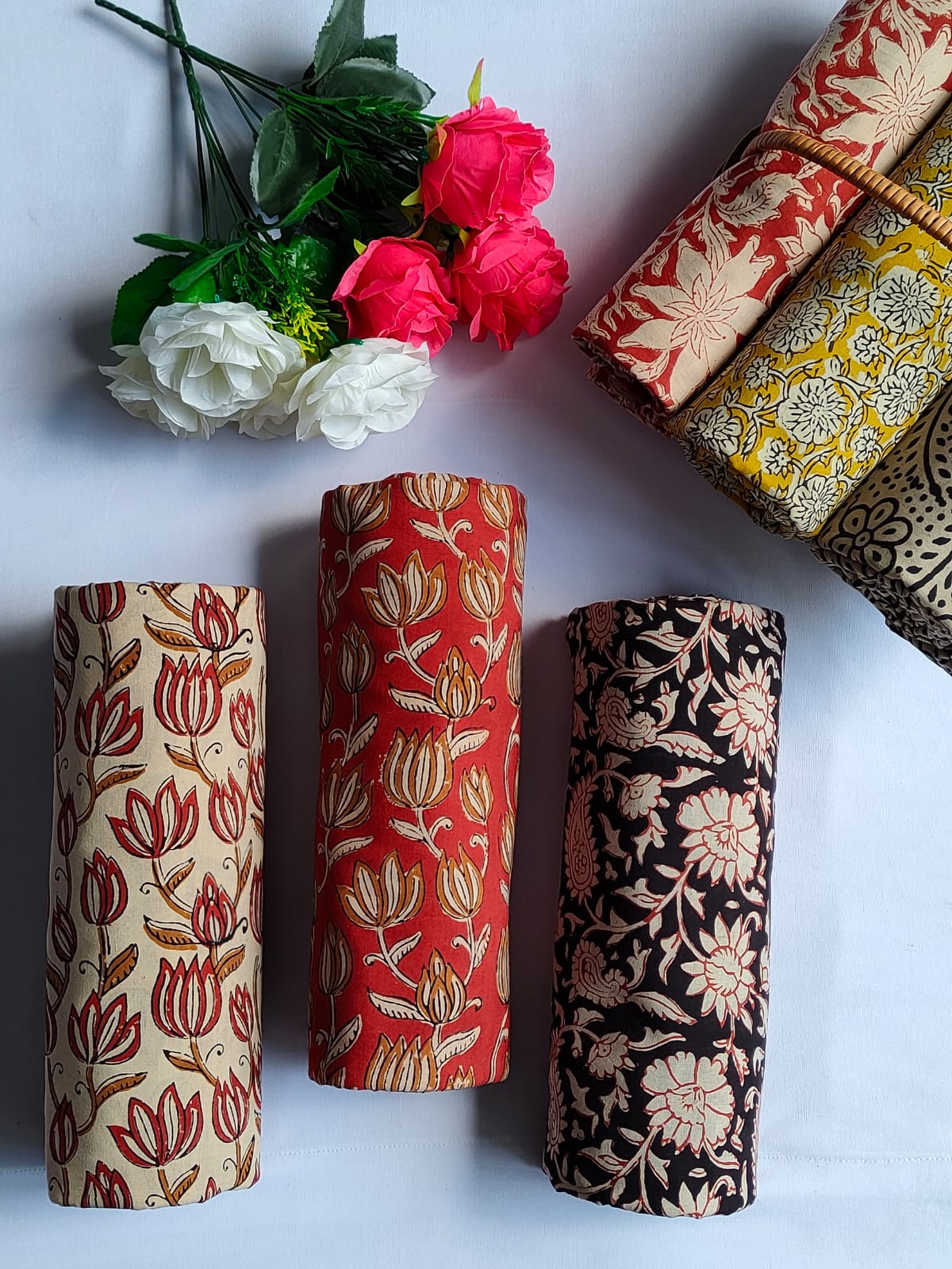


Block printed cotton has a way of making ordinary projects feel more personal. A simple cushion cover becomes a statement piece, a plain tote bag gets a distinctive pattern, and an everyday kurta can feel special with the right floral or geometric print. Whether you enjoy sewing at home, create handmade gifts or design products for a small business, block printed cotton offers plenty of opportunities to turn beautiful fabric into something useful.
India has a rich tradition of textile printing, with regional styles such as Bagru and Sanganeri from Rajasthan and Ajrakh from Gujarat inspiring generations of textile designs. These traditions feature different motifs, colours and printing practices, from delicate florals to intricate geometric patterns. Today, block printed cotton can be used in both traditional and contemporary projects, making it suitable for clothing, accessories, home décor and creative crafts.
The best part is that you do not need an elaborate sewing setup to get started. Some projects require only basic stitching skills, while others are suitable for experienced makers who want to experiment with pattern placement, fabric combinations and finishing details.
In this guide, we will explore ten creative ways to use block printed cotton in your projects, explain how to choose the right fabric for each idea and share practical tips to help you get better results.
Why Choose Block Printed Cotton for Creative Projects?
Before exploring individual projects, it helps to understand why block printed cotton is such a versatile material.
Cotton is available in a wide range of weights, weaves and finishes. Depending on its construction, it can work for lightweight garments, structured accessories, decorative home textiles and many small sewing projects.
The printed design adds another layer of creative possibility. Small repeating motifs can create a subtle look, while larger florals and geometric patterns can become the main feature of a finished product.
Traditional Indian-inspired prints also offer a wide variety of colour combinations. You can use earthy shades for a relaxed, natural look, bright florals for playful accessories or contrasting geometric designs for contemporary projects.
However, not every cotton fabric is suitable for every application. Lightweight cotton may be ideal for a scarf but too soft for a structured tote bag. A firmer cotton may work well for cushion covers but feel less comfortable for a flowing garment.
When selecting fabric, consider its composition, weight, width, print scale and care instructions. You should also distinguish between traditional hand block printed fabric and screen printed or digitally printed fabric featuring similar motifs. Both can be useful for creative work, but the printing methods are different.
Explore Jaipur Bazar's Hand Block Print Cotton Fabrics collection for designs associated with India's hand-printing traditions.
1. Create Your Own Block Printed Cotton Clothing
<text><italic>Best for: Home sewists, fashion enthusiasts, boutique owners and independent designers.</italic></text>
One of the most rewarding ways to use block printed cotton is to turn it into clothing. The right fabric can transform a simple pattern into a garment with colour, texture and character.
You do not need a complicated design. Even a basic silhouette can look distinctive when paired with a well-chosen print.
Make a relaxed cotton kurta
A kurta is a practical project for cotton prints, especially if you enjoy Indian-inspired clothing. Small floral motifs can create a subtle everyday look, while larger patterns can make the garment more expressive.
For a first project, choose a straightforward silhouette with minimal panels. This makes it easier to understand how the print behaves when cut and stitched.
Before cutting, check whether the design has a particular direction. If the flowers, leaves or geometric shapes are meant to face one way, position the pattern pieces accordingly.
Sew a summer dress
Block printed cotton can work well for shirt dresses, gathered dresses, A-line styles and relaxed everyday silhouettes, depending on the fabric's weight and drape.
A small repeating print may suit a simple dress that you plan to wear regularly. A larger floral design can become the focal point of a more minimal silhouette.
Consider the fabric's opacity and structure before choosing the pattern. Lightweight cotton may drape softly, while a firmer construction can provide more shape.
Try a printed shirt or tunic
A printed shirt can be a good project if you want to experiment with combining traditional motifs and contemporary clothing. Pair the fabric with a simple collar, plain buttons and clean finishing so that the design remains the main feature.
For a tunic, consider using a printed fabric for the main body and plain cotton for a contrasting panel or neckline detail.
Practical tip: Wash or prepare the fabric before cutting if the supplier recommends it. Cotton may shrink during washing, and prewashing can help you avoid unexpected changes to the finished garment.
Browse Jaipur Bazar's Printed Cotton Fabrics collection to explore patterns for your next clothing project.
2. Sew Tote Bags and Everyday Shopping Bags
<text><italic>Best for: Beginners, practical sewing projects, handmade product sellers and reusable gift ideas.</italic></text>
A tote bag is one of the most versatile projects for printed cotton. It can be used for shopping, carrying books, keeping sewing supplies together or taking everyday essentials on the go.
The design is simple enough for beginners, but there is plenty of room to customise the finished product.
Choose a print that suits the bag
Large floral motifs can look attractive across a broad front panel. Smaller repeating patterns are useful when you want a balanced design without having to match individual motifs precisely.
Traditional Indian-inspired patterns can give the bag a distinctive appearance, while geometric designs can create a more contemporary look.
Select a suitable cotton construction
The fabric needs enough strength for its intended use. A lightweight cotton that works for a blouse may be too soft for a bag expected to carry heavy items.
Depending on the fabric, you may need a lining, interfacing or reinforced seams. Strong handles and secure stitching are also important.
Add practical details
You can customise a tote with:
-
An internal pocket for keys or a phone.
-
A contrasting plain cotton lining.
-
A small zippered compartment.
-
Wide handles for comfortable carrying.
-
A decorative border or a different print on the pocket.
If you want a coordinated look, combine a printed exterior with plain cotton from Jaipur Bazar's Plain Cotton Fabrics collection.
For small businesses, printed tote bags can also be a useful product to develop from a consistent fabric range. Test the finished bag for strength and colour performance before offering it for sale.
3. Design Cushion Covers That Refresh Your Home
<text><italic>Best for: Home décor enthusiasts, renters, interior styling projects and handmade gifts.</italic></text>
You do not need to redecorate an entire room to make it feel different. Replacing a few cushion covers can introduce new colours and patterns without changing the furniture.
Block printed cotton is a natural option for this type of project because the print can become a decorative feature on an otherwise simple cushion.
Use one print as a statement
Choose a large floral or geometric design for one or two cushions, then pair it with plain cushions in complementary colours.
This keeps the pattern visible without making every part of the room compete for attention.
Mix different print scales
You can combine a large motif, a smaller repeating print and a plain fabric. A shared colour between the designs helps the cushions feel connected.
For example, a cushion with a bold floral pattern might sit alongside one with a small geometric design and another in plain indigo-inspired blue.
Choose the right fabric
Cushion covers should be made from fabric appropriate for their intended use. Consider the firmness of the cotton, the frequency of handling and the care requirements.
If the cushions will be used daily, ask about colourfastness and follow the washing instructions. If you use a removable cover, make sure its dimensions allow for the cushion insert without pulling the seams.
Try envelope-style cushion covers
An envelope closure is a practical option for a simple sewing project. It avoids the need for a zip and makes the cover easy to remove.
Once you are comfortable with the construction, you can experiment with piping, contrasting borders or a different print on the reverse side.
4. Make Table Runners, Placemats and Dining Accessories
<text><italic>Best for: Festive tables, everyday dining, handmade homeware and thoughtful housewarming gifts.</italic></text>
Printed cotton can bring pattern to the dining table without requiring elaborate decoration. A table runner or set of placemats can make a plain table feel more considered, whether you are preparing a family meal or setting up for a special occasion.
Sew a table runner
A table runner is a relatively straightforward project because it generally uses a long rectangular piece of fabric.
Before cutting, consider the placement of the print. If the design includes a border, you may want it to appear along the long edges. A repeating floral motif can also work well when centred along the length of the runner.
Finish the edges neatly and choose a fabric that suits the amount of use the runner will receive.
Create matching placemats
Placemats can be made from printed cotton with a suitable lining or backing. A firmer construction can help them lie flat on the table.
You can use the same print for every placemat or alternate two complementary designs. If the fabric has a large motif, position the pieces so that each placemat looks intentional rather than cutting through the most prominent part of the pattern wherever possible.
Make reusable fabric napkins
Cotton napkins are another practical sewing project. Depending on the construction, they can be made by hemming the edges of square pieces of fabric.
Choose a fabric that feels comfortable and can be cared for according to its intended use. Because table linen may need frequent washing, check the care instructions and test a sample first.
Important: Printed cotton is suitable for many decorative dining accessories, but suitability for direct food contact depends on the product and any applicable requirements. Do not assume every fabric is appropriate for every food-contact application.
5. Make Small Pouches, Pencil Cases and Cosmetic Bags
<text><italic>Best for: Beginner sewing, using fabric leftovers, handmade gifts and small business products.</italic></text>
Small accessories are excellent projects for block printed cotton because they require less material than garments or large home textiles.
A simple pouch can be used for stationery, makeup, travel essentials, craft tools or everyday storage. The printed fabric provides visual interest without needing complicated construction.
Choose the right print scale
Small repeating motifs can work particularly well on narrow pouches. Larger designs may be better for wider cosmetic bags where more of the pattern remains visible.
Consider the direction of the print when cutting the front and back panels.
Add structure where necessary
Some cotton fabrics are soft and flexible. If you want a pouch that holds its shape, you may need interfacing or a suitable lining.
The right construction depends on what the pouch will hold. A soft fabric pouch for lightweight items has different requirements from a structured organiser for heavier objects.
Coordinate the outside and lining
One way to make a pouch look finished is to use printed cotton on the exterior and plain cotton on the inside.
You can also add a contrasting zip panel, an internal pocket or a small fabric loop.
Use offcuts creatively
If you have leftover material from a kurta, dress or cushion cover, turn it into matching pouches or small storage bags.
This is a useful way to make more of the fabric you already have while creating accessories that coordinate with a larger project.
6. Make Scrunchies, Headbands and Hair Accessories
<text><italic>Best for: Quick sewing projects, fabric scraps, handmade gifts and coordinated accessories.</italic></text>
Small fabric accessories are a good way to experiment with printed cotton without committing to a large project.
Scrunchies, headbands, fabric bows and simple hair ties can be made using relatively small pieces of fabric. A print that feels too busy for a full garment may work beautifully in a smaller accessory.
Sew a matching scrunchie
A scrunchie can coordinate with a dress, kurta or tote bag made from the same fabric.
Small florals and repeating motifs are particularly useful because they remain visually interesting even when the fabric is gathered.
Use elastic suitable for the intended accessory and make sure the seams are secure.
Make a fabric headband
A headband can be constructed from a narrow strip of printed cotton. Depending on the design, you may want to add a lining or soft support to help it hold its shape.
Choose a fabric that bends comfortably and does not feel excessively stiff.
Create a matching gift set
You can combine a scrunchie, a small pouch and a reusable gift bag made from the same print or from complementary fabrics.
This works well for birthdays, festive gifts or small handmade product collections.
If you are making accessories for sale, check seam quality, comfort and colour performance before producing a batch.
7. Create Patchwork, Quilts and Decorative Fabric Panels
<text><italic>Best for: Experienced sewists, craft enthusiasts and anyone who enjoys combining patterns.</italic></text>
Block printed cotton can bring variety to patchwork and quilting projects. Different prints can be arranged into a larger design, allowing you to combine colours and motifs in ways that are difficult to achieve with a single fabric.
Build a coordinated patchwork palette
Start by selecting a few prints that share one or two colours. For example, you might combine a floral print, a small geometric pattern and a plain cotton in a complementary shade.
A shared colour helps different designs feel connected.
You can also vary the scale of the motifs. One larger print can become the focal point, while smaller patterns provide supporting details.
Use prints for decorative panels
You do not have to make a full quilt to use patchwork. Smaller panels can be added to cushion covers, wall hangings, fabric organisers or the front of a tote bag.
This approach lets you experiment with colour placement without using a large quantity of fabric.
Check fabric stability before sewing
If your project combines several cotton fabrics, consider whether they have similar weights and care requirements. Different constructions may behave differently during washing.
Test samples where appropriate and prepare the fabrics according to the project instructions before assembling the finished item.
Make use of small pieces
Offcuts can be arranged into strips, squares or other simple shapes. Even small pieces can become useful design elements when placed thoughtfully.
The aim is to balance the prints rather than use every pattern in the same area. A little plain fabric can give the eye a place to rest.
8. Sew Fabric Book Covers, Journal Sleeves and Organisers
<text><italic>Best for: Students, stationery lovers, home offices and handmade gifts.</italic></text>
Printed cotton can give everyday stationery a more personal look. Fabric book covers, journal sleeves and small organisers are practical projects that work well with repeating patterns.
Make a removable book cover
A fabric book cover can protect a notebook or journal from everyday handling. The design can be simple, with folded fabric sections that hold the front and back covers.
Measure the book carefully before cutting, allowing enough material for folds and seams. The construction should fit securely without making the cover difficult to remove.
Create a journal sleeve
A padded journal sleeve can be made from printed cotton with a suitable lining. You can add a small pocket for a pen or notes.
If you want the sleeve to provide more structure, consider using interfacing or light padding compatible with the fabric.
Organise sewing and craft supplies
A printed cotton organiser can hold scissors, threads, needles or other small tools. Add pockets of different sizes according to what you need to store.
For heavier tools, reinforce the seams and use a suitable lining.
Personalise gifts
A journal sleeve paired with a matching pouch can make a thoughtful handmade gift. Choosing a print that reflects the recipient's favourite colours or style makes the project feel more personal.
9. Make Curtains, Valances and Decorative Window Treatments
<text><italic>Best for: Home décor projects, sewing enthusiasts and people refreshing a room on a budget.</italic></text>
Printed cotton can be used for selected window treatments, including lightweight curtains, short valances and decorative panels. The suitability depends on the fabric's weight, opacity, construction and the requirements of the space.
Choose a print that works with the room
Small florals can suit relaxed interiors, while geometric prints may work well in more contemporary spaces. Large motifs can create a statement, but consider the size of the window and how much of the pattern will remain visible when the curtains are gathered.
If the room already contains several patterns, a simpler print may be easier to coordinate.
Check the fabric's weight and opacity
Lightweight cotton may allow more light through than a firmer fabric. This can be useful when you want a soft, airy appearance, but it may not provide the coverage required for privacy.
Consider lining the curtains if you need more body or coverage. The lining and outer fabric should be compatible with the intended care method.
Plan the pattern repeat
For curtains, pattern alignment matters because two panels may hang side by side. Calculate the amount of fabric required for the panel length, hems and repeat matching before ordering.
Check safety and performance requirements
Window treatments may be subject to specific requirements depending on their location and intended use. Check the relevant rules for your market and household, particularly when products will be used around children.
Printed cotton can be an attractive decorative choice, but it should not be assumed to meet specialist performance requirements without supporting information.
10. Turn Block Printed Cotton into Handmade Gifts and Small Business Products
<text><italic>Best for: Craft sellers, independent brands, gift makers and creative entrepreneurs.</italic></text>
Block printed cotton offers opportunities to create coordinated handmade products. Rather than using a fabric for only one item, you can develop a small collection that shares a print or colour palette.
This approach can be useful for craft fairs, online shops, boutique gift collections or personal projects.
Build a coordinated product range
For example, one fabric design could be used for a tote bag, a pouch, a scrunchie and a cushion cover. Different products appeal to different customers, while the shared print creates a recognisable collection.
You can also combine several related prints instead of using the exact same fabric everywhere.
Start with products that suit your sewing skills
If you are new to selling handmade products, begin with items you can make consistently. Simple pouches, tote bags and cushion covers may be easier to standardise than fitted garments.
Calculate the material needed for each item, including lining, interfacing, thread and other components. Include time spent cutting, sewing, finishing and packaging when setting your price.
Test the product before selling it
Check the finished item's construction, usability and care requirements. Test washing where appropriate and inspect whether the print remains attractive after normal handling.
If you describe a fabric as hand block printed, make sure that statement accurately reflects the manufacturing process. A traditional-looking motif is not enough to establish that the fabric was printed using carved blocks by hand.
Make use of offcuts
Smaller products can be made from fabric left over after cutting larger pieces. This can help reduce unused material, although the time and cost of making each item still need to be considered.
For business orders, confirm the available quantity and whether additional fabric from the same design is likely to be available later.
Explore Jaipur Bazar's Hand Block Print Cotton Fabrics collection and Printed Cotton Fabrics collection when planning a coordinated project or product range.
How to Choose the Right Block Printed Cotton for Your Project
The fabric you choose can influence the comfort, structure and appearance of the finished product. Before buying, consider these five factors.
1. Fabric weight
Choose a fabric that suits the intended use. Lightweight cotton may work for scarves, tops and some curtains, while a firmer construction may be more suitable for bags and organisers.
Do not judge quality by thickness alone. The weave, yarn and finishing also affect performance.
2. Print scale
Think about the size of the motifs in relation to the finished item. A large floral pattern may look striking on a cushion cover but require careful placement on a small pouch.
Smaller repeating patterns can be easier to position across several garment pieces.
3. Colour combination
Choose colours that work with your project. If you plan to combine several prints, look for a shared colour or use plain cotton to balance the overall design.
4. Care requirements
Check whether the fabric needs special washing or ironing. If you are making products that will be washed frequently, ask about colourfastness and test a sample when possible.
5. Available width and quantity
Check the usable width and calculate how much fabric you need. Allow for seams, hems, motif matching, directional patterns and potential shrinkage where relevant.
For a larger project, ordering a sample first can help you confirm that the fabric suits your design.
How to Care for Block Printed Cotton Projects
Once your project is complete, suitable care can help maintain its appearance.
-
Follow the fabric supplier's care instructions.
-
Wash new or colour-sensitive items separately until you understand their colour performance.
-
Use a suitable detergent and avoid harsh chemicals unless permitted.
-
Avoid excessive heat when washing, drying or ironing.
-
Turn garments inside out where appropriate to reduce friction on the printed surface.
-
Blot stains gently instead of scrubbing the design.
-
Store fabric products only when completely dry.
-
Test a sample before washing a large quantity or finished product.
Care requirements vary with the cotton construction, dyes, printing medium and finishing. Do not assume every hand block printed textile uses natural dyes or requires exactly the same washing routine.
A Note on India's Block Printing Traditions
Many contemporary projects draw inspiration from India's regional textile heritage. Bagru and Sanganeri printing in Rajasthan and Ajrakh in Gujarat are examples of traditions with distinct patterns, techniques and histories.
Bagru is often associated with earthy colour palettes and resist-printing practices, while Sanganeri designs are known for fine floral motifs. Ajrakh is recognised for its geometric arrangements and multistage resist-printing and dyeing process.
These traditions can inspire clothing, accessories and home décor, but a similar-looking print does not necessarily mean the fabric was made using the traditional process or in the region associated with the design.
If you specifically want traditional hand block printed cotton, check the product description and ask the supplier about the printing method and origin. If you are choosing a fabric mainly for its visual style, a clearly described contemporary print may also suit your project.
For more options, browse Jaipur Bazar's Bagru Print Cotton Fabrics collection and Hand Block Print Cotton Fabrics collection.
Conclusion: Make Something Personal with Block Printed Cotton
Block printed cotton offers more possibilities than clothing alone. You can turn it into tote bags, cushion covers, table runners, pouches, hair accessories, patchwork projects, journal sleeves, curtains and coordinated handmade gifts.
The best projects begin with a clear idea of how the finished item should look and perform. Choose a fabric with a suitable weight, check the print scale, plan the cutting layout and understand the care requirements before you begin.
If you are combining several prints, use colour and motif size to create balance. If you are making a product for sale, test a finished sample and make sure the fabric's printing method is described accurately.
Most importantly, choose a project that matches your skill level and enjoy experimenting with the fabric. A simple design can become distinctive through thoughtful pattern placement, neat stitching and a well-chosen colour combination.
Ready to plan your next sewing project? Explore Jaipur Bazar's Hand Block Print Cotton Fabrics, Printed Cotton Fabrics and All Cotton Fabrics collections to find cotton designs for clothing, accessories and home décor.
Frequently Asked Questions
1. What can I make with block printed cotton fabric?
You can make clothing, tote bags, cushion covers, table runners, placemats, pouches, scrunchies, headbands, patchwork projects, journal sleeves, curtains and handmade gifts. The best use depends on the fabric's weight, construction and care requirements.
2. Is block printed cotton suitable for beginners?
Yes. Simple projects such as tote bags, cushion covers, pouches and fabric napkins can be good starting points. Choose a straightforward pattern and a fabric that is easy to cut and sew.
3. Which block printed cotton is best for tote bags?
Choose a cotton fabric with suitable strength and structure for the intended bag. A firmer construction may be preferable, and you may need lining or interfacing. Test the finished bag before using it to carry heavy items.
4. Can I use block printed cotton for home décor?
Yes. It can be used for cushion covers, table runners, decorative panels and some window treatments. Check the fabric's weight, opacity, strength and care requirements for the specific project.
5. How do I combine different block printed fabrics?
Choose prints that share one or two colours, vary the motif scale and use plain cotton to create balance. A large pattern can be the focal point, while smaller prints provide contrast.
6. Can I use fabric scraps for small projects?
Yes. Offcuts can be useful for scrunchies, pouches, patchwork panels, small organisers and decorative details. Plan the cutting layout so the most attractive part of the print appears where you want it.
7. Does hand block printed cotton need to be washed before sewing?
Prewashing may be helpful because cotton can shrink during washing. Check the supplier's instructions and test a small sample first, especially if colour transfer or a special finish is a concern.
8. Is screen printed cotton the same as hand block printed cotton?
No. Hand block printing applies a design through carved blocks pressed onto fabric by hand. Screen printing transfers colour through selected areas of a prepared screen. Both can produce attractive designs, but the processes are different.
9. How should I care for finished block printed cotton products?
Follow the fabric's care instructions, use suitable detergent, avoid harsh scrubbing and excessive heat, and dry the item appropriately. Test a sample or inconspicuous area when the care requirements are uncertain.
10. Where can I buy block printed cotton fabric online?
You can explore Jaipur Bazar's Hand Block Print Cotton Fabrics collection, Bagru Print Cotton Fabrics collection and Printed Cotton Fabrics collection. Check each product's composition, printing method, width and care instructions before ordering.