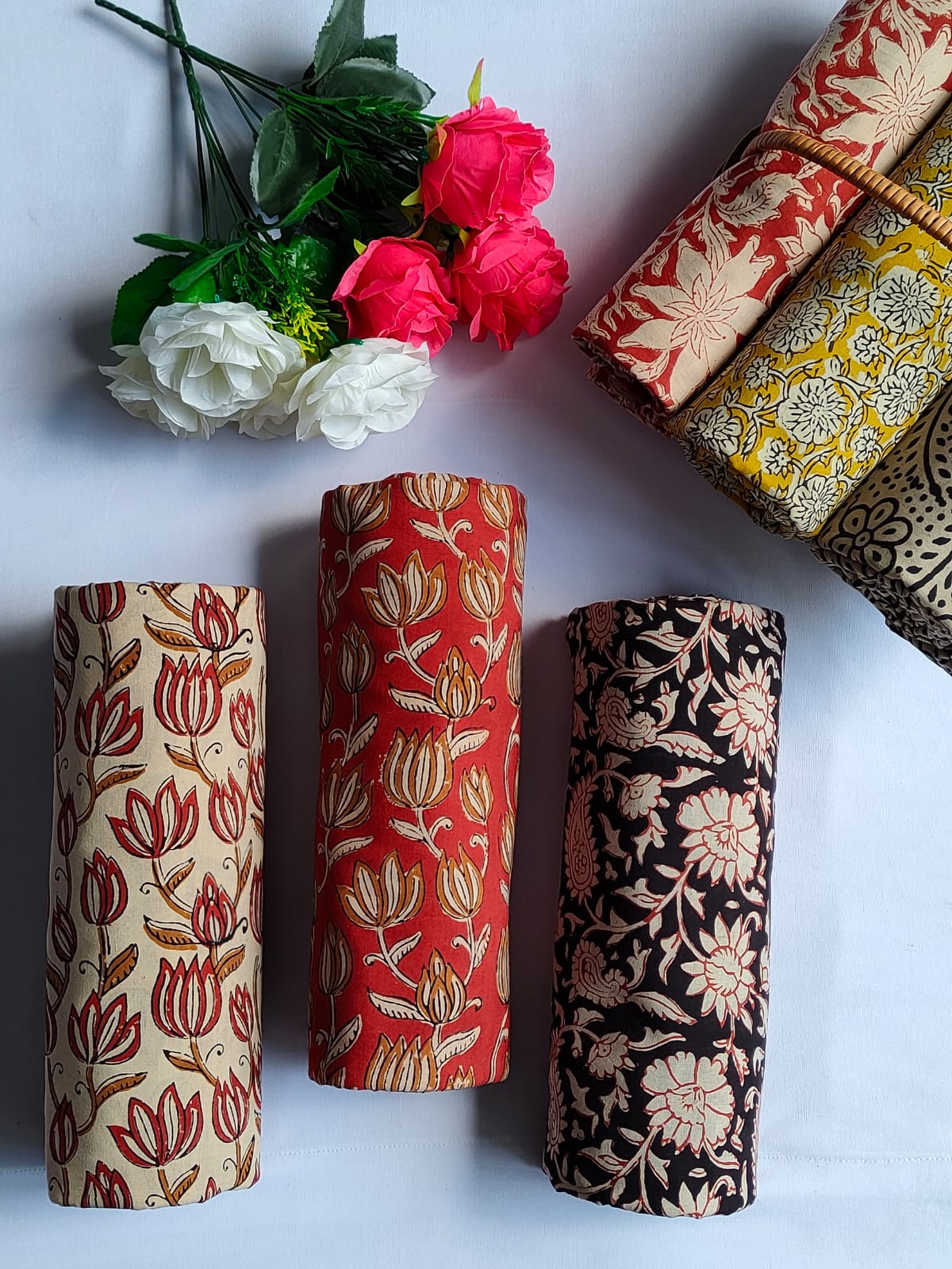


Screen printed cotton fabric brings together the comfort of cotton, the versatility of printed designs and the practicality of a production method used across the textile industry. From floral yardage for everyday clothing to bold geometric patterns for home décor, screen printing gives buyers access to a wide range of colours, motifs and repeat patterns.
But choosing the right fabric involves more than finding a print you like. You need to consider the cotton quality, fabric weight, printing method, colour performance, intended use and the reliability of the supplier.
India offers an especially interesting perspective on printed textiles. Across Rajasthan and Gujarat, regional traditions such as Bagru, Sanganeri and Ajrakh demonstrate how patterns, colours and printing techniques develop within particular communities. These traditions also help buyers understand an important distinction: a fabric inspired by traditional Indian motifs is not necessarily hand block printed or made in the region associated with that style.
In this guide, we will explore how screen printed cotton fabric is made, what to check before purchasing it, how it compares with hand block printing, and how Jaipur Bazar's India-inspired cotton fabric collection can help you find designs for your next project.
What Is Screen Printed Cotton Fabric?
Screen printed cotton fabric is cotton cloth onto which a design is applied using a screen and a patterned stencil. The screen allows printing ink or colour paste to pass through selected areas while blocking it from others. Each colour in a design may require a separate screen or printing step, depending on the production process.
The method can produce florals, stripes, geometric arrangements, abstract artwork, traditional Indian motifs and contemporary patterns. It is used for fashion fabrics, dress materials, accessories and home furnishings.
Cotton is a popular base because it comes in a variety of constructions and weights. Lightweight cotton can suit summer garments and scarves, while firmer cotton fabrics may work better for structured clothing, tote bags and cushion covers.
It is worth remembering that cotton describes the fibre, while screen printing describes how the design is applied. Two screen printed cotton fabrics can look similar but perform differently because their yarn quality, weave, weight, printing paste and finishing treatments may not be the same.
How Is Screen Printed Cotton Fabric Made?
Understanding the production process helps you evaluate fabric descriptions and ask suppliers more useful questions.
1. Preparing the cotton fabric
The base cloth is inspected and prepared before printing. Depending on its condition and intended finish, preparation may include washing, scouring or other treatments to remove impurities and improve the fabric's suitability for printing.
A clean, appropriately prepared surface helps the print adhere more consistently.
2. Creating the design and screens
The design is converted into a printable pattern. A screen is prepared with open areas that allow the printing medium to pass through in the intended shape.
For multicolour designs, different screens may be used for separate colours. Accurate alignment between these printing stages helps create a clear finished pattern.
3. Applying the print
The screen is positioned over the fabric, and printing ink or colour paste is pushed through its open areas. The fabric or screen is then moved into position for the next impression.
Screen printing can be performed using manual equipment or automated production systems. The scale and equipment influence output, consistency and the range of designs a manufacturer can produce efficiently.
4. Fixing and finishing
The printed fabric may undergo drying, curing, steaming or other finishing steps, depending on the printing chemistry. These processes help the print develop the required adhesion, colour performance and handle.
Buyers should not assume that every screen printed fabric uses the same ink or finishing process. If colourfastness, skin contact or a particular chemical standard matters for your application, ask the supplier for relevant test information rather than relying on the print's appearance alone.
Screen Printing and India's Regional Textile Traditions
India's textile heritage includes many distinct printing traditions. Their patterns reflect local histories, artisan knowledge, materials and changing customer needs.
For buyers exploring printed cotton, these traditions offer inspiration. They also show why it is important to distinguish the appearance of a design from the method used to produce it.
Bagru prints of Rajasthan
Bagru, near Jaipur, is known for its hand block printing tradition, associated with the Chhipa printing community. Traditional Bagru textiles often feature earthy colours, repeated floral forms and carefully arranged motifs. Some designs use dabu, a resist-printing technique in which selected areas are protected from dye so that a pattern emerges through the subsequent dyeing process.
The Government of India's handicrafts resource documents Bagru's tools, materials, printing methods and characteristic designs. It also notes that some workshops now use screen printing and chemical dyes to meet larger production demands. <Cite refs={["turn355370search2"]} />
This is an important point for fabric buyers. A contemporary screen printed fabric may draw inspiration from Bagru's colour palette or floral vocabulary, but that alone does not establish that it was hand block printed in Bagru.
If you are looking for the traditional craft itself, ask how the fabric was printed and where it was produced. If your priority is a particular look, an India-inspired screen printed design may be a practical alternative.
Explore Jaipur Bazar's Bagru Print Cotton Fabrics to discover designs influenced by this regional textile tradition.
Sanganeri prints of Rajasthan
Sanganer, near Jaipur, is another important centre for Indian hand block printing. Sanganeri designs are often associated with delicate floral motifs, small butis, flowing vines and botanical patterns, frequently arranged on white or light-coloured backgrounds.
The Government of India's craft documentation describes the use of carved wooden blocks and the careful printing, washing, drying and finishing processes involved in Sanganeri textiles. It also records their use in clothing materials, bedsheets, curtains and other home textiles. <Cite refs={["turn355370search0","turn355370search1"]} />
The fine, repeating floral patterns associated with Sanganer have clear relevance for contemporary cotton fabric design. Similar-looking motifs can be recreated through screen printing, making them accessible to different production volumes and price points.
However, a floral screen print inspired by Sanganeri aesthetics should not automatically be described as authentic Sanganeri hand block printing. Accurate product descriptions help customers understand what they are purchasing and respect the work of the artisans who maintain the original tradition.
Browse Hand Block Print Cotton Fabrics for Indian-inspired patterns and traditional print styles.
Ajrakh of Gujarat
Ajrakh is a distinctive resist-printing and dyeing tradition associated with Kachchh in Gujarat and with a wider cultural history extending into Sindh. Its designs are recognised for geometric organisation, repeated motifs, structured borders and rich colour combinations, particularly indigo and red.
Traditional Ajrakh production involves multiple stages of printing, resisting, dyeing and washing. Hand-carved wooden blocks are used to build intricate patterns, and different materials and processes contribute to the finished textile. The Government of India's handicrafts resource documents Kutch Ajrakh as a regional craft with its own tools, materials and design vocabulary. <Cite refs={["turn355370search9","turn355370search4"]} />
Ajrakh's visual language continues to inspire contemporary fashion and textile design. Geometric screen printed cotton fabrics can offer a similar visual direction for garments, accessories or interiors, although the manufacturing process may be entirely different.
For buyers, the distinction matters. If you specifically need traditional Ajrakh, ask about the production location, printing technique and dyeing process. If you want a geometric Indian-inspired pattern for a project, compare the design, cotton quality and performance of the available options.
How these traditions are preserved today
Regional textile traditions survive through the continued work of printers, dyers, block carvers, designers, sellers and the communities that pass these skills from one generation to the next. They also adapt as customer preferences, production costs and market requirements change.
Preservation does not mean every textile must be produced in exactly the same way forever. It means the knowledge behind a tradition is recognised, skilled practitioners have opportunities to continue their work, and buyers receive honest information about what they are purchasing.
Buyers can support this process by:
-
Choosing clearly described products that identify the printing method accurately.
-
Asking for the production location when regional origin is important.
-
Buying from suppliers who can explain their sourcing and manufacturing practices.
-
Seeking out artisan-made textiles when the craft process is central to the purchase.
-
Avoiding claims such as “natural dyed,” “handmade” or “authentic Ajrakh” unless the supplier can substantiate them.
Screen printing and hand block printing serve different purposes. Screen printing can make certain designs available consistently at scale, while traditional hand printing carries craft knowledge and a distinct production process. One does not need to be misrepresented as the other for both to have a place in the modern textile market.
Screen Printing vs Hand Block Printing: What Is the Difference?
Although both methods can produce beautiful printed cotton, they differ in how the design reaches the fabric.
| Feature | Screen printing | Hand block printing |
|---|---|---|
| Printing method | Colour or printing medium passes through a prepared screen | A carved wooden block is pressed onto the fabric |
| Pattern consistency | Can produce highly consistent repeats with suitable equipment and process control | Small variations can occur between hand impressions |
| Design possibilities | Suitable for detailed artwork, repeated motifs and many colour combinations | Design depends on block carving, registration and the artisan's technique |
| Production | Can be manual or automated and adapted to different production volumes | Labour-intensive, with impressions applied block by block |
| Regional identity | Can reproduce designs inspired by regional textile traditions | May form part of a named regional craft, depending on where and how it is produced |
| Buying priority | Check print quality, fabric construction and finishing | Check the craft process, fabric quality, provenance and finishing |
Neither method guarantees better fabric quality on its own. A poorly finished screen print may disappoint, just as a hand block printed fabric can vary in quality. Evaluate the base cotton, print application, colour performance and suitability for your intended use.
The Ultimate Buyer's Checklist for Screen Printed Cotton Fabric
Before placing an order, work through these practical checks.
1. Check the cotton composition
Start with the fibre composition. If you specifically need cotton, check whether the product is described as 100% cotton or as a cotton blend.
Do not rely only on a product name or a photograph. If the fabric will be used for a customer-facing product, request a specification or composition information from the supplier.
You can also explore Jaipur Bazar's All Cotton Fabrics collection to compare different cotton fabric options.
2. Choose the right fabric weight and construction
The best cotton fabric depends on the item you plan to make.
-
Summer shirts and kurtas: Consider lightweight or medium-weight cotton with a comfortable drape.
-
Dresses and tunics: Choose a weight that provides the desired fall, coverage and structure.
-
Tote bags and pouches: Look for a firmer construction that can handle the intended use.
-
Cushion covers and table linen: Consider fabric strength, maintenance requirements and how frequently the item will be used.
-
Children's clothing: Prioritise appropriate composition, comfort, finishing and the relevant safety requirements for your market.
Weight alone does not tell you everything about strength or quality. Weave, yarn, finishing and intended use also matter.
For lighter fabric options, compare Cotton Cambric Fabrics and Mulmul Cotton Fabrics, checking the specifications of individual products before selecting one.
3. Inspect the print closely
Look at the design at both normal viewing distance and close range.
Check whether the lines are clear, the colours are applied evenly and the pattern repeats as expected. Look for unwanted smudges, missing sections, ink deposits or inconsistent areas that might affect the finished garment.
For multicolour designs, check that the colours align correctly. Minor variation may be acceptable in some styles, but obvious printing defects can affect cutting, sewing and the final appearance.
If you are buying online, use close-up product photographs and ask for additional images when print details are unclear.
4. Ask about colourfastness
Colourfastness describes how well colour resists fading, rubbing or transfer during use and care. Results depend on the printing medium, fabric preparation, fixation and finishing.
Ask the supplier whether the fabric has been tested for washing and rubbing performance, especially if you intend to manufacture clothing or products that will be washed regularly.
Follow the supplier's care instructions. If you are developing a product line, test a sample under realistic washing conditions before placing a large order.
5. Understand the finish and feel
A print can look excellent while the fabric feels different from what you expected. Some finishes make cloth feel smoother or firmer; some printing methods can leave a more noticeable layer on the surface.
Check whether the fabric remains comfortable and flexible for your intended use. For garments, consider how it drapes and moves. For bags or furnishings, consider the structure and durability you need.
If hand feel is important, order a sample before committing to a larger quantity.
6. Review the usable width
Fabric width affects how efficiently you can cut pattern pieces and calculate material requirements.
Confirm the usable width rather than estimating it from photographs. Also check whether the design has a directional orientation, a large repeat or a border that affects cutting layouts.
For garment production, these details can make a noticeable difference to fabric consumption and waste.
7. Calculate the repeat and cutting allowance
A design with a large repeat may require extra fabric to align motifs across seams. Directional prints may also need to be cut in a consistent orientation.
Before ordering, estimate the amount required for your pattern or product. Include a suitable allowance for shrinkage, matching repeats, cutting mistakes and quality inspection.
For business orders, a sample cut can help confirm the design scale and how the print works with your chosen pattern.
8. Compare prices fairly
A low price is not necessarily a good deal if the fabric has inconsistent printing, poor colour performance or an unsuitable construction.
When comparing suppliers, look at the full specification: fibre composition, width, weight, print quality, finishing, order quantity, shipping cost and expected delivery time.
If you are buying for resale or manufacturing, calculate the usable cost per finished product rather than comparing only the price per metre.
9. Confirm availability and delivery
If your project depends on a launch date, confirm stock availability, processing time and shipping arrangements before paying.
For repeat orders, ask whether the same design, base cloth and colour combination are likely to remain available. Even when a design is repeated, the supplier should clarify whether the new batch will match the original sample.
What Are the Best Uses for Screen Printed Cotton Fabric?
Screen printed cotton is versatile, but the best choice depends on the construction of the base fabric and the quality of the print.
Clothing and everyday wear
Floral, geometric and abstract cotton prints can work well for shirts, dresses, kurtas, tunics, skirts and relaxed everyday garments. Lightweight fabric may suit warm-weather clothing, while medium-weight options may offer more structure.
Choose a print scale that suits the garment. Small motifs can work well for detailed pieces, while larger patterns may be better suited to simple silhouettes.
Kidswear
Bright colours and playful designs make printed cotton useful for children's clothing. Look beyond appearance, however, and consider comfort, seam performance, colour transfer and applicable product safety requirements.
Always confirm that the fabric and its finishes are suitable for the intended garment.
Bags and accessories
Screen printed cotton can be used for tote bags, pouches, fabric organisers and other accessories. For products that need to hold their shape or carry weight, a stronger base cloth or suitable lining may be necessary.
Consider whether the print will remain attractive where the fabric folds, rubs or experiences repeated handling.
Home décor
Printed cotton can be used for cushion covers, table accessories, lightweight curtains and decorative fabric projects. Select a construction that suits the expected wear and cleaning routine.
For frequently used home textiles, ask about colourfastness and care instructions rather than choosing on pattern alone.
How to Buy Screen Printed Cotton Fabric Online
Buying fabric online is convenient, but photographs cannot communicate every important specification. A simple buying process can reduce uncertainty.
First, define your project. Decide whether you need fabric for apparel, accessories, home décor or resale. This helps narrow down the weight, print style and construction.
Next, read the product details. Look for fibre composition, width, price unit, available quantity, printing method and care instructions. If any of these are missing and important to your project, ask before ordering.
Then, compare the design and fabric together. A beautiful print is only useful if the underlying cotton works for your application. Review close-up photographs and request a sample when possible.
Finally, confirm order and delivery details. Clarify available stock, dispatch estimates, shipping charges, return conditions and the process for reporting defects.
At Jaipur Bazar, buyers can browse the Printed Cotton Fabrics collection to explore printed fabric options. The wider All Cotton Fabrics collection offers another starting point for comparing cotton types.
Jaipur Bazar's India-inspired block print fabric collection brings traditional Indian design influences into a contemporary fabric-shopping experience. If you are looking specifically for hand block printed styles, browse the dedicated Hand Block Print Cotton Fabrics collection. Check each product description to understand the actual fabric and printing method rather than assuming that all traditional-looking motifs are hand printed.
How to Care for Screen Printed Cotton Fabric
Correct care helps maintain both the cotton base and its printed design.
-
Read the care instructions supplied with the fabric.
-
Wash a sample separately before processing a large quantity.
-
Use a suitable detergent and avoid harsh chemicals unless the care label permits them.
-
Avoid excessive heat when washing, drying or ironing.
-
Turn finished garments inside out where appropriate to reduce abrasion.
-
Test ironing temperature on an inconspicuous area before applying heat directly to a printed surface.
-
For production orders, assess shrinkage and colour performance before cutting the full quantity.
Cotton fabrics and printing systems differ, so there is no single care routine that suits every printed textile. Follow product-specific guidance whenever it is available.
Making a Better Choice: Design, Fabric and Craft
India's printing traditions demonstrate how textile design carries cultural knowledge as well as visual appeal. Bagru's earthy hand block prints, Sanganer's delicate florals and Ajrakh's structured geometric patterns each have their own histories and production practices.
Screen printed cotton offers buyers another way to work with patterned fabric, particularly when they need consistent repeats or designs suited to contemporary clothing and home projects. It can draw inspiration from India's rich visual heritage without replacing the importance of traditional craft.
The best purchase is the one that matches your needs and is described honestly. Check the cotton composition, fabric weight, printing method, colour performance, width and finishing before ordering. If regional authenticity or artisan production is important to you, ask the supplier for clear information about origin and process.
Explore Jaipur Bazar's Printed Cotton Fabrics and Hand Block Print Cotton Fabrics to compare contemporary printed options with designs inspired by India's textile traditions.
Frequently Asked Questions
1. What is screen printed cotton fabric?
Screen printed cotton fabric is cotton cloth decorated by pushing printing ink or colour paste through selected areas of a prepared screen. It can be used for clothing, accessories and home décor.
2. Is screen printed cotton the same as hand block printed cotton?
No. Screen printing uses a prepared screen to apply a design, while hand block printing uses carved wooden blocks pressed onto fabric by hand. Both methods can create attractive textiles, but they involve different processes.
3. Is screen printed cotton fabric suitable for clothing?
Yes, provided the fabric weight, construction, print finish and care requirements suit the garment. Lightweight cotton may work for summer clothing, while firmer cotton may suit structured pieces. Check the individual product specifications.
4. What is the difference between Bagru, Sanganeri and Ajrakh prints?
Bagru and Sanganeri are hand block printing traditions associated with Rajasthan. Bagru is often associated with earthy palettes and resist-printing techniques, while Sanganeri is known for fine floral motifs. Ajrakh is a distinctive resist-printing and dyeing tradition associated with Kachchh in Gujarat and a wider regional history. Their designs can inspire screen prints, but screen printing is a different production method.
5. How can I check the quality of screen printed cotton fabric?
Check fibre composition, fabric weight, usable width, print clarity, colour alignment, surface feel and finishing. Ask about colourfastness and request a sample if the fabric is intended for a large order or commercial product line.
6. Does screen printed cotton fade after washing?
It can fade or transfer colour depending on the printing medium, fixation, finishing and care. Ask about colourfastness and follow the supplied washing instructions. Test a sample before processing a large quantity.
7. Can screen printed cotton be used for bags and home décor?
Yes. It can be suitable for tote bags, pouches, cushion covers and other home projects, depending on the strength and construction of the base fabric. Heavier use may require a firmer fabric, lining or additional reinforcement.
8. Where can I buy printed cotton fabric online?
You can explore Jaipur Bazar's Printed Cotton Fabrics collection and compare product details to find fabric suited to your project. Review the composition, width, print method, availability and care instructions before placing an order.
9. Does a traditional Indian motif mean the fabric is hand printed?
No. A design inspired by Bagru, Sanganer or Ajrakh may be produced through screen printing or another modern process. If you need authentic hand block printing or a specific regional origin, confirm the manufacturing method and provenance with the supplier.