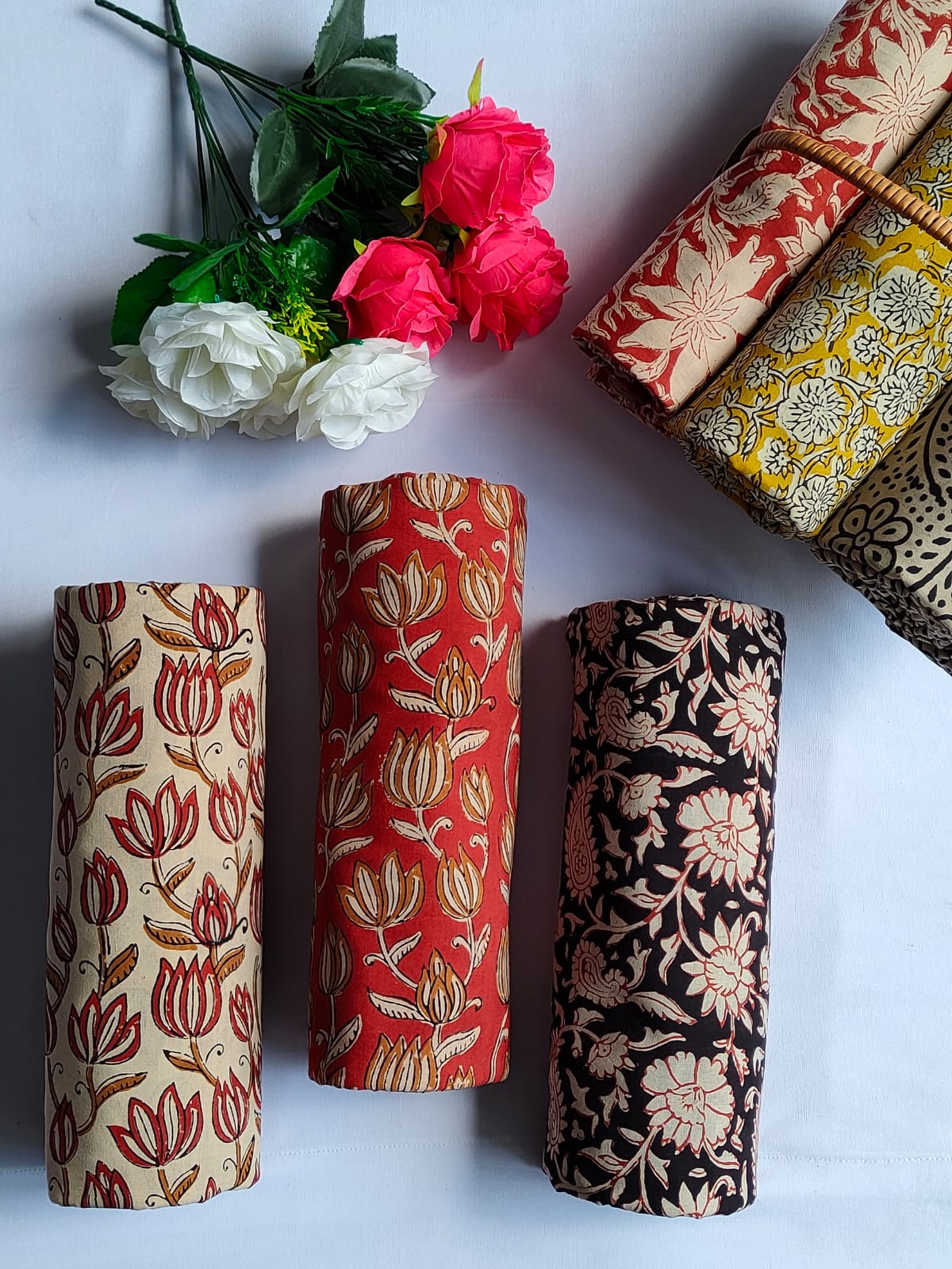


Buying handblock fabric is about more than finding an attractive print. If you are choosing fabric for a kurta, a summer dress, a shirt, a tote bag or a home décor project, you also need to consider the quality of the base cloth, the clarity of the printed design, the colour, the finishing and the information provided by the seller.
India's handblock printing traditions offer a remarkable variety of choices. Rajasthan's Bagru prints are associated with earthy colours and distinctive repeating motifs. Sanganer is known for delicate floral patterns, while Ajrakh, with its strong association with Gujarat's Kutch region and the wider Sindh tradition, is recognised for intricate geometric designs and resist-printing techniques.
These textiles reflect generations of artistic knowledge. Artisans carve wooden blocks, prepare printing materials, position patterns by hand and carry out the finishing processes that turn plain cloth into printed fabric. Understanding this work can help you recognise what to look for when shopping.
In this guide, we explain how to assess handblock fabric quality in 2026, compare regional printing traditions, identify useful signs of careful workmanship and choose fabric for clothing, sewing and home décor. We also explore how informed buying can help preserve India's textile heritage.
What Is High-Quality Handblock Fabric?
Handblock printing is a method of applying a design to fabric using carved blocks. Artisans press the blocks onto the cloth, building the pattern through repeated impressions. Designs with several colours may require separate blocks for outlines, details and colour fills.
High-quality handblock fabric should be assessed through several factors rather than one visual feature alone.
-
Base fabric: The fibre, weave, weight and construction should suit the intended use.
-
Print execution: Motifs should be reasonably clear, with alignment appropriate to the design and printing method.
-
Colour and finish: The fabric should have a finish and colour performance appropriate to its stated use.
-
Construction consistency: The fabric should be suitable for cutting, stitching or the intended decorative application.
-
Reliable product information: The seller should clearly describe the fibre, printing method, dimensions, care requirements and any claims about regional origin or dyes.
Handblock printing can produce small variations because the design is placed manually. These variations may be part of the process, but they do not automatically prove authenticity or guarantee quality. A well-made fabric still needs to be judged by its overall workmanship and suitability.
For a broader introduction to Indian block printing, read Jaipur Bazar's The Art of Handblock Printing: A Complete Guide.
1. Check the Base Fabric Before Looking at the Print
The printed pattern often attracts attention first, but the base cloth determines how the fabric feels, drapes and performs during use.
Two fabrics with similar designs may behave very differently if one is lightweight and the other has a more substantial construction.
Check the fibre composition
If you want cotton, look for a clear statement that the fabric is cotton. Do not assume that every fabric described as handblock printed is made from cotton. Handblock printing is a printing method and can be applied to different textiles.
For cotton products, check whether the listing provides a composition description and any relevant construction details.
Consider the weave and weight
The weave and weight affect the fabric's structure and drape. A lighter fabric may suit a flowing garment, while a more structured fabric may be preferable for a shirt, tote bag or cushion cover.
Neither heavier nor lighter fabric is automatically better. The correct choice depends on the project.
Look for a suitable surface
A fabric intended for sewing should have a surface and construction that work with your chosen pattern. Check for obvious holes, unwanted snags, severe unevenness or damaged areas in product photographs where these details are visible.
If you are buying in person, inspect the cloth under good lighting and handle it gently. Online shoppers should look for close-up images and ask the seller for additional photographs if important details are unclear.
Compare similar fabric categories
Cotton cambric, mulmul and other cotton fabrics can differ in weight, weave and finish. Their names alone do not guarantee that they will all behave the same way.
You can compare available options in Jaipur Bazar's All Cotton Fabrics collection.
For more detailed guidance, read How to Identify High-Quality Cotton Fabric.
2. Examine the Clarity and Alignment of the Print
The quality of the printed design is another important consideration. Look closely at the outlines, repeated motifs and areas where different colours meet.
Are the motifs clear?
Flowers, leaves, geometric shapes and other motifs should be recognisable in relation to the design. Some traditional patterns have intentionally soft or textured outlines, so sharpness alone is not a reliable measure of quality.
Look for unwanted smudges, large unprinted patches or accidental marks that interrupt the intended pattern.
Are repeated patterns reasonably aligned?
Handblock printing involves repeated manual impressions. Slight differences in alignment can occur, especially where one block meets another or where several colours are printed separately.
The important distinction is between natural variation and poor execution. Repeated gaps, major overlaps or misplaced impressions that disrupt the intended design may be worth questioning, depending on the product description and expected finish.
Do the colours work together?
Check whether the colours are consistent with the product images and description. Some designs intentionally combine contrasting shades, while others use a softer, more subtle palette.
A colour difference between a screen image and the physical fabric may result from lighting, photography or display settings. Ask for additional images if colour accuracy is important to your project.
Remember that perfect repetition does not prove quality
Machine printing can reproduce a design with very uniform spacing, while handblock printing may show small differences between impressions. Neither uniformity nor irregularity alone proves whether a fabric is handblock printed.
To understand the method, look for credible information about the maker and production process alongside the visual evidence.
3. Understand the Importance of Colour and Dye Information
Colour is a major part of Indian block print design, from earthy reds and browns to delicate florals and deep indigo. But the appearance of a colour does not tell you which dye or printing material was used.
Traditional printing practices may use natural dyes, while contemporary production can involve synthetic dyes or combinations of materials.
Ask what type of dyes were used
If natural dyes are important to you, look for a clear product statement or ask the seller for details. Do not assume that every fabric described as traditional, handmade or handblock printed uses natural dyes.
Likewise, a claim such as “azo-free” should be supported by reliable product information rather than inferred from the colour or regional style.
Consider colourfastness
Colourfastness describes how well a dye or colour remains during exposure to washing, rubbing or light. Performance depends on the materials and how the fabric has been processed.
A product listing may not provide formal test results, so do not assume that every handblock fabric will behave identically.
If you are buying fabric for a garment that will be washed frequently, ask the seller about recommended care and any known colour-release precautions.
Test a small piece when possible
If you have a fabric sample, follow the seller's care instructions and test it before cutting the entire length. A small test may help you identify unwanted colour transfer or shrinkage before committing to a larger project.
Avoid using harsh detergents or aggressive testing methods that could damage the material.
4. Look at the Reverse Side of the Fabric
Examining the reverse side can provide useful clues about how a pattern was applied, particularly when comparing handblock printing with some surface-printing methods.
In many handblock-printed textiles, colour is visible on the reverse because the printing material has penetrated the cloth. However, the extent of penetration varies with the fabric, colour, printing technique and finishing process.
What to look for
-
Is the pattern visible on the reverse side?
-
Does the printing appear consistent with the type of fabric and design?
-
Are there signs of uneven coverage or unexpected marks?
-
Does the seller provide information about the printing method?
A clearly visible reverse-side pattern can be a useful observation, but it is not definitive proof of handblock printing. Some machine-printed methods also produce colour on the reverse, and some legitimate printing techniques may show less penetration.
Use this check alongside the seller's description, the quality of the fabric and information about its origin.
5. Check the Finishing and Overall Construction
Fabric finishing includes the processes carried out after printing and dyeing to prepare the material for use. These processes can affect the fabric's feel, appearance and performance.
Traditional printing workflows may include washing, drying and other finishing stages. The exact process depends on the regional tradition, printing technique, dye system and final product.
Look for visible defects
When inspecting a fabric, check for:
-
Holes, tears or damaged areas.
-
Severe creasing that hides the surface.
-
Unwanted stains or marks.
-
Large areas of uneven printing.
-
Unexpected changes in texture across the fabric.
-
Damage that could affect cutting or stitching.
Not every difference in texture or colour is a defect. Some designs intentionally create a layered, textured appearance, and hand printing can produce natural variation. Judge the fabric against its description and intended use.
Consider the finished feel
A fabric may feel crisp, soft, smooth or textured depending on its construction and finish. None of these characteristics automatically makes it higher quality.
Choose a finish that suits the project. A soft fabric may work for a flowing garment, while a firmer material may be more practical for a structured accessory.
6. Learn the Regional Differences: Bagru, Sanganer and Ajrakh
Regional printing traditions offer useful clues about the patterns, colours and techniques you may encounter. Understanding them can also help you recognise when a product description is making a claim about actual origin rather than design inspiration.
Bagru: Earthy Patterns and Resist Printing
Bagru, near Jaipur in Rajasthan, is known for its handblock printing heritage and its association with the Chhipa community. Traditional designs often feature floral and botanical motifs, repeating patterns and earthy colour combinations such as red, black, brown and indigo.
Bagru is also associated with Dabu, a resist-printing technique that uses a paste to protect selected areas of the fabric during dyeing. Once the resist is removed, the protected areas create contrasting parts of the design.
Bagru and Dabu are related but distinct terms. Bagru refers to a regional tradition, while Dabu describes a technique used in certain printed textiles.
What to look for when choosing a Bagru-inspired fabric:
-
Botanical motifs and repeated patterns that suit your project.
-
A colour palette that matches the intended garment or home décor.
-
Clear information about the base fabric and printing method.
-
Accurate descriptions of whether the product was made in Bagru or is inspired by its style.
Explore Jaipur Bazar's Bagru Print Cotton Fabrics collection for patterns inspired by this regional tradition.
Sanganer: Fine Florals and Detailed Motifs
Sanganer, near Jaipur, is widely recognised for delicate floral patterns and carefully arranged botanical designs. Common motifs include small butis, larger butas, vines, leaves and interconnected floral jaals.
Sanganeri printing is often associated with light-coloured backgrounds, but contemporary designs can use different grounds and colour combinations. The important feature is the design tradition and production method, not just the background colour.
The Government of India's handicrafts documentation describes Sanganer's floral motifs, wooden blocks and printing process. <Cite refs={["turn551716search1"]} />
What to look for when choosing a Sanganeri-inspired fabric:
-
Clear floral motifs that suit the scale of your project.
-
A suitable background and colour contrast.
-
Repeating patterns that will work across garment pieces.
-
Product information that distinguishes authentic regional production from a style inspired by Sanganeri designs.
Fine florals can be useful for dresses, kurtas, blouses, scarves and selected home textiles. Browse Jaipur Bazar's Printed Cotton Fabrics collection to explore available printed styles.
Ajrakh: Geometric Patterns and Deep Colours
Ajrakh is a distinctive resist-printing tradition associated with Sindh and Gujarat's Kutch region, with related traditions also found in parts of Rajasthan.
Traditional Ajrakh designs often feature geometric symmetry, repeated stars and diamonds, decorative borders and combinations of indigo, red, black and white. Production can involve multiple stages of printing, resist application, dyeing and washing.
What to look for when choosing an Ajrakh-inspired fabric:
-
Geometric motifs that suit the intended item.
-
A pattern scale that works with the garment or accessory.
-
Clear information about the fabric composition and care.
-
Accurate details about the production method and regional origin.
Ajrakh-inspired patterns can work well for shirts, kurtas, stoles, jackets, tote bags and cushion covers. However, a geometric pattern or indigo colour alone does not prove that a fabric is authentic Ajrakh.
7. How to Tell Handblock Printing Apart From Machine Printing
Handblock printing, screen printing and digital printing can sometimes create similar-looking patterns. If the printing method is important to you, ask the seller to explain how the design was applied.
Handblock printing
A carved block is pressed onto the fabric by hand. Complex designs may use multiple blocks and repeated impressions. Small differences in alignment can occur.
Screen printing
Printing colour is transferred through a prepared screen. This method can produce highly consistent patterns and can be used for a wide range of designs.
Digital printing
A digital printer applies a design directly to the fabric. It can reproduce detailed imagery and complex colour combinations.
These methods are different ways of decorating textiles. A uniform pattern is not automatically better than a hand-printed one, and handblock printing does not automatically guarantee superior fabric construction or colourfastness.
The key is to make sure the product is accurately described and that its quality suits your needs.
For more background on the process, read Jaipur Bazar's How Handblock Printing Works: Techniques & Traditions.
8. Choose the Right Fabric Quality for Your Project
The best fabric is one that performs well for its intended use. Consider the item you are making before choosing a pattern or material.
| Project | What to check | Design ideas |
|---|---|---|
| Summer dress | Weight, drape, opacity and care | Fine florals, small butis |
| Shirt or kurta | Surface, structure and fabric width | Botanical prints, geometric repeats |
| Tote bag | Body, seam strength and lining needs | Bold florals, repeating motifs |
| Pouch or organiser | Ease of sewing and pattern scale | Small prints, two-colour designs |
| Cushion cover | Construction and expected wear | Floral jaal, geometric patterns |
| Table runner | Fabric width and border placement | Vines, borders and repeating motifs |
| Patchwork | Compatible weights and care requirements | Small prints paired with plain cotton |
This table is a starting point rather than a guarantee. Fabrics within the same category can differ, so check the specifications of the individual product.
Cotton cambric
Cotton cambric can be useful for shirts, kurtas, blouses and other projects that benefit from a relatively smooth surface and defined shape. Check the actual weight and finish because these can vary.
Explore Cotton Cambric Fabrics.
Mulmul cotton
Mulmul is associated with lightweight cotton fabric. Depending on its construction, it can suit soft garments and projects that call for a light drape. Check opacity and consider lining when needed.
Explore Mulmul Cotton Fabrics.
Plain cotton
Plain cotton can be useful for linings, contrast panels, pockets, patchwork and mixed-print projects. Choose a compatible fabric weight and consider whether the materials need similar care.
Explore Plain Cotton Fabrics.
9. Check the Seller's Product Information
Online shopping makes it easier to explore fabric designs, but the listing needs to give you enough information to make a sensible decision.
Before ordering, check the following details.
Fibre composition
Look for a clear description of the material. If you need cotton, confirm that the listing identifies the fabric as cotton rather than relying on the appearance of the print.
Fabric width and quantity
The width affects how much usable material you have for a project. Check the length and width carefully, and allow extra fabric if your pattern requires matching large motifs or borders.
Printing method
If you specifically want handblock printing, check that the seller identifies the method clearly. Do not assume that all traditional-looking patterns are hand printed.
Dye and finishing information
If natural dyes, particular certifications or specific finishing methods matter to you, look for supporting details or ask the seller.
Care instructions
Check how the fabric should be washed, dried and stored. This is particularly important for printed fabrics whose colour behaviour may depend on the dye and finishing process.
Regional origin
If a fabric is described as Bagru, Sanganeri or Ajrakh, look for clear information about where it was made. A design inspired by a regional tradition is not necessarily produced in that region.
10. How to Assess Handblock Fabric Quality When Shopping Online
You cannot always touch or inspect a fabric before buying it online, so use the available product information carefully.
Study close-up photographs
Look at the motif edges, repeated impressions and areas where colours meet. Close-up photographs can help you understand the pattern scale and surface appearance.
Compare the front and reverse sides
If both sides are shown, check how the print appears on the reverse. This can provide useful information, but it is not definitive proof of the printing method.
Read the specifications rather than relying on the product name
Words such as cotton, cambric, mulmul, handblock and Ajrakh-inspired describe different aspects of a product. Check what each description actually means for the fabric you are buying.
Ask questions before ordering
If the listing does not explain composition, width, dye information or printing method, ask the seller. A clear answer is more useful than making assumptions from a photograph.
Keep return and care policies in mind
Review the seller's applicable return policy and care instructions before buying, especially if you are ordering a large quantity or choosing fabric for a specific project.
11. How Traditional Printing Is Preserved Today
High-quality handblock fabric is connected to the people and knowledge behind its production. Preserving Indian printing traditions involves more than reproducing familiar motifs.
Passing skills between generations
Handblock printing requires knowledge of block carving, fabric preparation, printing, dyeing and finishing. These skills develop through practice, and experienced artisans often learn the finer details of the work over time.
Supporting workshops and craft businesses that continue to practise traditional methods helps keep these skills visible and creates opportunities for future generations to learn.
Preserving regional identity
Bagru, Sanganer and Ajrakh have different histories and design traditions. Official craft documentation and geographical recognition help record the identity of these practices and distinguish regional products from designs that simply take inspiration from them.
For buyers, accurate product descriptions are important. A seller should not claim a particular origin or traditional production method unless the claim is supported.
Making traditional designs useful today
Traditional motifs can be used in contemporary clothing, bags, scarves, cushion covers and other household items. This gives people new ways to appreciate the designs while keeping their visual language part of everyday life.
A delicate floral repeat can be used for a modern dress, while a geometric print can work for a shirt or tote bag. The garment may be contemporary, but the design can still reflect an older printing tradition.
Being transparent about materials
Traditional printing practices have used natural dyes, while modern production may use synthetic dyes or combinations of materials. A handblock label alone does not establish whether a fabric is organic, naturally dyed or environmentally sustainable.
Buyers can encourage better transparency by looking for specific information about fibre, dyes, production methods and origin.
Supporting informed buying
When customers understand the difference between a regional craft and a print inspired by it, they can make more informed choices. Learning about the process also helps them appreciate the skill required to produce detailed printed textiles.
Thoughtful buying cannot preserve a craft on its own, but accurate information and continued interest in traditional designs can help keep these practices visible.
Explore India-Inspired Block Print Fabrics at Jaipur Bazar
Choosing high-quality handblock fabric starts with understanding what you need. Look at the base cloth, examine the print, check the product information and choose a pattern that suits the intended use.
Jaipur Bazar's India-inspired fabric collections offer a starting point for exploring printed cotton designs for clothing, sewing and home décor.
-
Browse Hand Block Print Cotton Fabrics for a variety of traditional-inspired patterns.
-
Explore Bagru Print Cotton Fabrics for earthy floral and repeating designs.
-
Discover Dabu Cotton Fabrics for resist-print-inspired patterns.
-
Compare different designs in Printed Cotton Fabrics.
-
Browse All Cotton Fabrics to compare available cotton options.
Review the composition, width, design details and care instructions of each product before ordering. Choosing fabric based on both quality and suitability will help you get more from the material and the pattern.
Frequently Asked Questions
1. How can I identify high-quality handblock fabric?
Check the base fabric, print clarity, finishing and product information. Look for visible damage or unwanted defects, and make sure the fabric's composition and dimensions suit your project. Small printing variations may occur with handwork, but irregularity alone does not prove authenticity.
2. Does a handblock print have to look imperfect?
No. Handblock printing can produce small variations in alignment or impression, but their extent depends on the design and production process. A fabric does not need obvious imperfections to be genuine, and imperfections alone do not prove that a fabric was printed by hand.
3. How can I tell handblock printing from screen printing?
Check the seller's production information and examine close-up photographs. The reverse side and the alignment of repeated motifs may provide useful clues, but neither is conclusive by itself. Ask the seller directly if the printing method is important to you.
4. Are all Bagru, Sanganeri and Ajrakh fabrics naturally dyed?
No. These traditions have histories connected with different printing and dyeing practices, but contemporary products can use different materials. Check the specific product's dye information rather than assuming that every fabric uses natural dyes.
5. Which handblock fabric is suitable for summer clothing?
Cotton fabrics with a suitable weight, weave and finish can work well for summer clothing. Fine florals and small repeating motifs are common design choices, but comfort depends on the fabric construction as well as the print.
6. How do I check colourfastness before sewing?
Follow the seller's care instructions and, if you have a sample, test it according to the recommended washing method. Testing a small piece can help you identify possible colour transfer or shrinkage before cutting the full length.
7. Is a Geographical Indication label enough to confirm authenticity?
A Geographical Indication is a form of regional recognition, but buyers should still check the seller's information and the product's origin. The presence of a claim or logo alone may not establish every detail about an individual item.
8. Where can I buy handblock print cotton fabric online?
You can explore Jaipur Bazar's Hand Block Print Cotton Fabrics collection. Review the individual product details to compare patterns and select fabric that suits your needs.
Final Thoughts
Choosing high-quality handblock fabric in 2026 means looking beyond an attractive pattern. The base cloth, printing execution, colour information, finishing and seller transparency all matter.
Learning about Bagru, Sanganer and Ajrakh can also make the buying process more meaningful. Each tradition reflects a distinctive approach to printing and a body of knowledge developed by artisans over generations.
Whether you are choosing fabric for clothing, sewing or home décor, take time to check the specifications, understand the print and select a material suited to your project. Informed buying helps you choose more confidently while keeping India's rich textile traditions in view.