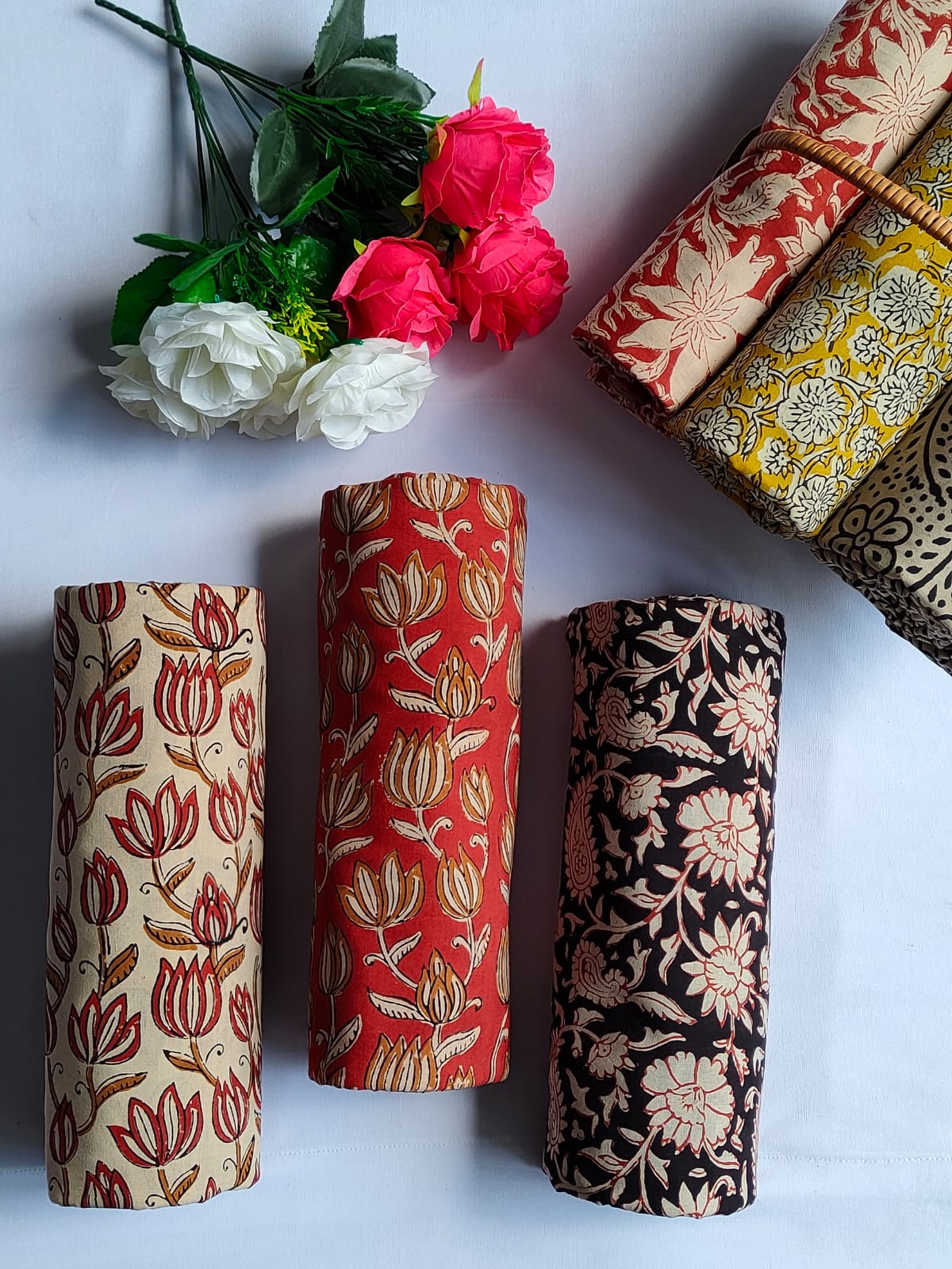


Choosing a handblock print fabric is about more than finding a pattern you like. The right design should suit your project, complement its shape, work with your preferred colours and feel appropriate for the way you intend to use it.
A delicate floral print might be perfect for a summer dress, while an earthy Bagru pattern could bring character to an everyday kurta. An intricate Ajrakh-inspired geometric design may work beautifully for a statement shirt, and a small repeating motif could be ideal for a tote bag, cushion cover or other sewing project.
India's handblock printing traditions offer an extraordinary range of choices. Rajasthan's Bagru and Sanganer are known for distinctive approaches to floral and botanical patterns, while Ajrakh, associated with Gujarat's Kutch region and the wider Sindh tradition, is celebrated for its geometric designs and layered resist-printing techniques.
Understanding these traditions can make choosing fabric more enjoyable. It also helps you appreciate the artisans, skills and regional histories behind the patterns.
In this guide, we explain how to choose the perfect handblock design for clothing, accessories and home décor, explore the differences between major Indian printing traditions, and share practical tips for selecting fabric. We also look at how thoughtful buying can help preserve India's textile heritage.
1. Start With the Purpose of Your Project
Before choosing a print, decide what you want to make. A pattern that looks beautiful on a fabric swatch may behave differently when used for a full dress, a narrow sleeve or a small accessory.
The purpose of your project will help you narrow down the choices.
For dresses and summer clothing
Small florals, delicate botanical motifs and lighter-looking patterns are versatile options for everyday dresses. Sanganeri-inspired florals are worth exploring if you prefer detailed designs on a light background.
For relaxed summer clothing, also check the fabric's composition, weave and weight. The print itself does not determine whether a fabric will feel cool or comfortable.
For kurtas and tunics
Bagru-inspired florals, repeating butis, bel motifs and medium-scale botanical designs can work well for kurtas and tunics. Earthy colours create a traditional appearance, while brighter combinations can give the garment a more contemporary feel.
Consider the placement of the pattern around the neckline, sleeves and front panel, especially if the design includes larger motifs or borders.
For shirts and contemporary outfits
Geometric prints, compact repeats and bold indigo patterns can work well for casual shirts, oversized silhouettes and contemporary ethnic wear.
Ajrakh-inspired patterns are one option if you prefer structured geometry and strong colour contrast. For a more understated look, choose smaller motifs with more space between them.
For bags and accessories
Tote bags, pouches and fabric accessories offer opportunities to use smaller pieces of printed fabric. Bold motifs can be effective because the finished item has a limited surface area.
If you are using fabric left over from a garment, a complementary print or a plain cotton fabric can help you create a coordinated set.
For home décor
Cushion covers, table runners, fabric baskets and other decorative projects can benefit from repeated motifs and patterns that work across a wider surface.
Consider the colours already present in your room. A strong geometric print may suit a simple interior, while a delicate floral pattern can complement a softer decorative style.
For more project ideas, read Jaipur Bazar's guide to Hand Block Print Fabric for Sewing & Crafts.
2. Understand the Difference Between Bagru, Sanganer and Ajrakh
Indian handblock printing is not a single design style. Different regions have developed their own motifs, colour preferences and production techniques.
Three traditions worth understanding before choosing a print are Bagru, Sanganer and Ajrakh.
Bagru: Earthy Patterns With a Traditional Character
Bagru, near Jaipur in Rajasthan, has a long history of handblock printing associated particularly with the Chhipa community. Traditional Bagru textiles often feature botanical motifs, repeating floral arrangements and earthy combinations of red, black, brown and indigo.
Artisans use carved wooden blocks to build the pattern impression by impression. Some designs use direct printing, while others incorporate Dabu, a resist-printing technique in which a paste protects selected areas of the fabric during dyeing.
Bagru printing has traditionally been used for clothing and household textiles. Today, its design language also inspires contemporary garments, scarves, bags and decorative pieces.
Choose Bagru-inspired patterns if you like:
-
Earthy colours and grounded colour combinations.
-
Botanical motifs with a strong repeating rhythm.
-
Traditional-looking prints for everyday clothing.
-
Dabu-inspired patterns with contrasting, textured effects.
Explore Jaipur Bazar's Bagru Print Cotton Fabrics collection for designs inspired by this regional tradition.
Remember that a Bagru-inspired motif does not necessarily mean the fabric was produced in Bagru. If regional origin is important to you, check the seller's product information.
Sanganer: Fine Florals and Delicate Details
Sanganer, near Jaipur, is widely recognised for delicate floral handblock printing. Its design vocabulary includes small butis, larger butas, vines, leaves and interconnected floral jaals.
Traditional Sanganeri designs are often associated with white or light-coloured backgrounds, although contemporary products use a wider range of colours and grounds.
The fine details make these patterns a useful option when you want a decorative print that does not overwhelm the garment. Small florals can work well for everyday clothing, while larger botanical arrangements offer more visual presence.
Choose Sanganeri-inspired patterns if you like:
-
Fine floral motifs and botanical details.
-
Light backgrounds with colourful prints.
-
Elegant patterns for dresses, kurtas and blouses.
-
Repeating designs that work across different garment shapes.
Sanganeri handblock printing has a recognised regional identity documented by India's handicrafts authorities. Its traditions demonstrate how a distinctive design language can develop around a particular printing centre.
For more options, browse Jaipur Bazar's Printed Cotton Fabrics collection.
Ajrakh: Geometric Patterns and Deep Indigo
Ajrakh is a distinctive resist-printing tradition associated with Sindh and the Kutch region of Gujarat, with related traditions also found in Barmer, Rajasthan.
Its characteristic design language often includes symmetrical geometric patterns, repeating stars and diamonds, floral geometry and carefully aligned borders. Deep indigo, red, black and white are familiar colours in traditional Ajrakh textiles.
The production process can involve multiple stages of washing, resist printing and dyeing. In traditional forms, repeated impressions and careful alignment create complex patterns across the cloth.
Ajrakh-inspired designs can be a good fit for people who prefer stronger geometry over small florals.
Choose Ajrakh-inspired patterns if you like:
-
Repeated geometric motifs and symmetry.
-
Deep indigo and red colour combinations.
-
Strong borders and structured patterns.
-
Statement designs for shirts, jackets, stoles and accessories.
The Government of India's handicrafts documentation describes Ajrakh's regional history, resist-printing process and distinctive colour palette.
When buying a product described as Ajrakh, check whether the seller explains its origin and production method. A contemporary design inspired by Ajrakh is not necessarily an authentic textile produced using the traditional process.
3. Choose the Right Pattern Scale
Pattern scale is one of the most important considerations when selecting fabric. A tiny repeating motif and a large floral design can create very different effects, even when they use similar colours.
Small-scale patterns
Small motifs repeat frequently across the fabric. They can be a practical choice for everyday clothing, children's garments and projects that involve several narrow pieces.
Small-scale patterns are often easier to coordinate with plain fabrics because they do not dominate the overall design.
Good for: Everyday kurtas, shirts, blouses, children's clothing and small accessories.
Medium-scale patterns
Medium-sized motifs provide a balance between detail and visual impact. They can work well on dresses, tunics, skirts and cushion covers.
This scale is useful when you want the print to be noticeable without making it the only feature of the finished project.
Good for: Dresses, kurtas, tunics, skirts and home décor.
Large-scale patterns
Large flowers, geometric arrangements and decorative motifs create a strong statement. However, they need more attention during cutting and sewing.
A large motif may look excellent across a dress front but become partially hidden in a narrow sleeve or small accessory. You may need additional fabric to position the pattern as intended.
Good for: Statement garments, jackets, large cushion covers, bags and decorative panels.
Practical tip: Check close-up photographs and, where possible, the stated dimensions of the repeat. Do not judge the scale from a small product thumbnail alone.
4. Select Colours That Match Your Vision
Colour affects how a handblock design feels and how easily it coordinates with other fabrics.
Traditional printing styles offer a wide range of palettes, from earthy reds and browns to delicate florals and deep indigo geometry.
Earthy colours
Rust, brown, black and muted red can create a grounded appearance. These shades work well for people who enjoy traditional-looking prints and want a fabric that pairs easily with neutral colours.
Bagru-inspired designs are a useful starting point for this colour direction.
Light and colourful florals
White, cream and pastel backgrounds can make small flowers and leaves stand out. This palette works well for delicate dresses, blouses, everyday kurtas and lightweight-looking outfits.
Sanganeri-inspired florals are worth exploring if you prefer this style.
Indigo and high-contrast colours
Deep blue paired with red, black or white can create a strong visual statement. Geometric patterns become especially prominent when the contrast between the background and motifs is clear.
Ajrakh-inspired designs offer plenty of inspiration for this look.
Minimal two-colour combinations
A design that uses just two main colours can be easy to coordinate with plain fabric. This is useful when you want to combine a print with solid sleeves, contrasting panels or a plain bottom.
Before buying, consider whether the colours will work with the rest of your wardrobe or the room where the finished piece will be used.
5. Consider the Fabric, Not Just the Print
A beautiful pattern cannot compensate for a fabric that is unsuitable for your project. Handblock printing describes how a pattern is applied, not what the fabric is made from.
Check the product details for the fibre composition, weave, weight, width and finish.
Cotton for everyday sewing
Cotton is commonly used for Indian handblock printing and can be suitable for shirts, kurtas, dresses, children's clothing and accessories.
However, cotton fabrics vary considerably. Their comfort, drape and durability depend on the yarn, weave, construction and finishing.
Lightweight cotton for flowing garments
If you are making a gathered dress, a relaxed kurta or a garment with soft movement, look for a fabric whose weight and drape suit the design.
Do not assume every printed cotton is lightweight. Check the product details and sample the fabric if possible.
More structured cotton for defined shapes
Some projects benefit from a fabric that holds its shape more readily, such as a structured shirt, tote bag or cushion cover.
The right choice depends on the intended design. Fabric weight alone does not tell you everything about how a material will behave.
To compare different options, explore All Cotton Fabrics at Jaipur Bazar.
For more help evaluating fabric quality, read How to Identify High-Quality Cotton Fabric.
6. Think About Borders, Motif Direction and Placement
Some printed fabrics have a continuous all-over pattern, while others feature decorative borders or motifs that have a clear direction.
These details matter when you start cutting the cloth.
All-over prints
An all-over pattern repeats across the fabric without relying on a single focal point. It is often easier to use for garments with several separate panels.
However, you should still consider the pattern repeat if you want motifs to line up across seams.
Border prints
Border patterns are concentrated along one or more edges. They can be useful for sleeve ends, hems, dupattas, table runners and cushion covers.
Before cutting, decide where you want the border to appear. You may need additional fabric to create matching borders on both sleeves or to place the design consistently.
Directional motifs
Some motifs have an obvious top and bottom, such as a flower on a stem or a bird facing one direction. Turning a pattern upside down on one garment panel may create an unintended effect.
Check the fabric layout before cutting and plan the direction of each piece.
Large motifs and pattern matching
If your design features large butas, geometric medallions or prominent floral arrangements, plan where the motifs will sit on the finished garment.
Allow extra material if you need to match patterns across seams. This is especially important for garments with symmetrical fronts or prominent centre panels.
7. Match the Design to Your Sewing Skill Level
Some prints are easier to work with than others, particularly if you are new to sewing.
If you are a beginner
Start with an all-over print that does not require precise motif placement. Small florals or compact geometric repeats can be useful for simple skirts, shirts, cushion covers and tote bags.
A repeating pattern can help you focus on construction rather than matching a large design across several pieces.
If you have some sewing experience
Try a medium-scale floral, a bel motif or a fabric with a decorative border. These designs allow you to experiment with placement while keeping the overall project manageable.
If you enjoy detailed sewing
Large motifs, border prints and complex geometric patterns can reward careful planning. Consider how the design will align across seams and where you want the main motifs to appear.
Before cutting expensive or limited fabric, make a simple layout plan on paper. It can help you estimate the quantity needed and avoid placing a prominent motif somewhere you do not want it.
For more practical ideas, see Hand Block Print Fabric for Sewing & Crafts.
8. Understand How Traditional Printing Techniques Affect the Design
Knowing a little about the printing method can help you choose a fabric whose appearance suits your project.
Direct handblock printing
In direct printing, artisans apply colour to a carved block and press it onto the fabric. Different blocks may be used for outlines, details and additional colours.
The alignment and clarity of the impressions influence the final look. Small variations may occur because the pattern is placed by hand.
Resist printing
In resist printing, a paste or other material protects selected areas from dye. Once the resist is removed, the protected areas create contrasting shapes.
Dabu printing in Rajasthan and traditional Ajrakh production are examples of traditions that use resist techniques, although their processes and design languages differ.
Why the distinction matters
A resist-printed pattern may have a different visual character from a direct print. If you prefer layered contrasts and textured-looking motifs, resist-printing traditions may appeal to you.
However, the printing method alone does not guarantee a particular level of quality, colourfastness or environmental impact. Those qualities depend on the materials, construction and production process.
For a deeper explanation, read How Handblock Printing Works: Techniques & Traditions.
9. Check Product Details Before You Buy
When buying fabric online, the product description is an important part of the decision.
Before placing an order, check:
-
Composition: Is the fabric cotton or another fibre?
-
Width: Will the available width suit your pattern pieces?
-
Quantity: Have you allowed enough fabric for seams, hems and motif matching?
-
Print details: Is the product handblock printed, machine printed or described as inspired by a regional tradition?
-
Colour and pattern: Are there close-up images that show the motif scale?
-
Care instructions: How should the fabric be washed and maintained?
-
Origin claims: If regional authenticity matters, is the place of production clearly explained?
Do not assume that every handblock print uses natural dyes or that every traditional-looking motif was produced by artisans in the region associated with it.
Clear product information helps you choose the fabric based on what it actually offers rather than on appearance alone.
10. Choose Thoughtfully to Help Preserve Indian Textile Traditions
Choosing a fabric can also be an opportunity to learn about the people and places behind its design.
Bagru, Sanganer and Ajrakh represent distinctive traditions that have developed through generations of specialised work. Their patterns reflect regional histories, community knowledge and different approaches to printing and dyeing.
Support accurate craft representation
When sellers clearly explain a fabric's origin and printing method, customers can make informed choices. It also helps distinguish regional craft products from modern designs that take inspiration from traditional motifs.
A Bagru-inspired floral and an authentic textile produced in Bagru may look similar, but the descriptions should not suggest they are the same unless the product's origin supports that claim.
Recognise the skill behind the pattern
Traditional printing involves more than stamping a motif onto cloth. Depending on the technique, production may include block carving, fabric preparation, colour preparation, resist application, repeated printing, washing and drying.
Complex patterns require careful planning and experience. Learning about these stages helps buyers appreciate the work behind the finished textile.
Make room for traditional designs in modern projects
Traditional patterns can remain relevant when people use them in contemporary clothing, bags, accessories and home décor.
A Bagru-inspired print might become an everyday shirt. A delicate floral pattern can be used for a summer dress, while an Ajrakh-inspired geometric design may suit a jacket or tote bag.
These new applications can introduce more people to Indian textile design, provided the origins and techniques are described accurately.
Look beyond broad sustainability claims
Some traditional printing workshops use natural dyes and traditional materials, while others use synthetic dyes or a combination of methods. The environmental impact depends on the actual production process, materials, water use and waste management.
A fabric should not automatically be considered organic or environmentally harmless simply because it is handblock printed.
Thoughtful purchasing starts with accurate information about the product and the people who make it.
Explore India-Inspired Block Print Fabrics at Jaipur Bazar
Choosing the right handblock design becomes easier when you know what you want to make, which patterns you prefer and how the fabric will be used.
For delicate floral details, explore Sanganeri-inspired designs. For earthy motifs and resist-print effects, consider Bagru-inspired patterns. If you prefer strong geometry and deep indigo tones, Ajrakh-inspired designs may be worth exploring.
Jaipur Bazar's India-inspired fabric collections offer a starting point for discovering printed cotton fabrics for clothing, sewing and home décor.
Browse the Hand Block Print Cotton Fabrics collection, explore Bagru Print Cotton Fabrics, or discover Dabu Cotton Fabrics.
Review each product's composition, width, design and care information before ordering. Choosing a fabric that fits your project will help you get more from both the pattern and the material.
Frequently Asked Questions
1. How do I choose the right handblock design for my project?
Start by deciding what you want to make. Consider the garment or item's shape, the size of the motifs, your preferred colours and the fabric's weight and width. Small repeats are often practical for everyday garments, while larger motifs and borders need more careful placement.
2. Which handblock print is best for dresses?
Delicate florals, small butis and botanical patterns are popular choices for dresses. Sanganeri-inspired designs are worth exploring if you prefer fine floral details. Always check the fabric's composition, weight and drape to make sure it suits the intended garment.
3. What is the difference between Bagru and Sanganeri prints?
Bagru is often associated with earthy colours, botanical patterns and Dabu resist printing. Sanganer is widely recognised for fine floral motifs, including butis, butas and jaals, often on light backgrounds. Both are important printing traditions from Rajasthan, but their typical design characteristics differ.
4. Is Ajrakh suitable for contemporary clothing?
Yes. Ajrakh and Ajrakh-inspired geometric designs can be used for shirts, kurtas, jackets, stoles, scarves and accessories. Check the fabric's composition and weight to determine whether it suits the particular garment.
5. How much fabric should I buy for a project?
The required quantity depends on the garment pattern, fabric width, size, sleeve length, seam allowances and design placement. Border prints and large motifs may require extra material for matching. Use your sewing pattern's fabric estimate and allow for additional matching where needed.
6. Are all handblock printed fabrics made with natural dyes?
No. Natural dyes have an important place in some traditional printing practices, but contemporary production may use synthetic dyes or combinations of materials. Check the specific product description if dye composition is important to you.
7. How can I tell whether a fabric is genuinely handblock printed?
Appearance alone is not enough, because screen and digital printing can reproduce similar patterns. Look for clear information about the printing method, maker or workshop, and place of production. Ask the seller if important details are missing.
8. Where can I buy handblock print cotton fabric online?
You can explore Jaipur Bazar's Hand Block Print Cotton Fabrics collection. Check the individual product details to choose a design and fabric that suit your project.
Final Thoughts
The perfect handblock design is one that works for your project while reflecting your personal taste. Small florals, earthy Bagru patterns, delicate Sanganeri motifs and Ajrakh-inspired geometry each offer a different way to bring Indian textile design into everyday life.
Consider the purpose of your project, the scale and colour of the print, the fabric's composition and the practical details of cutting and sewing. Learning about the tradition behind a design can also make the selection process more meaningful.
With thoughtful choices and accurate product information, you can enjoy the beauty of Indian handblock-inspired textiles while helping keep the stories behind these designs visible for future generations.