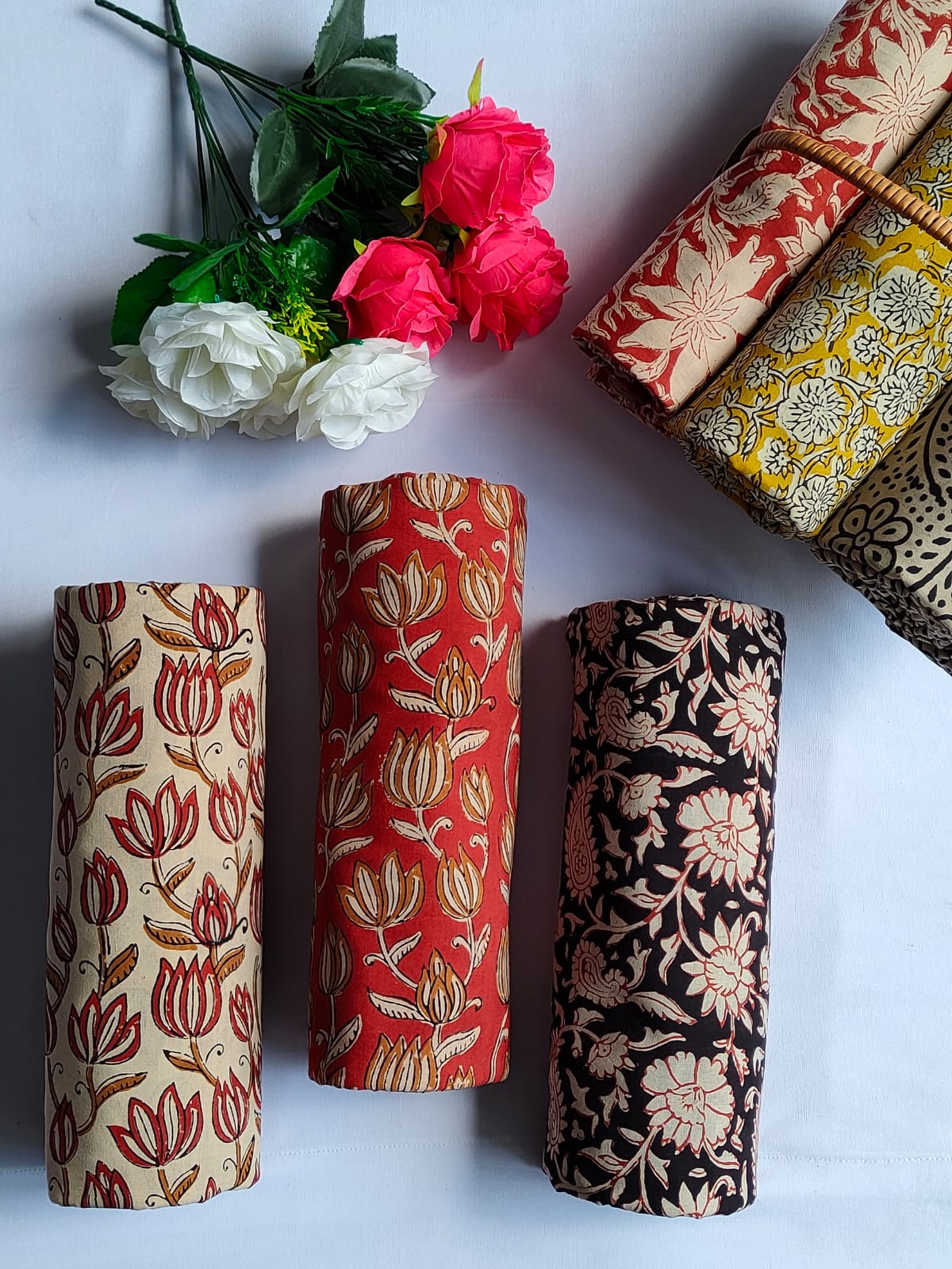


There is something special about fabric printed by hand. A repeating flower, a row of tiny leaves, or a geometric pattern may look simple at first glance, but each design carries the marks of a craft that has been practised, refined, and passed down through generations.
India has a particularly rich tradition of handblock printing. Across Rajasthan, Gujarat, and other parts of the country, artisans use carved wooden blocks, carefully prepared colours, and skilled hand movements to transform plain cloth into patterned textiles. The results range from the earthy reds and blacks associated with Bagru to the delicate florals of Sanganer and the intricate indigo geometry of Ajrakh.
Today, handblock-printed cotton is used for much more than traditional clothing. Sewists choose it for dresses, shirts, skirts, and kurtas. Crafters use it for tote bags, pouches, quilts, cushion covers, fabric gifts, and decorative projects. Designers bring traditional prints into contemporary collections, giving historic patterns a place in modern wardrobes and homes.
For anyone who enjoys working with fabric, handblock printing offers two kinds of inspiration: the visual beauty of the finished textile and the human skill behind its creation.
At Jaipur Bazar, India's textile heritage inspires a selection of printed cotton fabrics for clothing, sewing, and creative projects. The Hand Block Print Cotton Fabrics collection is a useful starting point for exploring India-inspired prints and finding patterns for your next project.
In this guide, we will explore the history and regional character of Indian handblock printing, explain how the process works, share sewing and craft ideas, and discuss how buyers can help preserve the traditions behind these fabrics.
1. What Is Hand Block Print Fabric?
Handblock printing is a textile-printing technique in which artisans use carved blocks, traditionally made from wood, to apply designs to fabric.
Each block carries a particular part of a pattern. When the artisan applies colour to the carved surface and presses it onto the cloth, the design is transferred as an impression. Repeating the process creates a continuous pattern across the fabric.
Simple designs may use one block and one colour. More elaborate prints can require several blocks, with separate ones for outlines, background colours, and decorative details. Each impression must be positioned carefully so that the elements align and the pattern remains balanced.
Unlike digital printing, which transfers a design through a digital production process, handblock printing depends on the physical interaction between the block, the colour, the fabric, and the artisan.
Small differences in placement or colour can occur because each impression is made by hand. These variations may contribute to the character of a handprinted textile, although they are not proof of authenticity on their own. Skilled artisans still aim for clarity, consistent colour application, and accurate pattern placement.
Why is handblock-printed cotton popular for sewing?
Cotton is a versatile textile material, and printed cotton fabrics are available in a wide range of colours, patterns, weights, and constructions.
Depending on its construction, cotton fabric can work well for garments, accessories, and many home craft projects. Its familiar handling characteristics also make it a practical choice for people who sew at home.
Handblock printing adds another dimension. Instead of beginning with a plain surface, the maker starts with a pattern that can guide the design of the finished item.
A small floral print may suit a gathered skirt or children's garment. A geometric pattern may work well for a cushion cover or tote bag. A more intricate design can become the central feature of a simple dress or shirt.
If you are new to choosing cotton, Jaipur Bazar's guide to the different types of cotton fabrics available can help you understand how different constructions suit different uses.
2. The Cultural Heritage Behind India's Handblock Printing
Indian handblock printing is not one uniform tradition. It includes many regional practices shaped by local communities, materials, design preferences, and production methods.
Rajasthan is known for established printing centres such as Bagru and Sanganer. Gujarat's Kutch region is associated with Ajrakh, a complex resist-printing tradition with historical connections across the wider Sindh region.
These traditions have their own visual identities. Yet they share an important feature: the finished textile depends on knowledge that extends beyond the printing block itself.
Artisans must understand how to prepare the cloth, apply colour, align the design, and carry out the necessary washing or dyeing stages. Block makers, printers, dyers, washers, and finishers may all contribute to the final product.
This knowledge is often developed through years of observation and practice. It is also part of a wider textile culture in which patterns and techniques connect people to particular places and communities.
The Indian government's handicrafts resources document Bagru, Sanganeri, and Kutch Ajrakh as distinct textile traditions, each with its own production methods and regional associations.
For people who sew or craft, learning about these traditions offers a richer way to appreciate the fabric. A print becomes more than a decorative surface. It becomes a connection to the people and skills that made it.
3. Bagru Block Prints: Earthy Patterns from Rajasthan
Bagru, a town near Jaipur, is one of Rajasthan's best-known centres for traditional handblock printing. The craft is closely associated with the Chhipa printing community and is recognised for its distinctive use of colour, motifs, and resist-printing techniques.
Bagru's printing heritage developed through generations of practical knowledge. The area's local environment and traditional production practices influenced how artisans prepared and printed their textiles.
What makes Bagru prints distinctive?
Bagru prints are often associated with earthy colour combinations, including reds, blacks, indigo blues, and muted natural-looking shades.
Common design elements include flowers, leaves, vines, stylised geometric motifs, and repeating patterns. Some designs are relatively simple, while others combine several colours and decorative elements.
The overall appearance can feel grounded and organic. Instead of relying only on bright contrasts, many Bagru-inspired prints create interest through the relationship between darker motifs, lighter backgrounds, and repeated shapes.
The exact look varies from one design to another. Contemporary Bagru-style fabrics may also use colour combinations that differ from more traditional palettes.
Understanding Dabu printing
Dabu is a mud-resist printing technique associated with Bagru and other textile-printing traditions in Rajasthan.
In resist printing, selected parts of the fabric are protected from dye. The artisan applies a resist paste to create areas where the dye will not penetrate in the same way as it does elsewhere.
After the resist is applied, the fabric may be treated with additional materials before dyeing. The protected areas retain a contrasting appearance, producing the characteristic patterns associated with resist-printed textiles.
Traditional Dabu processes may use locally prepared pastes and other materials, but exact recipes and production stages vary. Not every Bagru print is a Dabu print, and not every fabric described as Dabu is necessarily produced in the same way.
This distinction matters when buying fabric. A design may resemble traditional Dabu patterns without having been created using the traditional resist-printing process.
How to use Bagru prints for sewing
Bagru-inspired fabrics can work beautifully in projects where colour and pattern are central to the design.
For clothing, consider:
-
Everyday kurtas and tunics.
-
Relaxed shirts and tops.
-
Gathered skirts and simple dresses.
-
Lightweight jackets, depending on the fabric construction.
-
Scarves and other accessories.
For home and craft projects, consider:
-
Cushion covers.
-
Table runners and table linens.
-
Fabric pouches.
-
Tote bags.
-
Patchwork and quilting accents.
-
Decorative fabric panels.
The fabric's weight and construction should guide your final choice. A lightweight cotton may suit a gathered garment, while a more substantial construction may be preferable for an accessory that needs more structure.
If you love this style, explore Jaipur Bazar's Bagru Print Cotton Fabrics collection.
This collection is a starting point for discovering Bagru-inspired prints. Check the individual product details to confirm the actual print style, fibre composition, and construction before choosing a fabric for a particular project.
4. Sanganeri Printing: Delicate Florals from Rajasthan
Sanganer, near Jaipur, is another important centre of Rajasthan's textile-printing heritage. Sanganeri printing is widely associated with fine floral motifs, detailed patterns, and designs that often appear on white or light-coloured fabric.
The tradition has developed a distinctive visual character through its repeated flowers, leaves, vines, and decorative forms.
The signature look of Sanganeri prints
Sanganeri prints frequently feature small flowers, delicate foliage, flowering branches, and repeating motifs known as butis.
The details may appear subtle from a distance but become more noticeable when the fabric is examined closely. Carefully arranged motifs can create a balanced pattern that works well across an entire length of cloth.
White and off-white backgrounds are strongly associated with the tradition, although contemporary designs use a broader range of colours.
The resulting fabric can look delicate without being limited to traditional garments. Its patterns can work equally well in modern clothing, accessories, and home décor.
Why precision matters
Fine floral patterns require carefully carved blocks and accurate placement.
The printer must apply the right amount of colour, press the block evenly, and position each impression so that the design remains coherent. Where multiple blocks are used, the different elements must align.
This combination of repetition and precision is one of the most recognisable aspects of handblock printing.
Sewing ideas for Sanganeri cotton
Sanganeri-inspired prints are useful when you want pattern without an overly bold visual effect.
For clothing, consider a simple dress, a button-front shirt, a kurta, a tunic, or a gathered skirt. A small floral print can add detail without making the garment feel visually crowded.
For craft projects, try fabric bookmarks, patchwork squares, cushion covers, lined pouches, or fabric-covered notebooks.
Smaller motifs may be easier to work with when cutting narrow pieces, while larger prints may need more careful placement to preserve the design.
For example, if you are sewing a dress with a front opening or a collar, consider where the floral pattern will sit around the seams. Pattern placement can make a simple design look more considered.
You can explore Jaipur Bazar's Hand Block Print Cotton Fabrics collection to discover cotton prints inspired by India's block-printing traditions.
Sanganeri printing and craft preservation
Sanganeri Hand Block Printing is documented as a recognised geographical textile tradition in India's handicrafts resources.
Geographical Indication recognition helps identify products associated with a particular region and its established reputation or characteristics. It can support the identity of a regional craft, although buyers should still check the actual origin and production details of individual products.
A textile that imitates a Sanganeri design is not automatically made in Sanganer or produced using traditional handblock methods. Clear product descriptions help customers understand that difference.
5. Ajrakh Printing: Intricate Geometry from Gujarat
Ajrakh is a distinctive resist-printing tradition associated with Kutch in Gujarat and with the wider cultural history of the Sindh region.
The craft is known for intricate geometric patterns, carefully arranged borders, and colour combinations that often feature deep indigo, red, black, and pale unprinted areas.
Ajrakh printing demonstrates how complex a handprinted textile can be. The finished design may look like a single, unified pattern, but it can require multiple stages of printing, resisting, dyeing, and washing.
What makes Ajrakh different?
Unlike prints that rely mainly on a single repeated floral motif, Ajrakh often uses complex geometric arrangements.
Stars, grids, dots, borders, symmetrical shapes, and medallion-like forms can work together to create a richly detailed surface.
Indigo blue is especially associated with many Ajrakh textiles, although the designs and colours vary. The combination of deep colour and geometric structure gives the fabric a distinctive appearance.
The role of resist printing
Resist printing is central to many Ajrakh processes.
Artisans apply materials that protect selected parts of the fabric during dyeing. By repeating this process in a planned sequence, they can create several colours and layers within one design.
Different stages may be used to protect some areas, expose others, and build the final pattern. Indigo dyeing can add further complexity because the fabric needs to undergo the appropriate treatment for the blue colour to develop.
The exact method depends on the workshop and the materials used. Ajrakh is best understood as a skilled tradition involving multiple interconnected stages, rather than simply a decorative pattern printed onto cloth.
Ajrakh-inspired sewing and craft projects
Ajrakh's geometric patterns can become the focal point of a sewing project.
For clothing, consider a simple shirt, a tunic, a relaxed jacket, or a statement panel within a larger garment. A straightforward silhouette can help a detailed print stand out.
For accessories, Ajrakh-inspired cotton may work for pouches, tote bags, book covers, scarves, or patchwork designs. Depending on the fabric's construction, a lining or reinforcement may be needed for bags and other items that experience frequent handling.
For home décor, geometric prints can be used in cushion covers, table runners, wall panels, or other decorative fabric projects.
When working with a detailed pattern, think about the scale of the design and the size of each cut piece. A small pouch may show only part of a large motif, while a cushion cover may provide enough space to display the full pattern.
Preserving Ajrakh today
Ajrakh survives through the continued work of artisans who maintain knowledge of block carving, resist materials, dye preparation, and printing sequences.
Contemporary designers have also helped introduce Ajrakh-inspired patterns to new audiences through modern garments, accessories, and home products.
The challenge is to make these textiles relevant to contemporary buyers while recognising the communities and skills behind them.
A modern product can draw inspiration from Ajrakh's geometric language without being made through traditional Ajrakh processes. Accurate descriptions are important because they allow buyers to appreciate both the design and the actual craft involved.
For readers exploring Indian-inspired prints, Jaipur Bazar's printed cotton fabrics offer another place to browse. Check individual product descriptions for the specific printing technique and origin rather than assuming that every geometric print is Ajrakh.
6. Bagru, Sanganer, and Ajrakh: How Do They Compare?
Although these traditions share a connection with Indian textile printing, they have different visual identities and regional histories.
| Feature | Bagru | Sanganer | Ajrakh |
|---|---|---|---|
| Regional association | Bagru, Rajasthan | Sanganer, Rajasthan | Kutch, Gujarat, with historical links to Sindh |
| Common visual character | Earthy colours and stylised motifs | Fine florals and detailed repeating patterns | Intricate geometry and layered patterns |
| Associated colours | Reds, blacks, indigo, earthy shades | Often light backgrounds with varied floral colours | Indigo, red, black, and pale areas |
| Associated methods | Handblock printing and Dabu resist techniques | Fine handblock printing with precise motif placement | Complex resist printing and dyeing |
| Sewing possibilities | Clothing, bags, cushions, patchwork | Dresses, shirts, pouches, home décor | Statement garments, accessories, cushions, decorative panels |
These are general descriptions, not strict rules. Contemporary textiles can use different colours and designs, and a fabric's appearance alone cannot establish its origin or production method.
For sewing enthusiasts, the practical lesson is simple: choose a print based on the project's visual requirements, then check the fabric construction and product details.
7. Choosing the Right Handblock-Printed Fabric for Sewing
A beautiful print is a good starting point, but the fabric must also work for the item you want to make.
Cotton fabrics can vary in thickness, weave, softness, drape, and opacity. Even two fabrics with similar prints may behave differently when cut and sewn.
Consider the fabric's weight
Lightweight cotton may suit gathered dresses, relaxed tops, scarves, and other projects that benefit from a softer drape.
A more substantial cotton may be suitable for shirts, structured accessories, or items that need to hold their shape.
Do not assume that every printed cotton has the same weight. Read the product description and request additional information if necessary.
Check the weave and construction
A print can be applied to different types of cotton fabric. The underlying construction affects how the cloth handles during sewing and how the finished item looks.
For instance, a lightweight fabric may gather easily, while a more closely constructed fabric may provide a smoother or more stable surface.
If you are comparing options, browse cotton cambric fabrics and mulmul cotton fabrics to understand the different kinds of cotton available for sewing. These are alternative cotton fabric categories, not automatically handblock-printed products.
Think about print scale
Print scale can change the appearance of a finished project.
Small floral patterns can work well for narrow panels, collars, children's garments, and small accessories. Larger patterns may need more space to show their details.
Before cutting, lay the fabric flat and consider where the main motifs will fall. This is especially important for garments with front openings, collars, pockets, or matching pieces.
Check colour and care information
Fabric photographs can look different depending on lighting and screen settings. If a colour must match another material, request a sample where available.
Also check the care instructions. Washing requirements can vary according to the fabric, dye, and finishing process.
For additional guidance, read Jaipur Bazar's article on how to identify high-quality cotton fabric.
8. Handblock Print Fabric Ideas for Sewing Projects
One of the best things about handblock-printed fabric is that the pattern can provide the starting point for the entire project.
You do not need a complicated design to make good use of a beautiful textile. Sometimes a simple shape allows the print to do most of the work.
Dresses and skirts
A simple dress or gathered skirt can show off a repeating floral or geometric pattern.
Choose a fabric whose weight suits the pattern and shape of the garment. Lightweight cotton may work for gathered designs, while a more structured cotton may suit a different silhouette.
When cutting the pieces, pay attention to the print direction and any motifs that need to appear in a particular position.
Shirts, kurtas, and tunics
Printed cotton works well for everyday garments where pattern is an important part of the design.
A simple shirt can showcase a detailed floral print, while a relaxed kurta can make use of larger motifs or stronger colour contrasts.
For matching garments, check whether enough fabric is available from the same design and production lot if consistency is important.
Tote bags and pouches
Small accessories are useful projects for experimenting with traditional prints.
A tote bag can showcase a larger motif, while a pouch may suit smaller patterns. Depending on the intended use, the project may require lining, interfacing, or reinforcement.
The print itself does not determine the bag's strength. Fabric construction and the way the item is assembled matter just as much.
Quilting and patchwork
Handblock-printed cotton can add variety to patchwork and quilting projects.
Try combining different scales of floral patterns, geometric designs, and plain cotton fabrics. A consistent colour palette can help several prints work together without making the finished project feel too busy.
Before cutting the fabric into small pieces, check whether the design repeats in a way that can be used effectively in your layout.
Cushion covers and table linens
Printed cotton can be used for cushion covers, table runners, napkins, and other decorative projects.
A large geometric pattern may suit a cushion front, while a small floral print may work well across a table runner or a set of fabric accessories.
For home décor projects, consider how the print will look alongside existing colours and patterns in the room.
For more inspiration, explore Jaipur Bazar's article on the popular uses of cotton fabric in home décor.
Fabric gifts and handmade accessories
Smaller pieces of printed cotton can be used for bookmarks, gift bags, fabric-covered journals, decorative patches, or handmade gifts.
These projects are also a practical way to use leftover fabric from larger sewing projects.
Choose a design that suits the scale of the finished item. A tiny accessory may work best with a small repeating print, while a larger fabric panel can show off a more elaborate motif.
9. Practical Tips for Sewing with Handblock-Printed Cotton
Once you have chosen your fabric, a little preparation can make the sewing process easier.
Prepare the fabric before cutting
Check the care instructions before washing or preparing the fabric. If prewashing is appropriate, follow the recommended method and allow the material to dry properly before cutting.
Prewashing can help you understand how the fabric behaves, but the right method depends on the fibre, dyes, and finish.
Test your stitches
Use a scrap piece to test the needle, thread, and stitch settings before starting the main project.
Different cotton constructions can behave differently under the sewing machine. A test helps you check the stitch appearance and whether the fabric is being pulled or distorted.
Plan the pattern placement
Before cutting, arrange the pattern pieces on the fabric and check where the main motifs will appear.
You may want to align a border, centre a motif, or ensure that two visible pieces have a similar pattern direction.
Pattern matching can require additional fabric, so allow for this when estimating the quantity needed.
Use leftover pieces thoughtfully
Save useful offcuts rather than discarding them immediately. Small pieces may be suitable for patchwork, pocket details, binding, fabric-covered accessories, or decorative accents.
Combining leftovers from different prints can also create interesting designs, especially when the colours share a common theme.
Follow the fabric's care instructions
Do not assume that all handblock-printed cotton can be washed in the same way. Dye type, finishing, and fabric construction influence care requirements.
For general advice about cotton, read the best ways to care for and wash woven cotton fabrics.
10. How Indian Block-Printing Traditions Are Preserved Today
Traditional printing continues when artisans can maintain their skills, pass them on, and earn a living from their work.
Preservation is therefore about much more than keeping old patterns in circulation. It means supporting the people and production networks that make the craft possible.
Passing skills to younger generations
Many aspects of handblock printing are learned through practice.
An experienced printer knows how much colour to apply, how to hold and position a block, and how to respond when a print does not come out as expected. A dyer understands how materials behave at different stages of production.
This knowledge can be difficult to learn from a written description alone. It develops through observation, experimentation, and working alongside experienced artisans.
Opportunities for younger people to learn and earn from these crafts help keep that knowledge alive.
Supporting the wider artisan community
A printed textile may pass through several hands before it reaches a customer.
Block carvers create the tools. Printers apply the patterns. Dyers and washers carry out important stages of the process. Other workers prepare the cloth, inspect the finished material, and help bring it to market.
Supporting traditional printing means recognising this wider network of work.
Buyers can contribute by seeking accurate product descriptions, choosing responsibly sourced textiles where information is available, and understanding the difference between a labour-intensive craft and a mass-produced imitation.
Regional recognition and craft identity
Geographical Indication recognition can help identify textile traditions associated with particular regions.
Bagru and Sanganeri handblock printing are documented as recognised regional textile traditions in India's handicrafts resources. Such recognition helps distinguish established craft identities and their geographical associations.
However, buyers should not assume that every product using a regional name was made using the corresponding traditional process. Clear information about origin, technique, and materials remains important.
Contemporary design and new uses
Traditional motifs can remain relevant when artisans and designers adapt them to modern products.
A familiar floral pattern may appear on a contemporary shirt. A geometric print may become a cushion cover or a modern accessory. Traditional colours can be used in new combinations, and familiar patterns can be adapted to different scales.
This kind of evolution can help create demand for printed textiles while keeping regional design traditions visible.
The important point is to describe the process honestly. A fabric inspired by Bagru or Ajrakh is not necessarily the same as a fabric produced using traditional techniques in the region.
Digital commerce and textile education
Online stores, digital catalogues, and educational articles give printed textiles access to customers far beyond their places of production.
Clear descriptions and good product photography help buyers compare designs and understand their options. Educational content can also explain the differences between regional traditions and help customers make more informed choices.
For Jaipur Bazar, sharing information about Indian textile heritage alongside its India-inspired block print fabric collection gives readers a way to explore the designs while learning about their cultural background.
Preserving craft traditions requires many kinds of support, from artisan training and fair commercial relationships to accurate storytelling and continued demand for the finished textiles.
11. Buying Handblock-Printed Fabric Online: What to Look For
When shopping online, the print is only one part of the decision. The product should also meet your project's practical requirements.
Read the product description
Check the fibre composition, fabric width, available length, weight where provided, and care instructions.
If a listing identifies a regional style, look for an explanation of the printing method and place of origin. Ask the seller if any important information is missing.
Examine close-up photographs
A close-up image can help you assess the pattern, colour application, and scale of the design.
Photographs cannot confirm authenticity by themselves, but they can help you decide whether the pattern suits your project.
Confirm the quantity and price unit
Check whether the fabric is sold by the metre, yard, cut length, or piece. Make sure the quantity included in the listed price is clear.
If you need enough material for several garments or matching accessories, check the available length before finalising your project.
Ask about dyes if necessary
If you specifically want natural dyes, ask which dyes were used and whether the information applies to the particular product.
Traditional appearance does not automatically mean natural dyes were used. Contemporary handblock printing can use a variety of colour systems.
Request a sample where available
A sample lets you assess the texture, drape, print, and colour before buying a larger quantity.
This is particularly helpful if you are making several matching items or using a fabric for the first time.
Choose the fabric for its intended use
A beautiful print will not make an unsuitable fabric work for every project. Check whether the material has the weight, construction, and durability required for the finished item.
For additional guidance, explore Jaipur Bazar's guide to how to identify high-quality woven cotton fabric.
12. Discover India-Inspired Block Print Fabrics at Jaipur Bazar
India's handblock-printing traditions offer endless inspiration for sewing and craft projects. Bagru brings earthy colours and distinctive resist-printing aesthetics. Sanganer is known for delicate floral patterns. Ajrakh showcases intricate geometry and layered colour.
These traditions demonstrate how regional identity and artisan skill can shape the appearance of a textile. They also show why a printed fabric can be appreciated as both a useful material and a piece of cultural expression.
Jaipur Bazar's India-inspired printed cotton selection offers a starting point for customers looking for patterns for clothing, accessories, and creative projects.
Explore these collections:
-
Hand Block Print Cotton Fabrics: Discover printed cotton designs inspired by India's hand-printing heritage.
-
Bagru Print Cotton Fabrics: Explore the earthy, patterned aesthetic associated with Bagru prints.
-
Dabu Cotton Fabrics: Browse cotton designs associated with Dabu printing.
-
Printed Cotton Fabrics: Compare printed cotton options for sewing, crafts, and everyday projects.
-
Plain Cotton Fabrics: Find solid-colour cotton options that can complement printed fabrics.
-
All Cotton Fabrics: Browse the broader cotton fabric selection.
When choosing a fabric, check each product listing for its actual composition, construction, printing technique, and current availability. This is particularly important if you specifically want a traditionally handprinted textile rather than a machine-printed design inspired by regional patterns.
Frequently Asked Questions
What is handblock-printed fabric?
Handblock-printed fabric is made by applying designs to cloth using carved blocks, traditionally made from wood. Artisans press the blocks onto the fabric by hand, repeating the process to create patterns. Complex designs may use several blocks and colours.
Which regions of India are famous for handblock printing?
Rajasthan is known for Bagru and Sanganeri printing, while Gujarat's Kutch region is associated with Ajrakh. India has many other regional textile traditions, each with its own designs, production methods, and cultural background.
What is the difference between Bagru and Sanganeri prints?
Bagru is commonly associated with earthy colour combinations and resist-printing techniques such as Dabu. Sanganeri printing is often recognised for fine floral patterns and detailed repeating motifs, frequently on light-coloured backgrounds. Individual designs can vary.
What makes Ajrakh fabric special?
Ajrakh is known for geometric patterns, deep indigo and red colours, and complex resist-printing and dyeing processes. The craft involves detailed knowledge of blocks, dyes, resist materials, and the order of production stages.
What can I make with handblock-printed cotton?
Depending on its weight and construction, handblock-printed cotton can be used for dresses, shirts, kurtas, skirts, scarves, tote bags, pouches, cushion covers, table linens, and patchwork projects.
Is handblock-printed cotton suitable for beginners?
Many cotton fabrics are suitable for beginners, but the best choice depends on the fabric's construction and the sewing project. A relatively stable cotton with a manageable weight may be easier to work with than a very lightweight or slippery material.
Are all handblock-printed fabrics made with natural dyes?
No. Some artisans use natural dyes, while others use synthetic dyes or modern printing materials. If natural dyes are important to you, confirm the specific product's dye information with the seller.
How can I tell whether a fabric is genuinely handblock printed?
Look for clear information about the maker, origin, and printing method. Close-up images may help you understand the pattern, but visual irregularities alone cannot prove that a fabric was printed by hand.
How should I care for handblock-printed cotton?
Follow the specific care instructions for the fabric. Washing requirements vary according to the fibre, dye, and finishing. Where appropriate, testing a small piece first can help you check for colour transfer or changes in the material.
Where can I buy India-inspired block print fabric online?
You can explore Jaipur Bazar's Hand Block Print Cotton Fabrics collection and its Printed Cotton Fabrics collection. Review individual listings to confirm the fabric composition, print style, and availability.
Conclusion: Make Something Meaningful with Handblock-Printed Fabric
Handblock printing brings together regional history, artistic expression, and practical textile knowledge. From Bagru's earthy designs to Sanganer's delicate florals and Ajrakh's intricate geometry, India's printing traditions show how a simple piece of cloth can carry the character of a place and the skill of its artisans.
For sewing enthusiasts and crafters, these fabrics offer countless possibilities. A traditional print can become a dress, a shirt, a tote bag, a cushion cover, or a handmade gift. The pattern gives the project its character, while the fabric's construction determines how well it works for the intended use.
Choosing handblock-printed fabric can also be an opportunity to learn about the craft behind it. Understanding where a design comes from, how it is produced, and what materials it uses helps buyers appreciate the work involved and make informed decisions.
If you are ready to plan your next sewing or craft project, explore Jaipur Bazar's Hand Block Print Cotton Fabrics collection. Discover India-inspired patterns, compare the available cotton fabrics, and choose a design that brings your creative idea to life.
Every piece of fabric begins with possibilities. With handblock prints, it can also begin with a story.