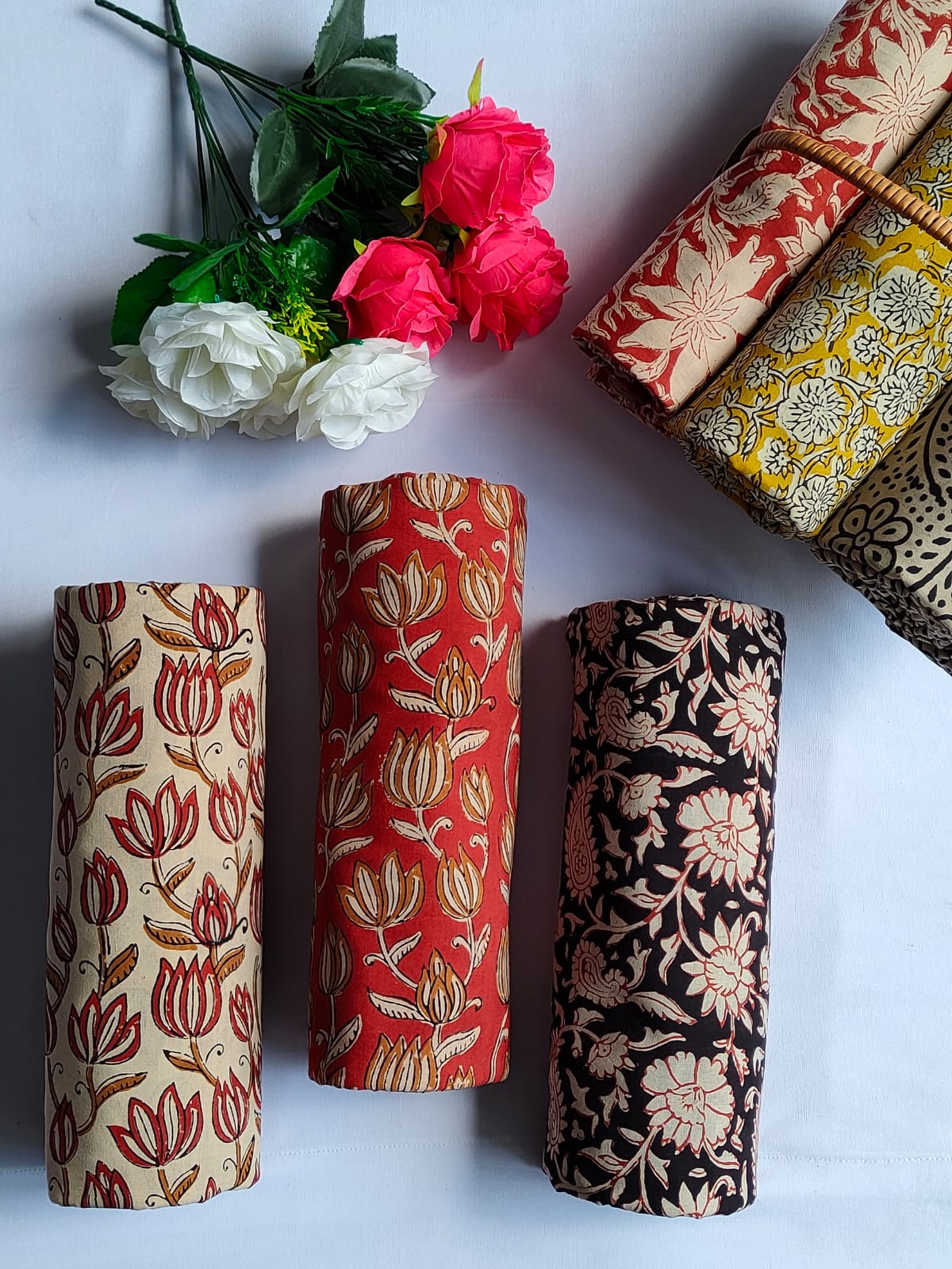


Handblock printing is more than a way to decorate fabric. It is an art shaped by generations of artisans, regional landscapes, traditional colour palettes and the cultural stories of India. From the earthy prints of Bagru in Rajasthan to the delicate florals of Sanganer and the geometric patterns of Ajrakh from Gujarat, every printing tradition has a distinctive visual identity.
In 2026, handblock prints continue to appeal to fabric lovers who appreciate the character of handmade textiles. These designs work beautifully for everyday clothing, contemporary ethnic wear, summer dresses, shirts, scarves, cushion covers and creative sewing projects. Some people prefer subtle floral motifs on light cotton, while others are drawn to deep indigo, bold geometric arrangements and traditional resist-print patterns.
What makes these textiles especially interesting is the relationship between heritage and modern design. Traditional motifs remain relevant because they can be adapted to different colours, scales, fabrics and silhouettes without losing their cultural roots.
In this guide, we explore the top 15 handblock designs for fabric lovers in 2026, explain the regional traditions behind them and look at how artisans, designers and conscious buyers can help preserve India's block printing heritage.
Why Handblock Prints Remain Popular in 2026
Handblock printing uses carved blocks to transfer patterns onto fabric. Artisans position the blocks by hand, apply printing colour or paste and stamp the design onto the cloth. Depending on the pattern, several blocks may be required to create outlines, colours, borders and decorative details.
Because the process involves manual placement, small variations can occur between impressions. These details are part of the character of handmade printing, although the quality of the final fabric still depends on the artisan's skill, the preparation of the cloth and the materials used.
Handblock prints appeal to fabric lovers for several reasons:
-
Distinctive patterns: Floral, botanical, geometric and abstract motifs offer a wide range of visual styles.
-
Versatile cotton fabrics: Many block-printed cotton fabrics work well for dresses, kurtas, shirts, skirts, scarves and home accessories.
-
Regional character: Bagru, Sanganer and Ajrakh each have their own printing traditions and design vocabulary.
-
Creative possibilities: Fabric by the metre allows makers to choose the pattern scale and placement for their projects.
-
A connection to craft: Understanding the printing process helps buyers appreciate the time and skill behind traditional textiles.
For shoppers exploring different styles, Jaipur Bazar's Hand Block Print Cotton Fabrics collection is a useful place to discover India-inspired patterns for clothing and sewing projects.
The Regional Traditions Behind Indian Handblock Printing
Before exploring individual designs, it helps to understand three important traditions that have influenced the visual language of Indian printed textiles.
Bagru: Earthy Colours and Traditional Printing
Bagru, near Jaipur in Rajasthan, is known for its long association with handblock printing and the work of the Chhipa community. The region's printing heritage includes floral and nature-inspired motifs, repeated patterns and earthy combinations of red, black, brown and indigo.
Traditional Bagru printing has made use of locally available materials and techniques developed around washing, dyeing and printing cloth. Artisans use carved wooden blocks to build patterns through carefully placed impressions. Some designs are printed directly, while others use Dabu, a mud-resist technique that protects selected parts of the fabric during dyeing.
Dabu is not a separate synonym for Bagru. It is a resist-printing method associated with Bagru and other textile traditions. Its use can create textured, contrasting patterns that look different from direct printing.
Bagru-inspired designs are especially appealing to people who like natural-looking colours, bold repeating motifs and textiles that pair easily with plain cotton.
Explore Jaipur Bazar's Bagru Print Cotton Fabrics to discover this earthy design direction. When shopping, check the product details to understand the fabric's actual origin and printing method, as a Bagru-inspired pattern is not necessarily produced in Bagru.
Sanganer: Fine Florals and Delicate Details
Sanganer, near Jaipur, is another major centre of Rajasthan's handblock printing heritage. Sanganeri printing is widely associated with fine floral designs, small repeating motifs and decorative arrangements on white, off-white or light-coloured grounds.
Common design terms include buti, a small motif; buta, a larger motif; bel, a flowing vine or creeper; and jaal, an interconnected pattern that spreads across the fabric. Flowers, leaves, buds and other natural forms often feature in these arrangements.
The appeal of Sanganeri designs lies in their balance. Small florals can create a gentle all-over pattern, while larger botanical motifs offer more visual presence. The designs work well for garments where the fabric itself is meant to be the main feature.
Sanganeri handblock printing is recognised as a regional craft with a Geographical Indication identity. Official Indian craft resources describe its characteristic motifs, materials and production process. https://handicrafts.gov.in/crafts/All_Crafts/Craft_Categories/Textile/Hand_Block_Printing/Sanganeri_Hand_Block_Printing/Sanganeri_Hand_Block_PrintingWebPage.html
For fabric lovers who prefer delicate prints, Jaipur Bazar's Printed Cotton Fabrics collection offers a starting point for exploring botanical patterns and other printed styles.
Ajrakh: Geometry, Indigo and Resist Printing
Ajrakh is a distinctive resist-printing tradition associated with Sindh and the Kutch region of Gujarat, with related practice also found in Barmer, Rajasthan. It is known for carefully arranged geometric patterns, strong symmetry and a palette often built around indigo, red, black and white.
Traditional Ajrakh production can involve many stages of washing, mordanting, resist printing and dyeing. Artisans may use several blocks to create a central pattern, repeated geometric forms and borders. In traditional forms, both sides of the cloth may carry the pattern.
The visual effect is different from the delicate florals of Sanganer. Ajrakh designs often have a rhythmic, almost architectural quality. Their repeating geometry makes them suitable for shirts, jackets, kurtas, stoles, bags and home accessories.
Natural dyes have an important place in traditional Ajrakh practice, but dye materials and production methods vary. It is best not to assume that every fabric labelled Ajrakh uses natural dyes or follows the same process.
The Indian handicrafts portal documents Ajrakh's regional history, resist-printing process and characteristic colours. https://handicrafts.gov.in/crafts/All_Crafts/Craft_Categories/Textile/Hand_Block_Printing/Kutch_Ajrakh/KutchAjrakhwebpage.html
Top 15 Handblock Designs for Fabric Lovers in 2026
The following designs bring together traditional motifs, regional influences and contemporary styling possibilities. They are not a ranking of officially recognised craft categories. Instead, they are 15 design directions worth exploring when choosing handblock-print-inspired fabric in 2026.
1. Delicate Floral Buti Prints
Small floral butis are among the most versatile designs in Indian printed textiles. Each motif can feature a tiny flower, a leaf sprig, a bud or a stylised botanical form, repeated across the fabric.
Sanganeri printing is particularly associated with delicate floral arrangements. On a white, cream or pastel background, small motifs create a light appearance without making the fabric feel visually busy.
Best uses: Summer kurtas, everyday dresses, blouses, children's clothing, scarves and relaxed shirts.
How to style it: Pair a fine floral fabric with a plain bottom or simple accessories. A small-scale pattern is especially useful when you want the garment to look detailed without relying on a large print.
2. Traditional Bagru Floral Prints
Bagru-inspired florals often have a more earthy character than fine Sanganeri designs. Flowers, leaves and repeating botanical motifs can be arranged in compact clusters or larger all-over patterns.
Traditional Bagru textiles have used colours such as red, black, brown and indigo. Modern interpretations may include additional shades, so colour alone should not be treated as proof of a fabric's regional origin.
Best uses: Kurtas, tunics, skirts, cotton dresses, dupattas and cushion covers.
How to style it: Let the print provide the visual interest. Solid-coloured garments and accessories can balance a detailed pattern, especially when the fabric has a dark or earthy base.
Browse the Bagru Print Cotton Fabrics collection for patterns inspired by Rajasthan's printing heritage.
3. Dabu Mud-Resist Designs
Dabu printing uses a resist paste, traditionally made with mud and other ingredients, to prevent dye from reaching selected areas of the cloth. Once the resist is removed, the protected areas create contrasting patterns.
The result may include dotted textures, irregular outlines, repeating floral forms or layered motifs. These designs often have a tactile, handcrafted appearance.
Dabu is particularly associated with Rajasthan's printing traditions, including Bagru, but it should be understood as a technique rather than a single pattern.
Best uses: Relaxed shirts, everyday kurtas, dresses, skirts, stoles and soft home furnishings.
How to style it: Combine a Dabu-inspired fabric with plain cotton in a complementary shade. Its textured pattern can make even a simple garment feel distinctive.
Discover Dabu Cotton Fabrics for this resist-print design direction.
4. Sanganeri Floral Jaal
A floral jaal is an interconnected arrangement of flowers, leaves and vines that spreads across the fabric. Rather than placing motifs separately, the design creates a continuous pattern.
Sanganeri-style jaals can look especially elegant on light backgrounds, where fine lines and botanical details remain easy to see. The scale of the repeat affects the final look: a small jaal feels delicate, while a larger one creates a stronger visual statement.
Best uses: Anarkali-style outfits, long dresses, kurtas, skirts, dupattas and bed linen.
How to style it: Choose a small-scale jaal for an understated outfit or a larger repeat when you want the fabric to stand out. Before buying, check the pattern scale in close-up product images.
5. Bel and Creeper Motifs
The bel is a flowing vine or creeper motif. It may travel along a border, curve diagonally across a fabric or connect flowers and leaves in a continuous arrangement.
This design offers movement without requiring a dense all-over print. It can create a graceful effect on long garments, sleeves, borders and home accessories.
Best uses: Kurtas, saree-inspired outfits, dupattas, shirt panels, table runners and cushion covers.
How to style it: Look for bel patterns when you want a design that follows the shape of a garment. Border placements can work particularly well along hems, cuffs and necklines.
6. Bold Buta and Paisley-Inspired Designs
A buta is a larger decorative motif compared with a small buti. Some designs use paisley-like forms, stylised flowers, leaves or ornamental shapes.
Larger motifs can make a fabric look more expressive, particularly when they are spaced apart instead of filling every part of the surface. Paisley-inspired patterns have a long history across several textile traditions, so they should not automatically be attributed to one printing region.
Best uses: Statement kurtas, tunics, dresses, jackets, stoles and decorative cushions.
How to style it: Consider how the motifs will fall across the finished garment. Larger prints may look different on a narrow sleeve than on a wide front panel, so buying enough fabric for pattern placement can be helpful.
7. Indigo Geometric Prints
Indigo is closely associated with several Indian textile traditions, including Ajrakh. Its deep blue shades can provide a strong background for repeated geometric motifs, small floral forms and contrasting borders.
Contemporary indigo prints may use different production methods, and not every indigo-coloured fabric is Ajrakh. The pattern, printing process and origin should be checked separately.
Best uses: Casual shirts, kurtas, wide-leg trousers, dresses, jackets, tote bags and cushion covers.
How to style it: Indigo works well with white, natural beige, cream and many earthy colours. A geometric repeat can give a modern look to a traditional colour palette.
8. Ajrakh Geometric Jaal
Ajrakh is especially recognised for structured, symmetrical designs. A geometric jaal may combine stars, diamonds, repeated blocks, floral geometry and carefully aligned borders.
The complexity comes from the way separate impressions work together. A central pattern, smaller repeating forms and border details may all contribute to the final composition.
Best uses: Shirts, jackets, kurtas, stoles, scarves, bags and statement accessories.
How to style it: Geometric Ajrakh-inspired prints can work as the main feature of an outfit. Pair them with plain fabric when you want the design to remain the focus.
9. Star and Eight-Pointed Geometric Motifs
Star-shaped and other symmetrical geometric motifs appear in a range of traditional decorative arts, including Ajrakh designs. Their repeating structure creates a sense of order and rhythm.
On fabric, these motifs may be arranged in compact grids, separated by smaller details or framed by borders. Depending on the colour contrast and scale, the overall effect can be subtle or bold.
Best uses: Shirts, contemporary ethnic wear, stoles, jackets and cushion covers.
How to style it: Choose a small repeat for everyday clothing or a larger, high-contrast pattern for a statement piece. A plain base colour can make the geometry easier to appreciate.
10. Lotus and Flowering Botanical Prints
Flowers have an important place in Indian textile design. Lotus motifs, flowering branches, buds and stylised leaves appear in many regional and contemporary printing styles.
A lotus-inspired print may look traditional, ornamental or minimal depending on how the motif is drawn. Some designs use naturalistic details, while others reduce the flower to a simple repeated shape.
Best uses: Dresses, kurtas, blouses, skirts, scarves, cushion covers and table linen.
How to style it: For a soft appearance, choose a botanical print with a light background and gentle colour contrast. For a bolder garment, look for larger motifs or a deeper base colour.
11. Small Jaali and Lattice Patterns
A jaali-style pattern uses a repeated grid or network of motifs. Depending on the design, it may appear geometric, floral or somewhere between the two.
This type of print can create a balanced all-over effect. Smaller lattice patterns are useful when you want a fabric with detail but without a single oversized motif dominating the garment.
Best uses: Everyday kurtas, shirts, dresses, lightweight jackets and home textiles.
How to style it: Check the distance between repeated motifs. A compact lattice can look dense from a distance, while a more open arrangement gives the fabric a lighter appearance.
12. Floral and Geometric Border Prints
Border designs concentrate decorative elements along one or more edges of the fabric. They may include vines, small flowers, geometric bands or a sequence of repeated motifs.
Borders are useful for garment construction because they can be placed along hems, sleeve ends, necklines or the edge of a dupatta. They also make it easier to combine printed and plain sections in one project.
Best uses: Kurtas, dresses, skirts, dupattas, scarves, table runners and cushion covers.
How to style it: Before cutting the fabric, decide where the border will sit. Allow enough extra material if you need matching borders on both sleeves or on several garment panels.
13. Birds, Leaves and Nature-Inspired Prints
Birds, leaves, flowering branches and other natural forms appear across many Indian textile traditions. These motifs can be detailed and decorative or simplified into repeating shapes.
Nature-inspired designs are a useful choice for people who enjoy botanical patterns but want something different from conventional florals.
Best uses: Shirts, dresses, children's clothing, scarves, tote bags and soft furnishings.
How to style it: Look for a print in which the motifs have enough space to remain distinct. For a busy pattern, a plain garment detail or a simple silhouette can help maintain balance.
14. Two-Colour and Minimal Handblock Patterns
Not every handblock-inspired fabric needs a complex, multicoloured design. Two-colour patterns use contrast to make repeated shapes stand out, while minimal designs may feature a small motif on an otherwise open background.
These patterns suit people who like the character of printed cotton but prefer a simpler wardrobe. They are also useful for sewing projects where a busy print might compete with the garment's shape.
Best uses: Oversized shirts, simple dresses, kurtas, children's wear, aprons and everyday accessories.
How to style it: Choose two colours that work well together and let the repeat create the interest. If you want to mix prints, use a similar colour family and vary the motif scale.
15. Contemporary Heritage-Fusion Prints
Heritage-fusion designs bring traditional Indian motifs into newer colour combinations, layouts or garment styles. A familiar floral repeat may be enlarged, spaced out, recoloured or paired with a modern silhouette.
This category can be useful for fabric lovers who appreciate traditional design but want to sew clothing that feels contemporary. However, a modern pattern inspired by a regional tradition should not be presented as an authentic regional craft unless its production and origin support that description.
Best uses: Oversized shirts, co-ord sets, modern kurtas, relaxed dresses, jackets, tote bags and home accessories.
How to style it: Consider the complete project rather than choosing a fabric based on the print alone. Pattern scale, cotton construction, drape, colourfastness and the amount of fabric required all affect the final result.
Bagru vs Sanganer vs Ajrakh: How to Choose a Design
These traditions offer different visual directions. The following comparison can help you decide what to explore.
| Feature | Bagru | Sanganer | Ajrakh |
|---|---|---|---|
| Regional association | Bagru, Rajasthan | Sanganer, Rajasthan | Kutch, Gujarat, with related traditions in Sindh and Barmer |
| Common visual character | Earthy florals and repeating motifs | Fine florals and botanical arrangements | Geometric symmetry and layered repeats |
| Familiar colours | Red, black, brown and indigo | Often light grounds with colourful florals | Indigo, red, black and white |
| Notable technique | Direct printing and Dabu resist printing | Hand-stamped printing with detailed motifs | Complex resist printing and repeated dyeing |
| Good starting point | Earthy, handcrafted-looking patterns | Delicate floral designs | Bold, structured geometric prints |
These are general tendencies, not rigid rules. Each region has evolved, and contemporary products can differ from older examples in colour, motif and production method. The label alone does not confirm that a fabric was made using a particular traditional process.
How Traditional Block Printing Is Preserved Today
Keeping handblock printing alive requires more than celebrating beautiful designs. The craft depends on people, practical knowledge, viable livelihoods and buyers who understand what goes into handmade textiles.
1. Passing Skills Between Generations
Block printing involves several kinds of expertise. A wooden block must be carved accurately, printing colours must be prepared and applied appropriately, and impressions must be placed with care. Resist-printing traditions require additional knowledge about the interaction between cloth, paste, dye and washing.
Much of this knowledge is learned through practice. Experienced artisans develop an understanding of how materials behave and how to correct small problems during production.
Supporting workshops and craft businesses that maintain these skills can help create opportunities for the next generation to learn the work.
2. Keeping Regional Identity Visible
Bagru, Sanganer and Ajrakh are not interchangeable names for any printed pattern. Their histories, techniques and design languages differ.
Official craft documentation and regional recognition help record these differences. Geographical Indication protection can also help identify goods associated with a specific region and its established production characteristics.
For buyers, this means reading product descriptions carefully. If a product is described as Bagru, Sanganeri or Ajrakh, look for clear information about where it was made and how it was printed. A pattern inspired by a tradition can still be attractive, but it should not be confused with verified regional production.
3. Making Traditional Prints Useful in Modern Life
Craft traditions remain more visible when people can use them in everyday life. Designers and makers are adapting block-printed textiles for shirts, dresses, co-ord sets, scarves, bags and home furnishings.
A traditional floral repeat may appear on a contemporary oversized shirt. A geometric pattern can become a jacket or tote bag. A delicate cotton print may be used for a summer dress or a child's outfit.
These adaptations do not need to replace traditional designs. They can give familiar motifs new contexts while allowing the underlying craft to remain relevant.
4. Helping Artisans Reach More Buyers
Online retail has changed how people discover printed textiles. Buyers can now explore regional styles without necessarily travelling to a printing centre. Product photography, detailed descriptions and clear information about fabric composition can help people make better choices.
At the same time, online descriptions need to be honest. Sellers should distinguish handblock printing from screen printing and should not claim natural dyes, artisan-made production or regional origin without reliable information.
Customers can support responsible craft commerce by choosing sellers who explain their products clearly and by asking questions when the origin or technique is uncertain.
5. Understanding the Environmental Side of Textile Production
Traditional printing knowledge often includes careful use of water, dye materials, washing and drying. Some workshops continue to use natural dyes and traditional processes, while others use synthetic dyes or combine methods to meet different production requirements.
Neither the word handblock nor the name of a region automatically proves that a fabric is organic, chemical-free or environmentally sustainable. Environmental impact depends on the materials, water use, dyeing methods, waste management and working practices involved.
Buyers interested in lower-impact textiles should look for specific, verifiable information rather than relying on broad claims.
6. Preserving the People Behind the Patterns
The most important part of a printing tradition is the knowledge held by its makers. When a design is discussed only as a trend, the work behind it can disappear from view.
Learning the names of regional crafts, understanding how blocks are used and recognising the time involved in complex printing are simple ways to develop a more informed appreciation. Buying thoughtfully and sharing accurate information also helps keep the craft visible.
How to Choose Handblock Print Fabric for Your Next Project
The best design depends on what you plan to make. A print that looks beautiful on a fabric swatch may behave differently once cut into sleeves, panels or a full garment.
Keep these practical points in mind.
Check the Fabric Composition
A handblock print describes a printing method, not a fibre. Check whether the fabric is cotton or another material and read the product details before buying.
If you are planning a warm-weather garment, you may also want to compare fabric weight, weave and finish. These characteristics influence comfort and drape.
Explore All Cotton Fabrics at Jaipur Bazar to compare different cotton fabric options.
Consider the Motif Scale
Small florals are generally easy to use for everyday clothing. Larger butas and bold geometric repeats can make a stronger statement but may require more careful cutting and placement.
If a design has a border, calculate how much extra fabric you need to align it across garment pieces.
Choose Colours for the Intended Use
Earthy reds and browns can create a grounded, traditional appearance. Indigo and dark geometric prints may look bolder, while light floral designs often feel delicate.
Consider the rest of your wardrobe or the colours already present in your home before choosing a print.
Read Product Details Carefully
Look for information about fabric width, composition, print method, colour and care. If the product is described as a specific regional craft, check whether its place of production and technique are explained.
For more guidance on cotton quality, read Jaipur Bazar's guide to identifying high-quality cotton fabric.
Follow Appropriate Washing Instructions
Printed fabrics may respond differently depending on the dye, printing paste, fabric construction and finishing. Follow the seller's care instructions, wash new printed fabric separately when advised, and avoid assuming every traditional print requires the same treatment.
You can also read Best Ways to Care for and Wash Woven Cotton Fabrics for general cotton care guidance.
Explore India-Inspired Block Print Fabrics at Jaipur Bazar
For fabric lovers, the appeal of Indian block printing lies in the variety of designs and the stories behind them. Fine Sanganeri florals, earthy Bagru-inspired patterns, Dabu resist designs and Ajrakh-inspired geometry each offer a different way to bring traditional textile aesthetics into modern sewing and styling.
Jaipur Bazar's India-inspired fabric range gives shoppers a place to explore printed cotton designs alongside other cotton fabric options. Whether you are planning a relaxed shirt, a summer dress, a kurta, a tote bag or a small home décor project, choose a pattern that suits your intended use and check the product details before placing an order.
Browse the Hand Block Print Cotton Fabrics collection to explore available designs. For a more specific look, visit the Bagru Print Cotton Fabrics collection or the Dabu Cotton Fabrics collection.
By learning about regional traditions and choosing products with clear, accurate descriptions, fabric lovers can enjoy the beauty of Indian prints while helping keep their stories visible.
Frequently Asked Questions
1. What are the most popular handblock designs for 2026?
Designs worth exploring include delicate floral butis, Bagru-inspired florals, Dabu resist patterns, Sanganeri floral jaals, bel vines, paisley-inspired butas, indigo geometry, Ajrakh-inspired jaals, star motifs, lotus prints, lattice patterns, decorative borders, nature-inspired designs, minimal two-colour prints and contemporary heritage-fusion patterns.
2. What is the difference between Bagru and Sanganeri prints?
Bagru is often associated with earthy colours, traditional floral motifs and the use of Dabu resist printing. Sanganeri printing is widely recognised for fine floral and botanical patterns, frequently arranged on white or light-coloured backgrounds. Both are important handblock printing traditions from Rajasthan, but their typical design characteristics differ.
3. What makes Ajrakh printing unique?
Ajrakh is known for symmetrical geometric patterns, rich indigo and red tones, and a complex process that can involve repeated resist printing, dyeing and washing. Traditional forms are associated with Kutch in Gujarat as well as the wider Sindh region.
4. Are all handblock printed fabrics made with natural dyes?
No. Traditional printing practices have used natural dyes, but contemporary production may use synthetic dyes or a combination of materials. Check the individual product's description rather than assuming that all handblock prints are naturally dyed.
5. Is Dabu printing the same as Bagru printing?
No. Bagru refers to a regional printing tradition, while Dabu is a mud-resist printing technique used in Bagru and other contexts. Some Bagru textiles use Dabu, but not every Bagru print is a Dabu print.
6. What type of handblock print is best for summer clothing?
Lightweight cotton with a comfortable weave can be a good option for summer clothing. Small floral prints, open botanical patterns and simple geometric repeats are popular design choices. Always check the actual fabric composition, weight and finish because print style alone does not determine comfort.
7. How can I identify an authentic regional handblock print?
Start by checking the seller's information about origin, production method and materials. Look for credible details about the artisan or workshop and any relevant regional recognition. Small variations can occur in hand printing, but appearance alone cannot prove that a fabric was printed by hand or produced in a particular region.
8. Where can I buy India-inspired handblock print cotton fabrics online?
You can explore Jaipur Bazar's Hand Block Print Cotton Fabrics collection. Review each product's available details, including composition, pattern, fabric width and care instructions, to find a suitable option for your project.
Final Thoughts
Indian handblock printing brings together regional history, artistic skill and an extraordinary range of patterns. Bagru's earthy character, Sanganer's delicate florals and Ajrakh's geometric precision show how different communities have developed distinct ways of working with blocks, colours and cloth.
The most meaningful way to enjoy these designs in 2026 is to look beyond appearance alone. Learn about the tradition behind a motif, choose fabric that suits your project and support sellers who describe their products accurately. These small choices help ensure that Indian textile heritage remains part of contemporary wardrobes, creative work and everyday life.