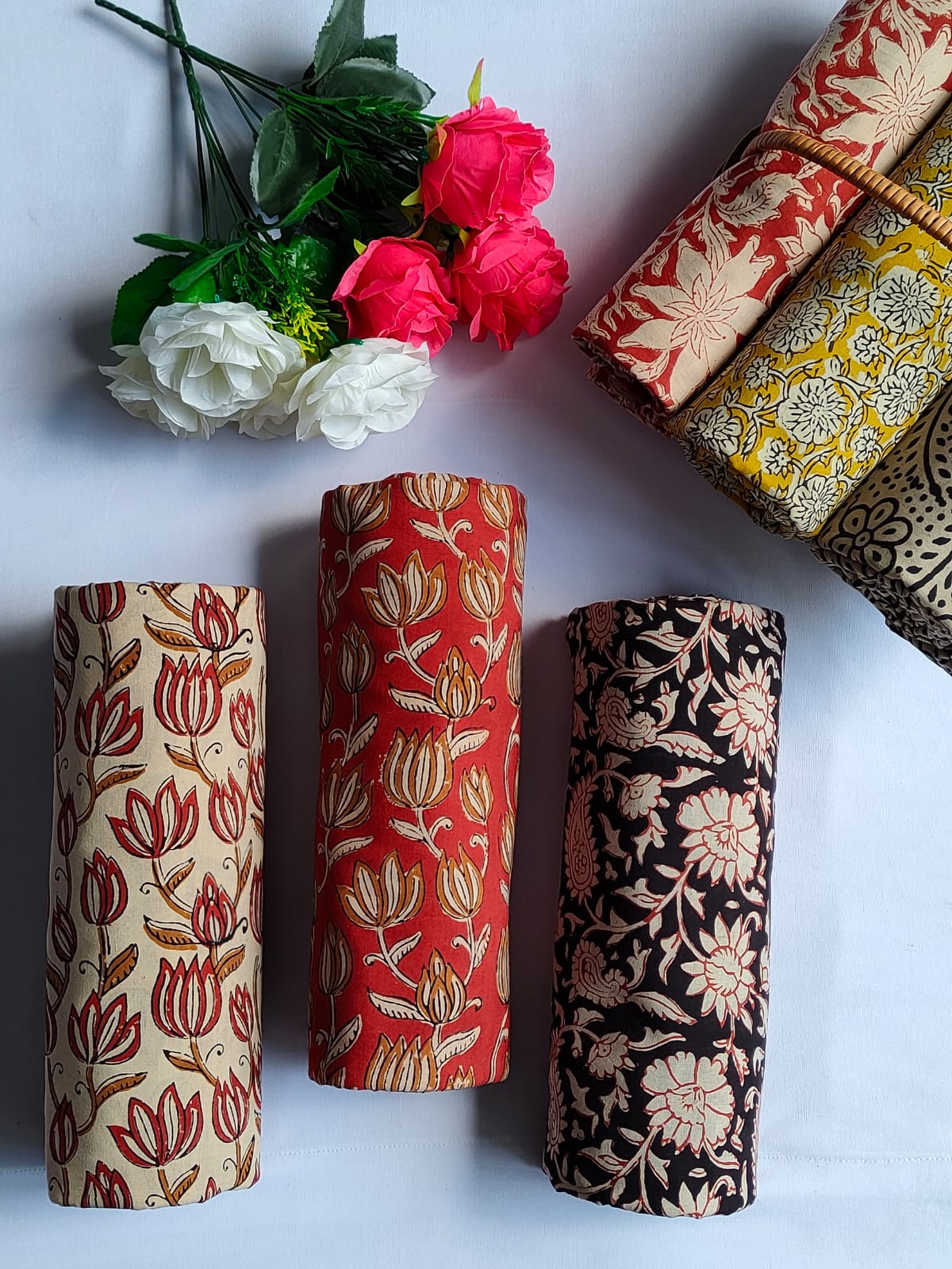


Hand block printed cotton has a character that goes beyond its colours and patterns. Each design begins with a carved block, a prepared piece of fabric and the skill of a printer who applies the motif by hand. Repeated impressions gradually transform plain cotton into a textile filled with flowers, leaves, geometric forms and decorative details.
In India, this craft carries a rich cultural history. Rajasthan's Bagru and Sanganeri printing traditions and Gujarat's Ajrakh textiles demonstrate how printing techniques develop their own regional identities. The designs reflect local knowledge, materials, communities and artistic choices that have been passed down and adapted over generations.
Today, hand block printed cotton is used for everyday clothing, dresses, kurtas, shirts, scarves, bags, cushion covers and other home textiles. It appeals to people who appreciate traditional Indian patterns but also want fabric that can work with contemporary styles.
So, what actually makes hand block printed cotton special? Is it the printing method, the design, the fabric, the small variations in the finished pattern, or the cultural history behind it?
The answer is a combination of all these things. In this guide, we explore how hand block printing works, what makes its designs distinctive, how India's regional traditions contribute to its appeal, and what to look for when buying hand block printed cotton fabric.
What Is Hand Block Printed Cotton?
Hand block printed cotton is cotton fabric decorated by pressing carved blocks onto the cloth by hand. The raised areas of a block transfer colour or printing paste to the fabric, creating an individual motif.
The printer repeats this process across the cloth to develop the complete pattern. For a multicolour design, several blocks may be required, with each block responsible for a particular colour, outline or detail.
Unlike a design produced entirely through a digital printing process, hand block printing depends on the physical placement of each impression. The printer must manage the amount of colour, pressure, spacing and alignment to achieve the intended result.
The technique is used in different forms across India. Rajasthan is particularly associated with Bagru and Sanganeri printing, while Kutch Ajrakh is a well-known tradition from Gujarat.
Each tradition has its own design vocabulary and production practices. However, not every hand block printed cotton fabric is made in one of these regions, and not every traditional-looking print is produced by hand. If the printing method or place of origin matters to you, it is worth checking the product description carefully.
1. Every Design Begins with Human Skill
One of the most distinctive things about hand block printed cotton is the role of the person making it.
A printer does not simply press a button and reproduce a complete design. The pattern is built through repeated physical impressions, often using different blocks for different parts of the motif.
The printer must understand how the blocks sit against the fabric, how much colour to apply and how to maintain the intended repeat. When a design contains several colours, the different impressions must also align correctly.
This requires practice and attention. A small shift in placement can change the relationship between the outline and the filled areas of a motif. Uneven pressure can affect how the colour transfers. The quality of the finished cloth depends partly on how well these details are managed.
The block itself also represents skilled work. Intricate patterns must be carved into wood so that the raised surfaces transfer the intended design. Complex motifs may require several blocks that work together.
This combination of block carving and printing gives hand block printed cotton a direct connection to the people who create it.
The appeal is not that every handmade textile is automatically perfect. It is that the finished design emerges from a physical process that requires knowledge, judgement and practice.
2. The Printing Process Gives the Fabric Its Character
Hand block printing involves more than dipping a block into colour and pressing it onto cloth. The fabric must be prepared, the printing materials must be suitable for the process, and the finished textile may need additional treatment to develop its final appearance.
Although the details vary between traditions and workshops, the process generally includes several stages.
Step 1: Preparing the design
The process begins with a pattern. It may feature small flowers, larger botanical forms, geometric arrangements, decorative borders or a repeating combination of motifs.
The design is planned with the printing blocks in mind. A complex pattern may need separate blocks for the outline, colour fills and other details.
Step 2: Carving the wooden blocks
The design is carved into wood to create the printing surface. The raised areas carry the colour or paste, while the recessed areas do not transfer the same impression.
When several blocks are needed for one design, they must work together so that the different parts align correctly.
Step 3: Preparing the cotton
The fabric may be washed, scoured or treated before printing. The exact preparation depends on the fabric, the printing technique and the colours or dyes being used.
Preparing the cloth helps create a suitable surface for the printing process. Some traditional techniques also require additional treatments before the fabric is printed or dyed.
Step 4: Applying the print
The printer applies colour or printing paste to the block and presses it against the fabric. This is repeated across the required area.
For a multicolour design, the printer may use several blocks in sequence. The order of the impressions matters because each stage contributes to the final pattern.
Step 5: Fixing, washing and finishing
Depending on the materials and method, the printed cloth may need drying, steaming, dyeing, washing or other finishing steps.
These stages help develop the final colour and remove excess printing material where required. The fabric is then prepared for use.
The exact process differs between Bagru, Sanganeri, Ajrakh and other printing traditions. That variation is part of what makes India's textile heritage so diverse.
3. Small Variations Can Give Hand Printed Fabric Its Individual Character
When a pattern is produced by hand, slight differences may appear between impressions. The spacing may vary a little, the edges may not align perfectly, or the colour may look slightly different in individual areas.
These variations can be part of the visual character of a hand printed textile. They remind the viewer that the design has been built through repeated manual work rather than produced as one uniform digital image.
However, it is important not to romanticise every irregularity. Large smudges, damaged fabric, missing sections or unintended printing defects may still indicate a quality problem.
A good-quality hand block printed fabric should be assessed according to its intended design and use. Minor variations may be acceptable, while defects that affect the appearance or usability of the cloth deserve attention.
It is also worth remembering that irregularities alone do not prove a fabric is hand block printed. Other printing methods can produce variations, and some hand printed textiles can be remarkably consistent.
When buying online, look at close-up photographs, read the product details and ask the supplier about the actual printing method if you need confirmation.
4. India's Regional Printing Traditions Make the Craft Richer
Hand block printing is not a single style. Different regions have developed their own patterns, colours and production techniques.
Bagru and Sanganer in Rajasthan and Ajrakh in Gujarat are useful examples of how local traditions contribute to the identity of printed cotton.
Bagru printing: earthy colours and traditional motifs
Bagru, near Jaipur in Rajasthan, is known for its hand block printing tradition, which is closely associated with the Chippa printing community.
Bagru textiles are often recognised for earthy colour combinations, repeating floral motifs and patterns that work well across clothing and home textiles. Some designs use direct block printing, while others incorporate Dabu, a resist-printing technique.
In resist printing, selected areas of the cloth are protected from dye. The fabric is then dyed or processed so that the protected areas develop a contrasting pattern.
The Government of India's handicrafts documentation describes Bagru's blocks, materials, printing process and traditional design vocabulary. It also notes that contemporary workshops may use screen printing and chemical dyes to meet larger production demands. <Cite refs={["turn758949search3"]} />
This is one reason why buyers should pay attention to the actual manufacturing process. A cotton fabric with earthy colours and Bagru-inspired motifs is not necessarily hand block printed in Bagru.
If you appreciate the visual style, explore Jaipur Bazar's Bagru Print Cotton Fabrics collection. Check individual product descriptions to understand how each fabric was made.
Sanganeri printing: delicate florals and fine details
Sanganer, near Jaipur, is another important centre for hand block printing. Sanganeri textiles are widely associated with fine floral patterns, small butis, larger botanical motifs and decorative vines.
Many traditional designs use a light background that allows the printed motifs to stand out. Flowers, leaves and other natural forms are arranged into repeating patterns that can appear delicate without losing detail.
The Government of India's craft documentation describes Sanganeri printing on light fabrics and outlines the use of wooden blocks, colour application, drying, steaming, washing and finishing. It also notes the tradition's association with clothing materials and home textiles. <Cite refs={["turn758949search0"]} />
These characteristics make Sanganeri-inspired prints useful for dresses, kurtas, shirts, scarves and decorative home projects.
The fine floral style can also be recreated through modern printing methods. If you specifically want Sanganeri hand block printing, however, confirm the production method and origin rather than relying on the pattern alone.
Explore Jaipur Bazar's Hand Block Print Cotton Fabrics collection for cotton designs associated with Indian hand-printing traditions.
Ajrakh: geometry, symmetry and resist dyeing
Ajrakh is a distinctive textile-printing tradition associated with Kutch in Gujarat and a wider regional history extending into Sindh.
Its patterns often feature geometric symmetry, repeating motifs and carefully arranged borders. Indigo, red, black and white are prominent in many traditional designs, although the materials and exact colours can vary.
Traditional Ajrakh production can involve multiple stages of preparation, resist printing, dyeing and washing. Carved wooden blocks are used to build the pattern, and the sequence of these stages contributes to the final result.
The Government of India's handicrafts resource describes the craft's materials, blocks, resist agents and multistage process. <Cite refs={["turn758949search4"]} />
Ajrakh demonstrates that hand block printing can involve detailed planning beyond the placement of individual motifs. The printer must consider how the design, resist materials and dyeing stages interact.
Contemporary fabrics may borrow Ajrakh-inspired geometry, but a similar appearance does not establish that a textile was made using traditional Ajrakh methods.
Why these regional differences matter
Bagru, Sanganer and Ajrakh show how printing traditions can develop distinctive identities through the combined influence of design, materials, techniques and communities.
For buyers, these differences create a wider choice of styles. For the textile industry, they also highlight the importance of accurately describing the method and origin of a product.
5. The Relationship Between Cotton and Hand Block Printing
Cotton is a widely used base for hand block printing because it is available in a range of weights and constructions and can be prepared for different printing processes.
However, not all cotton fabric behaves in the same way. A lightweight cotton may drape differently from a firm, closely woven fabric. The yarn, weave, surface preparation and finishing all influence the final result.
This matters because a printed design can look excellent while the underlying fabric is unsuitable for the intended garment or product.
For example, lightweight cotton may work well for relaxed summer clothing, while a firmer construction may be better for a structured bag or cushion cover.
When buying hand block printed cotton, consider both parts of the product:
-
The base fabric: fibre composition, weight, weave, width and feel.
-
The printed design: clarity, colour application, alignment and suitability for the intended use.
Cotton fibre alone does not guarantee that a fabric will be soft, durable or suitable for every application. Those properties depend on the complete construction and finishing.
You can compare different fabric options in Jaipur Bazar's All Cotton Fabrics collection.
6. Hand Block Printed Cotton Works with Traditional and Modern Clothing
One reason hand block printed cotton remains appealing is its versatility. Traditional motifs can be used in familiar silhouettes, while the same fabric can also suit contemporary designs.
Kurtas and everyday ethnic wear
Floral patterns, repeating butis and geometric motifs can work well for kurtas and tunics. The choice depends on the scale of the print and the style of the garment.
Small motifs can suit a simple everyday kurta, while a larger pattern may create a more noticeable look.
Dresses and relaxed silhouettes
Hand block printed cotton can be used for shirt dresses, gathered dresses, A-line shapes and relaxed summer clothing.
The fabric weight and drape should match the design. A lightweight cloth may work for a loose silhouette, while a firmer construction may be more suitable for a dress that needs structure.
Shirts and contemporary separates
Block printed cotton can also be used for casual shirts, tops and other contemporary garments. Pairing a printed fabric with plain cotton or simple garment details can help the pattern stand out.
For garments with pockets, collars or front plackets, plan the cutting layout so that the motif placement looks intentional.
Co-ordinated clothing
A print can become the starting point for a coordinated collection. You might use the same fabric for a kurta and a small accessory, or pair it with plain cotton in a complementary colour.
The key is to consider the print scale and colour balance rather than using the pattern everywhere without a plan.
For more cotton options, browse Jaipur Bazar's Printed Cotton Fabrics collection.
7. It Is Just as Useful for Home Décor and Accessories
Hand block printed cotton is not limited to clothing. It can also be used for decorative and practical products around the home.
Cushion covers
A printed cushion cover can introduce colour into a room without requiring a major change to the décor. Large motifs can work as feature pieces, while small repeating prints can be used across several cushions.
Choose a fabric with suitable strength and check its care requirements if the cushions will be used frequently.
Table runners and decorative accents
Printed cotton can be used for table runners, fabric placemats and other decorative pieces. Borders and repeating motifs can be particularly useful for these projects because they create a clear visual arrangement across the fabric.
For products that require frequent washing, check colourfastness and follow the supplier's instructions.
Tote bags and pouches
A distinctive hand block printed fabric can give a tote bag or pouch a decorative look. For bags that carry weight, choose a suitable base fabric and consider adding a lining or reinforcement.
Scarves and fabric gifts
Depending on its weight and construction, printed cotton can be used for scarves, gift bags and small handmade accessories. The design should suit the size and shape of the finished product.
The versatility of the fabric is part of its appeal: a repeating motif can work across several different products without requiring the same garment or accessory design every time.
8. Hand Block Printing Preserves Practical Knowledge, Not Just Patterns
When people talk about preserving a textile tradition, they often focus on the finished design. But a craft also depends on the knowledge required to produce it.
Hand block printing brings together several kinds of skill. Someone must design and carve the block. The printer must know how to apply the colour, position the impression and maintain the repeat. Other stages may involve preparing the fabric, managing dye or resist processes and finishing the cloth.
This knowledge is developed through practice. It includes details that are difficult to understand from a photograph of the finished fabric alone.
Regional traditions such as Bagru, Sanganeri and Ajrakh remain important because their identities are tied to particular communities, production practices and design histories.
The craft also changes over time. Artisans and workshops may adapt colours, motifs, products and production methods to meet contemporary demand. The use of modern materials or equipment does not mean every textile should be described as traditionally made, though. The product description should accurately reflect the process used.
How buyers can support the craft
Buyers can help preserve textile knowledge by:
-
Choosing products with clear and accurate printing descriptions.
-
Asking about the production method when hand printing is important.
-
Seeking verified regional provenance when purchasing a named regional craft.
-
Avoiding unsupported claims about natural dyes or artisan production.
-
Recognising the skill involved in block carving, printing and finishing.
-
Supporting makers and suppliers who communicate their practices transparently.
Hand block printing does not need to be presented as superior to every modern printing method to deserve appreciation. Its value lies in the specific knowledge, work and history behind the craft.
9. Does Hand Block Printed Cotton Always Use Natural Dyes?
No. This is an important point for anyone buying printed cotton.
Some traditional printing processes use natural dyes and materials. Others use synthetic dyes, pigments or a combination of materials, depending on the workshop, design and intended result.
Bagru and Ajrakh are associated with traditional dyeing and resist-printing practices, but that does not mean every fabric sold under a related style or description uses only natural dyes. Contemporary production varies.
If natural dyes are important to you, ask the supplier to confirm the dye type and explain what information they can provide. Do not assume that a muted colour palette or an earthy appearance proves that natural dyes were used.
The same principle applies to claims such as handmade, organic or sustainably produced. These terms should be supported by relevant information rather than inferred from the look of the fabric.
Clear product descriptions help buyers choose according to their priorities and help maintain trust in the textile market.
10. How to Choose High-Quality Hand Block Printed Cotton
A beautiful motif is only one part of a good fabric purchase. Before ordering, consider the quality of the cotton, the print and the finishing.
Check the fabric composition
Confirm whether the fabric is 100% cotton or a blend. If fibre composition is important for your project, rely on the product specification rather than the appearance alone.
Assess the weight and feel
Consider whether the cloth is suitable for the garment or product you intend to make. A fabric that feels too light for a bag may still be suitable for a loose top.
Look closely at the print
Check that the motifs are clear and that the pattern looks appropriate for the design. Some small variation can occur during hand printing, but large smudges or missing sections may affect usability.
Ask about colourfastness
If the fabric will be washed frequently, ask about its colour performance and care requirements. Request a sample when possible and test it before processing a large quantity.
Confirm the width and quantity
Check the usable width and estimate the required metres based on the pattern, motif size and cutting layout. Include allowances for shrinkage and matching prints where necessary.
Read the product description carefully
If you are buying a regional craft such as Bagru, Sanganeri or Ajrakh, check whether the supplier identifies the actual printing method and origin. A traditional-inspired design and a textile produced using the traditional craft process are not interchangeable.
For a more detailed checklist, read Jaipur Bazar's guide on how to choose high-quality handblock fabric in 2026.
11. Caring for Hand Block Printed Cotton
The right care routine depends on the cotton, printing materials, dyes and finishing used. Follow the supplier's instructions rather than assuming that every hand block printed fabric should be washed in the same way.
A few general practices can help:
-
Read the care label or product instructions before washing.
-
Test a small sample when the care method is uncertain.
-
Use a suitable detergent and avoid harsh chemicals unless recommended.
-
Avoid excessive heat during washing, drying and ironing.
-
Turn garments inside out when appropriate to reduce friction on the printed surface.
-
Check colourfastness before washing a large piece or a finished product.
If you are buying fabric for a business or a larger sewing project, testing a sample can help you assess shrinkage, colour performance and the effect of washing before committing to the full quantity.
12. Why Hand Block Printed Cotton Still Feels Relevant Today
Hand block printed cotton connects traditional design with everyday use. The same broad family of motifs can appear on a kurta, a modern shirt, a tote bag or a cushion cover.
Its appeal is not limited to nostalgia. The patterns can be adapted to different colours, garment shapes and interior styles. A delicate floral print can feel understated, while a geometric design can create a stronger visual statement.
At the same time, the craft offers a reminder that textile design is also a form of knowledge. The block, the printing sequence, the fabric preparation and the finishing all contribute to the final result.
In a market where printed fabrics can be produced through many different methods, understanding how a textile was made gives buyers a more meaningful way to choose.
For Jaipur Bazar customers, hand block printed cotton offers a way to explore Indian-inspired designs for clothing, accessories and home projects. The best choice is one that suits the intended use and is described accurately, including the actual printing method and fabric composition.
Conclusion: The Real Value of Hand Block Printed Cotton
What makes hand block printed cotton truly special is the relationship between material, design, skill and tradition.
The cotton provides the base. The carved block carries the motif. The printer builds the design through repeated impressions, while the preparation and finishing processes influence the final fabric. In regional traditions such as Bagru, Sanganer and Ajrakh, these techniques are connected to distinctive histories and communities.
The small variations that sometimes appear in hand printing can contribute to a fabric's individual character, but quality still matters. Buyers should look for clear prints, suitable fabric construction, accurate product information and appropriate finishing.
Hand block printed cotton can be used for everyday clothing, boutique collections, bags, accessories and home décor. Its designs work with traditional silhouettes and contemporary projects alike.
If you are exploring printed cotton for your next project, start with the fabric's intended use, then compare its weight, composition, print quality and care requirements. If you want a specific regional craft or natural-dyed textile, ask for details about the actual process and origin.
Explore Jaipur Bazar's Hand Block Print Cotton Fabrics collection and Bagru Print Cotton Fabrics collection to discover designs associated with India's textile traditions. With the right information, you can choose cotton fabric that fits your project while appreciating the knowledge and work behind the print.
Frequently Asked Questions
1. What makes hand block printed cotton special?
Hand block printed cotton is decorated using carved blocks applied by hand. The process requires skill in block carving, colour application and pattern alignment. Its appeal also comes from the regional traditions and design knowledge associated with different printing centres.
2. Is hand block printed cotton handmade?
The printing stage involves manually applying carved blocks to the fabric. However, other parts of production may use different tools or equipment. If the extent of handmade production matters to you, ask the supplier which stages are carried out by hand.
3. What is the difference between Bagru and Sanganeri prints?
Bagru and Sanganeri are regional hand block printing traditions associated with Rajasthan. Bagru is often associated with earthy colour palettes and resist-printing techniques, while Sanganeri is known for fine floral motifs and light backgrounds. Individual fabrics can vary, so check the product details.
4. Is Ajrakh a type of hand block printing?
Traditional Ajrakh is a distinctive resist-printing and dyeing tradition associated with Kutch in Gujarat and a wider regional history. It uses carved blocks as part of a multistage process. A screen printed fabric with Ajrakh-inspired motifs is not necessarily traditional Ajrakh.
5. Does hand block printed cotton always use natural dyes?
No. Some traditional processes use natural dyes, while other hand block printed fabrics may use synthetic dyes or pigments. Ask the supplier for specific information if natural dyes are important to your purchase.
6. Can hand block printed cotton be used for everyday clothing?
Yes. Depending on the fabric's weight, construction and finishing, it can be used for kurtas, dresses, shirts, tunics and other garments. Choose a fabric that suits the required drape, coverage and care routine.
7. Is slight variation in a hand block print normal?
Small differences in spacing, alignment or colour can occur during manual printing. However, not every irregularity is acceptable, and variation alone does not prove that a fabric was hand printed. Inspect the overall print quality and ask about the manufacturing method.
8. Can hand block printed cotton be used for home décor?
Yes. It can be used for cushion covers, table runners, decorative panels, bags and other home accessories, provided the base fabric and print are suitable for the intended use. Check strength, colourfastness and cleaning requirements.
9. How do I identify high-quality hand block printed cotton?
Check the fibre composition, weight, width, clarity of the print, colour application and finishing. Ask about colourfastness and request a sample when possible. If regional origin or a specific dye process matters, request information to support that claim.
10. Where can I buy hand block printed cotton fabric online?
You can browse Jaipur Bazar's Hand Block Print Cotton Fabrics collection and Bagru Print Cotton Fabrics collection. Check each product's description for fabric composition, printing method, available quantity and care instructions before ordering.