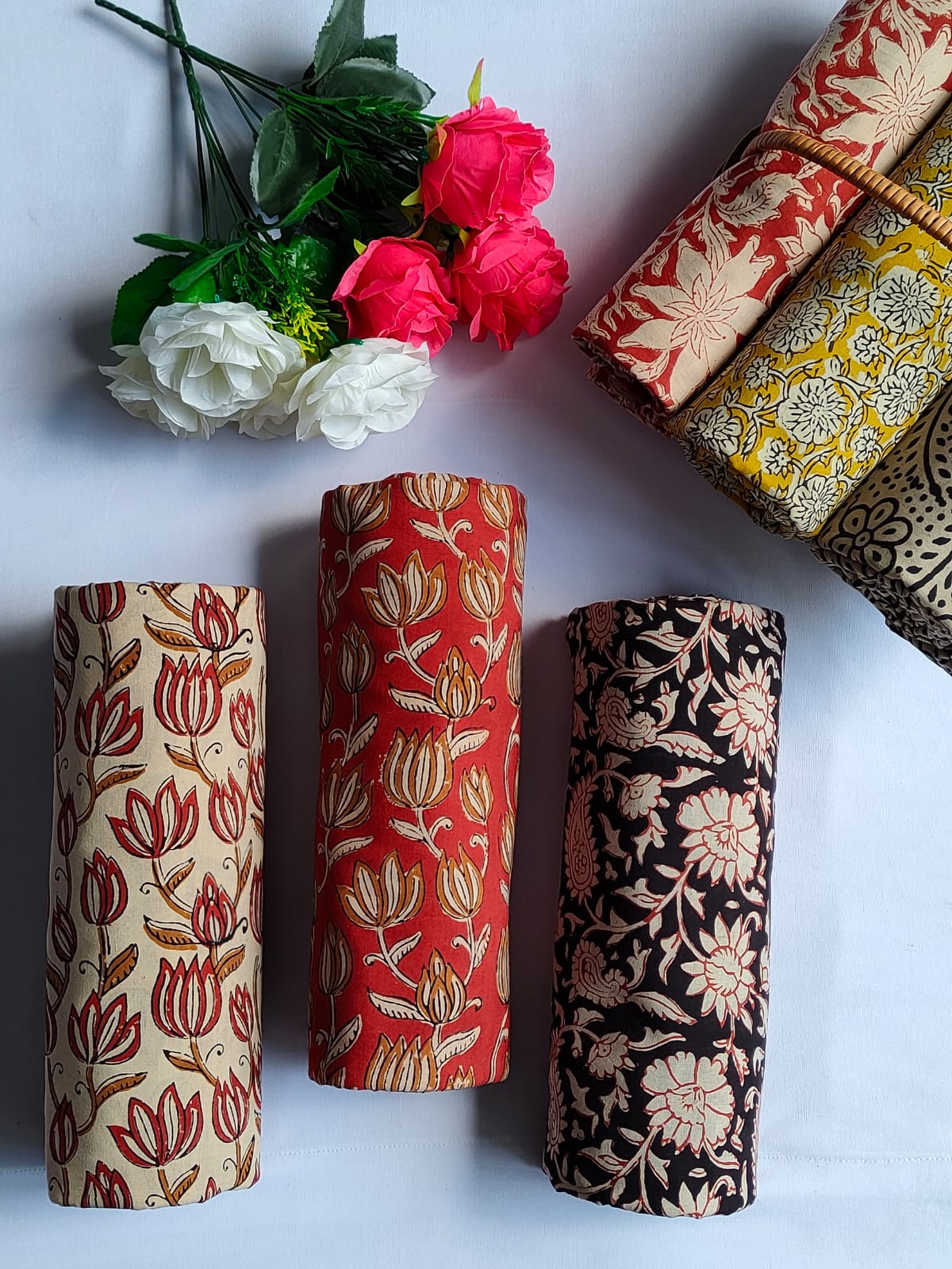


Choosing high-quality cotton poplin fabric is important whether you are buying material for shirts, dresses, kurtas, children's clothing, or a new fashion collection. At first glance, two cotton poplin fabrics may look almost identical, but differences in yarn quality, weave construction, fabric weight, finishing, and colourfastness can affect how they feel, look, and perform after stitching and washing.
Cotton poplin is popular because it typically has a smooth surface, a closely woven structure, and a slightly crisp feel. These characteristics make it suitable for garments that need a neat appearance and some structure without the heaviness of thicker fabrics. However, the name "cotton poplin" alone does not guarantee a particular quality level.
The good news is that you can assess many important quality indicators without specialised equipment. By checking the fabric's surface, weave, opacity, weight, stitching behaviour, and response to washing, you can make a more informed buying decision.
In this guide, we will explain how to identify high-quality cotton poplin fabric, which specifications to check before purchasing, and how to choose the right material for different clothing projects.
1. Understand What Cotton Poplin Fabric Is
Before assessing quality, it helps to understand what makes cotton poplin different from other cotton fabrics.
Cotton poplin is generally a woven fabric made using a plain-weave structure. Its construction commonly features a relatively dense arrangement of lengthwise warp yarns and a subtle crosswise rib. This gives the material its characteristic smooth surface and slightly crisp handle. Cotton poplin is commonly used for:
-
Shirts and formal wear
-
Women's blouses and tops
-
Cotton dresses and skirts
-
Kurtas and tunics
-
Children's clothing
-
Lightweight uniforms
-
Printed garments and coordinated sets
The fabric can be produced in different weights and finishes. Some versions feel crisp and structured, while others have a softer finish. Cotton poplin may also be blended with other fibres, so it is important to verify the composition if you specifically want 100% cotton.
A high-quality poplin fabric should be suitable for its intended purpose. A lightweight shirt fabric and a firmer fabric for a structured dress do not need to have identical specifications.
2. Check the Weave for Consistency
One of the first things to inspect is the fabric's weave. A well-made cotton poplin should generally have a regular, consistent construction without obvious weaving faults.
Hold the fabric close to your eyes or use a magnifying glass to examine its surface.
Look for:
-
Evenly arranged yarns
-
A consistent fabric surface
-
No obvious holes or missing yarns
-
No unusual clusters of thick or thin yarns
-
No major irregularities in the weave
-
Consistent construction across the sample
Cotton poplin commonly has a fine crosswise rib that is more noticeable on close inspection. However, the exact appearance varies with yarn sizes, density, and finishing. Do not reject a fabric simply because its ribbing is subtle.
Why weave consistency matters
Uneven construction can affect the fabric's appearance and behaviour during cutting and stitching. Visible defects may also become more noticeable when the material is used for large garment panels.
For example, a shirt made from a fabric with inconsistent yarn distribution may look less uniform than one made from a consistently constructed material.
Practical tip: Examine several areas of the fabric rather than checking only one corner. If you are buying a full roll or a large quantity, ask the supplier about fabric inspection and defect allowances.
3. Feel the Surface and Assess the Texture
High-quality cotton poplin typically has a relatively smooth surface and a firm but comfortable feel. Depending on its finish, it may feel crisp, soft, or somewhere in between. Run your fingers lightly across the surface and check whether the fabric feels consistent.
A few useful questions to ask are:
-
Does the surface feel reasonably smooth?
-
Is the texture consistent across the sample?
-
Does the fabric feel excessively rough or uneven?
-
Does it have enough body for the garment you want to make?
-
Does the finish feel appropriate for the intended use?
Remember that softness alone is not a reliable indicator of quality. A very soft fabric is not necessarily stronger or better constructed than a slightly crisp one.
Some poplin fabrics are deliberately finished to feel crisp, while others are treated to feel softer. The right choice depends on whether you are making a structured shirt, a flowing dress, or another type of garment.
4. Check the Fabric Weight
Fabric weight is an important specification when comparing cotton poplin. It is commonly measured in grams per square metre, abbreviated as GSM.
A fabric's weight affects its thickness, drape, opacity, and suitability for different garments. However, GSM should not be used as the only measure of quality.
Cotton poplin is available in a broad range of weights, and suitable specifications depend on the particular product and intended use. <Cite refs={["turn684984search2","turn684984search5"]}/>
Here is a general guide to selecting poplin by intended application.
| Intended use | What to look for |
|---|---|
| Lightweight shirts and blouses | A lighter fabric with a smooth surface and suitable opacity |
| Summer dresses | A comfortable weight with enough body for the design |
| Structured dresses | A fabric with sufficient firmness to support the silhouette |
| Children's clothing | A suitable weight, comfortable feel, and appropriate durability |
| Uniforms | Consistent construction and a weight suited to regular wear |
| Printed garments | A suitable surface, print compatibility, and adequate opacity |
These are selection principles rather than fixed weight standards. The ideal GSM varies with the garment pattern, fabric construction, colour, and finish.
How to compare fabric weight
If a supplier provides GSM specifications, compare samples using the same measurement method. If you need precise verification for a bulk purchase, request a fabric specification sheet or have the weight independently tested.
Avoid assuming that heavier fabric is always better. A lightweight poplin can be excellent for a summer shirt, while a heavier fabric may be more suitable for a structured garment.
5. Hold the Fabric Against the Light to Check Opacity
Opacity is another important factor, especially if you plan to use cotton poplin for white shirts, light-coloured dresses, or garments that need sufficient coverage.
Hold the fabric against a consistent light source and observe how much light passes through it.
Check whether:
-
The fabric provides the coverage you need.
-
The weave looks reasonably consistent.
-
There are obvious thin patches.
-
The opacity changes noticeably across the sample.
A fabric that looks sufficiently opaque when folded may appear more transparent when used as a single layer in a finished garment.
Is transparent cotton poplin always low quality?
No. Some lightweight poplin fabrics are intentionally made for garments that use lining or layering. Transparency must be assessed against the intended application.
For a white dress, you may need a denser fabric or an appropriate lining. For a lightweight summer blouse, a little transparency may be acceptable depending on the design.
Practical tip: Check the fabric in the same colour and approximate lighting conditions in which the garment will be worn. White and pastel fabrics often reveal transparency more clearly than dark colours.
6. Verify the Fibre Composition
The term "cotton poplin" describes a fabric category, but it does not automatically prove that the material contains 100% cotton.
Poplin can be made from cotton or from fibre blends. The composition can affect the fabric's feel, crease behaviour, stretch, drying characteristics, and care requirements. <Cite refs={["turn684984search5","turn684984search2"]}/>
If you specifically want pure cotton poplin, check the product label, technical specification, or supplier documentation.
Look for a clearly stated fibre composition, such as:
-
100% cotton
-
Cotton-polyester blend
-
Cotton with elastane
-
Another clearly identified fibre blend
Do not rely only on the fabric's appearance or feel to establish fibre content. Different fibres can produce similar-looking surfaces, and finishing treatments can change how a fabric feels.
Why fibre composition matters
If you are making breathable everyday shirts or cotton dresses, you may prefer a particular cotton composition. If you need a garment with greater stretch or specific crease-resistance properties, a blend might be more suitable.
The important point is to know exactly what you are buying rather than assuming every poplin fabric is pure cotton.
For technical or commercial purchases, ask for documentation that matches the actual fabric batch.
7. Assess Strength and Durability
High-quality cotton poplin should have construction appropriate to its intended use. A fabric for everyday shirts may need to withstand repeated wear and washing, while a material for occasional decorative use may have different requirements.
A simple hands-on inspection can help identify obvious weaknesses, although it cannot replace laboratory testing.
What to check
-
Look for weak-looking or damaged yarns.
-
Inspect the fabric for holes and visible defects.
-
Check whether the edges fray excessively during handling.
-
Observe whether the fabric distorts easily when gently handled.
-
If you have a sample, sew a short seam and check how it behaves.
Avoid pulling the fabric aggressively, since this can damage the sample and does not provide a reliable measurement of strength.
Why durability matters
Weak construction or unsuitable yarns may lead to problems during cutting, stitching, or repeated use. However, durability depends on several factors, including fibre quality, yarn construction, weave density, finishing, garment design, and care.
For bulk purchases, consider requesting relevant strength or seam-performance test results when durability is important to your product.
8. Check Colour Consistency and Colourfastness
For dyed or printed cotton poplin, colour quality is just as important as fabric construction.
A good fabric should have a colour appearance appropriate to the product specification. Check for unwanted patches, visible streaks, uneven shades, or inconsistencies between samples.
For printed poplin, also examine:
-
Pattern alignment
-
Print clarity
-
Unevenly coloured areas
-
Visible gaps or smudges
-
Consistency of the print across the sample
What is colourfastness?
Colourfastness describes how well a textile retains its colour when exposed to conditions such as washing, rubbing, or light.
A fabric can look attractive when new but still lose colour or transfer dye during use. Visual inspection alone cannot reliably establish colourfastness.
If colour performance is important, request test information for the relevant conditions, such as washing or rubbing. A small home wash test can provide a preliminary indication, but it is not a substitute for a standardised test.
For printed garments, colourfastness is particularly important because uneven fading can affect the appearance of the entire design.
Explore printed cotton fabrics for different printed styles and compare the print quality and fabric specifications before selecting material for a garment.
9. Test Shrinkage Before Cutting and Stitching
Cotton fabrics can shrink during washing, and the amount of shrinkage varies with the yarn, fabric construction, finishing, and care conditions.
Testing shrinkage is particularly useful if you are buying cotton poplin for dresses, shirts, uniforms, or bulk garment production.
A simple shrinkage check
-
Cut a representative sample and record its original length and width.
-
Wash and dry it according to the intended care instructions.
-
Allow it to condition in a suitable environment before measuring again.
-
Compare the final dimensions with the original measurements.
The percentage change can be calculated using the following formula:
For example, if a 50 cm sample measures 49 cm after washing, the lengthwise shrinkage is 2%.
The test should reflect how the finished garment will be cared for. Washing temperature, drying method, and ironing can all influence the result.
Why prewashing helps
If you are sewing your own garments, prewashing the fabric may help account for shrinkage before cutting the pattern. For commercial production, ask about the fabric's dimensional stability and whether it has received shrinkage-control finishing.
Do not assume that every high-quality cotton fabric is completely shrink-proof.
10. Check How the Fabric Drape and Crispness Suit Your Design
Cotton poplin is often chosen for garments that need a clean appearance and some structure. However, different poplin fabrics can vary considerably in stiffness, softness, and drape.
Before buying, hold the sample up and observe how it falls naturally.
For shirts and blouses
A smooth poplin with suitable body can help create a neat silhouette. Check whether it feels comfortable and whether it can accommodate the collar, cuffs, and other details in your design.
For dresses
The right poplin should suit the intended shape. A firmer fabric can support a structured dress, while a lighter version may work better for a more relaxed design.
For children's clothing
Choose a suitable weight and texture for the garment. Avoid selecting a fabric based only on how crisp it looks in a product photograph.
For printed garments
Consider whether the surface supports the desired print appearance and whether the fabric's drape suits the final silhouette.
A fabric can be well made yet still be unsuitable for a particular design. Quality means matching the material to the purpose, not simply choosing the stiffest or smoothest option.
11. Inspect the Fabric Edges and Check for Defects
The edges and overall surface can reveal useful information about fabric consistency.
If you have a sample or a cut length, inspect the selvedge, cut edges, and several points across the material.
Look for:
-
Holes or broken yarns
-
Visible stains
-
Unusual thick or thin areas
-
Weaving irregularities
-
Uneven colour
-
Printing defects
-
Distortion or skewing that could affect cutting
A cut edge may naturally fray because cotton poplin is a woven fabric. Some fraying alone does not mean the fabric is poor quality.
For commercial orders, ask how the supplier handles fabric inspection, defect classification, and acceptable quality limits. These details are particularly important when purchasing a large quantity for garment manufacturing.
12. Check How Cotton Poplin Performs During Stitching
If you are buying fabric for garment production, a small sewing test can be more useful than judging the fabric by touch alone.
Different cotton poplin fabrics may behave differently when cut and stitched. The result depends on the fabric construction, thickness, finish, sewing equipment, and garment design.
Try a short seam on a sample and check the following:
-
Does the fabric feed consistently through the machine?
-
Does the seam look even?
-
Is there excessive puckering?
-
Does the fabric distort around the stitches?
-
Does the material fray more than expected?
-
Does the finished seam suit the intended garment?
The correct needle, thread, stitch length, and machine settings can affect the result. Poor stitching does not automatically mean the fabric is defective.
For clothing businesses, a sample garment or trial production run can reveal issues that are difficult to detect from a fabric swatch alone.
13. Compare Supplier Specifications Before Buying
When comparing cotton poplin from different suppliers, do not rely solely on product names or photographs. Two fabrics sold as cotton poplin can have different constructions, weights, compositions, and finishes.
Request the most relevant specifications before making a decision.
| Specification | Why it matters |
|---|---|
| Fibre composition | Confirms whether the fabric is pure cotton or a blend |
| Fabric weight (GSM) | Helps compare weight and intended use |
| Fabric width | Determines cutting layout and material requirements |
| Weave and construction | Helps explain the fabric's structure and behaviour |
| Colour or print details | Helps verify the intended appearance |
| Shrinkage information | Useful for garment sizing and production planning |
| Colourfastness information | Important for dyed and printed fabric |
| Care instructions | Helps determine washing and maintenance needs |
| Sample availability | Allows physical inspection before a larger order |
Why samples are important
Product photographs cannot reliably show softness, thickness, opacity, or how a fabric behaves when stitched.
Requesting a sample allows you to check the material against your actual requirements. If you are buying for commercial production, keep an approved sample and compare it with the delivered fabric where possible.
For bulk orders, make sure the written specifications and approved sample correspond to the same product.
14. Common Mistakes to Avoid When Buying Cotton Poplin
Even experienced buyers can make mistakes when choosing fabric if they focus on just one characteristic.
Here are some common issues to avoid.
Assuming Heavier Fabric Is Always Better
A heavier fabric may provide more body, but a lighter fabric can be the better choice for a summer shirt or blouse. Choose weight according to the garment.
Judging Quality Only by Softness
Softness is influenced by fibre characteristics and finishing. A smooth fabric is not automatically stronger, more durable, or better constructed.
Assuming All Poplin Is 100% Cotton
Poplin may contain blends. Check the composition instead of relying on the product name.
Ignoring Shrinkage
Cotton may shrink after washing. Consider prewashing for sewing projects and request dimensional-stability information for commercial purchases.
Overlooking Transparency
A fabric may appear different when used as a single layer in a finished garment. Check opacity in appropriate lighting.
Buying in Bulk Without Testing a Sample
A sample test can reveal differences in colour, texture, stitching performance, and washing behaviour before you commit to a larger order.
Comparing Prices Without Comparing Specifications
A lower price does not automatically mean lower quality, and a higher price does not guarantee better performance. Compare composition, weight, construction, finish, and test information wherever possible.
No single check proves that a fabric is high quality. The best decision comes from combining physical inspection, supplier specifications, and tests relevant to the garment's intended use.
Conclusion
Identifying high-quality cotton poplin fabric requires more than checking whether it feels soft or looks smooth. Its weave consistency, fibre composition, weight, opacity, colour quality, dimensional stability, and stitching performance all contribute to its suitability for clothing.
Start by confirming that the fabric meets your requirements. Inspect the surface, check the specifications, and test a sample where possible. If you are buying for a clothing business, also request information about shrinkage, colourfastness, fabric width, and quality-control procedures.
Remember that the best cotton poplin is not necessarily the heaviest or most expensive option. It is the fabric that provides the right balance of construction, appearance, comfort, and performance for your intended garment.
If you are exploring cotton materials for shirts, dresses, kurtas, or printed clothing, visit the Jaipur Bazar cotton fabric collection to compare different fabric options for your next project.